OEM vs ODM Baby Toys: Which Manufacturing Model Is Right for Your Brand?
Introduction
If you are sourcing baby toys for your brand, you have likely come across two terms that seem interchangeable but are fundamentally different: OEM and ODM. Choosing the wrong model can mean overspending on tooling you do not need, or ending up with a product every competitor is also selling.
In the baby toy industry — where safety certifications, material quality, and brand trust are non-negotiable — the OEM vs ODM decision shapes everything from your upfront investment to your time-to-market and competitive positioning.
This guide breaks down OEM and ODM in clear, practical terms. We compare them across seven critical dimensions — design, customization, development, mold, cost, speed, and best-fit brand stage — and help you decide which fits your baby toy line.
What Is OEM?
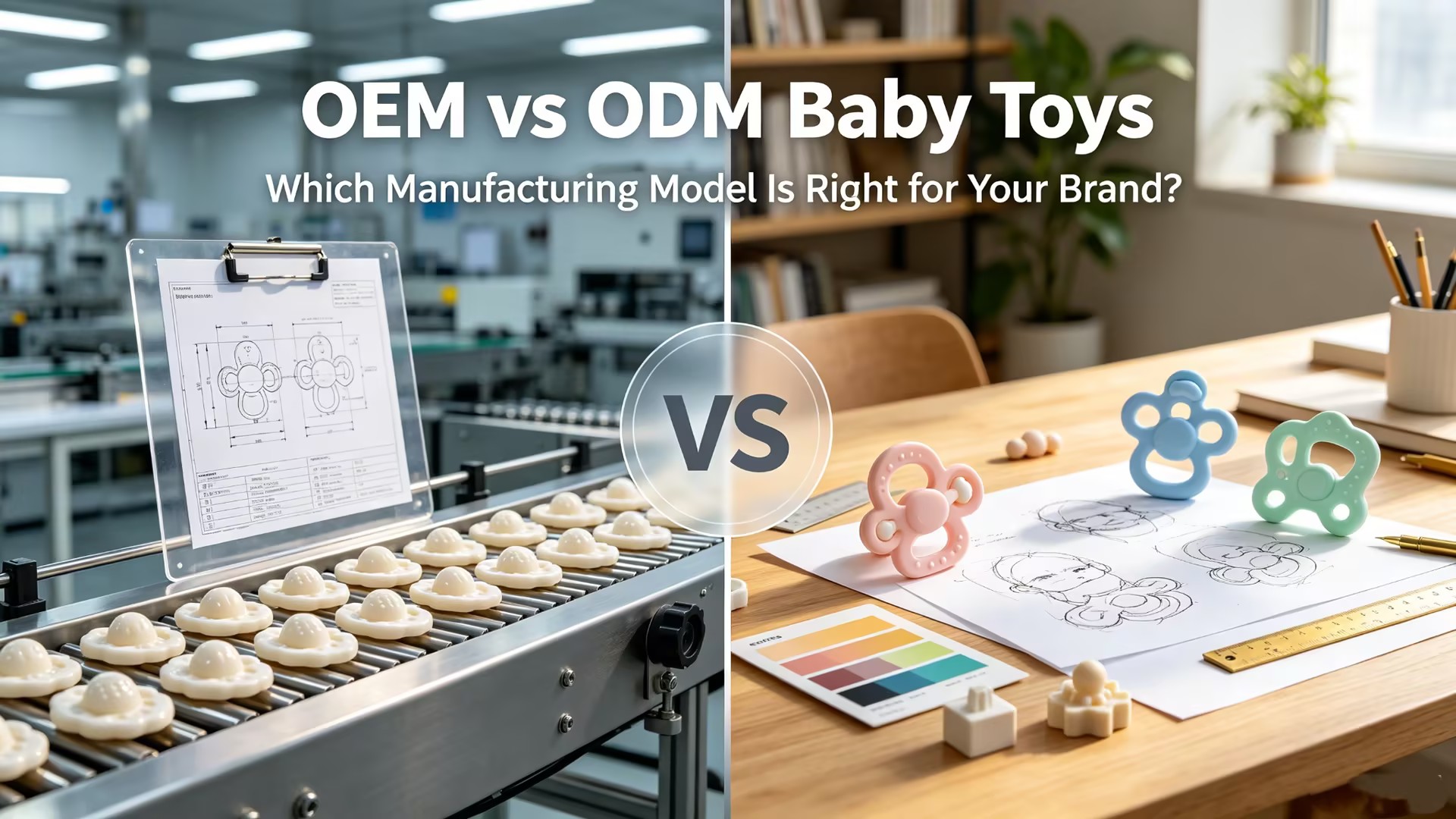
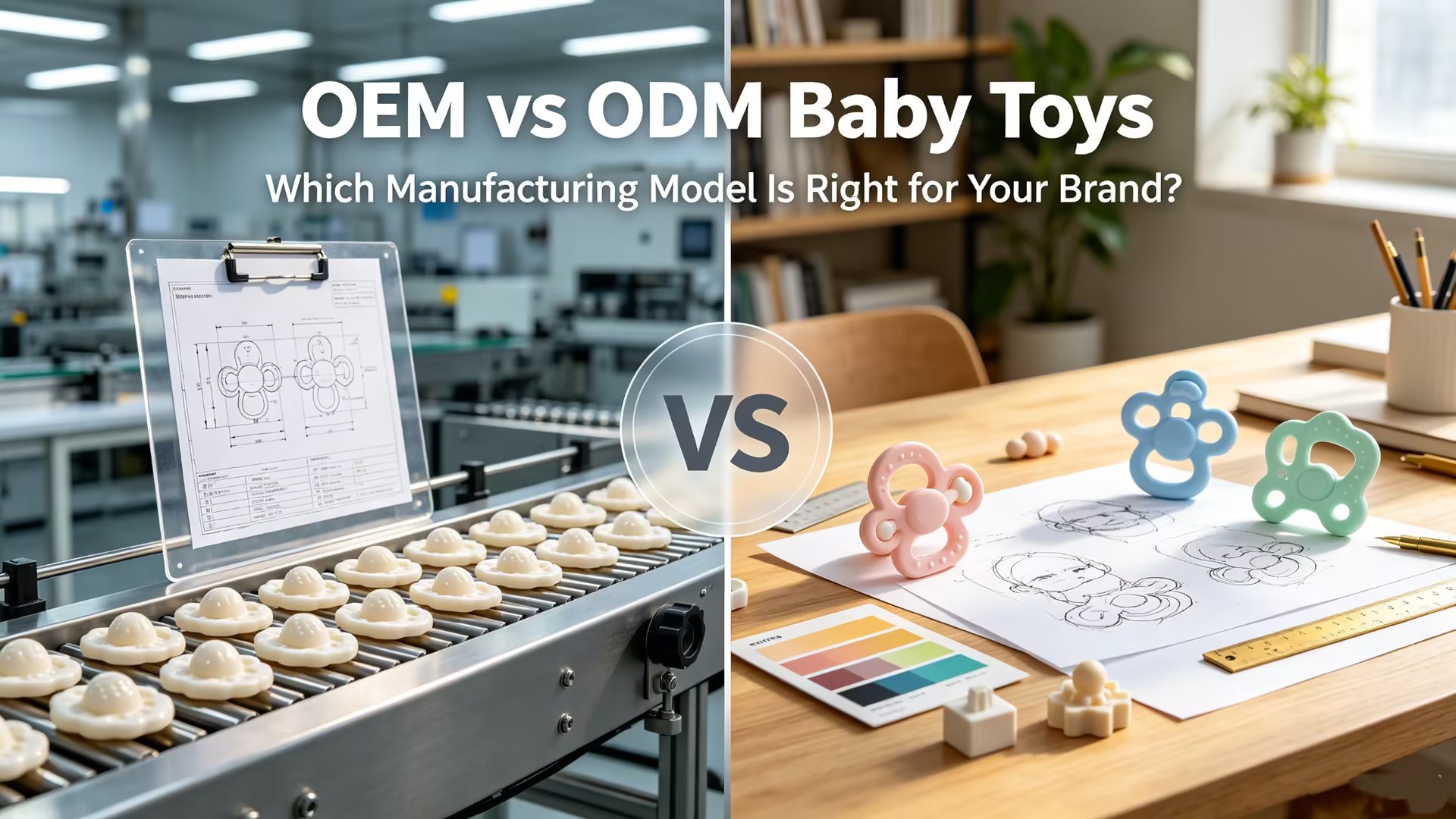
OEM stands for Original Equipment Manufacturer. In an OEM arrangement, you — the buyer and brand owner — bring the complete product design: technical drawings, 3D files, material specs, dimensions, and quality standards. The factory manufactures exactly what you specify.
Think of OEM as "I design, you make." You own the IP, the mold, and the product concept. The factory is essentially an extension of your production capacity — executing your vision with their equipment, labor, and QC systems.
For baby toys, an OEM project might look like this: your industrial designer creates a unique natural rubber teether with a proprietary texture pattern. You send the 3D model and material specs to the factory, which cuts a custom mold and produces the toy exactly as designed. No other brand can sell this exact product because the design and mold belong to you.
Key characteristics of OEM:
- Buyer owns the design and IP
- Custom mold required
- Higher upfront cost
- Longer lead time
- Maximum product uniqueness
- Full control over materials and features
What Is ODM?
ODM stands for Original Design Manufacturer. In an ODM arrangement, the factory designs and develops the product. They maintain a catalog of existing designs, molds, and proven concepts. You select from their range and customize the elements that matter for your brand — logo, packaging, colors, and sometimes minor design modifications.
Think of ODM as "you design, I brand." The factory owns the base design and mold, but the finished product enters the market under your brand name. You get a professionally designed product without the time and expense of developing it from scratch.
For baby toys, an ODM project might look like this: the factory has an existing natural rubber bath toy set with five animal shapes. You select the set, choose your brand's color palette, request your logo via pad printing, and design custom retail packaging. The toy is based on the factory's design, but the customer experience — branding, packaging, marketing — is entirely yours.
Key characteristics of ODM:
- Manufacturer owns the base design
- Existing or modified mold
- Lower upfront cost
- Faster lead time
- Medium product uniqueness
- Brand-level customization (logo, packaging, colors)
OEM vs ODM: The Definitive Comparison
The table below gives you an at-a-glance comparison across the seven dimensions that matter most for baby toy brands.
| Dimension | OEM | ODM |
|---|---|---|
| Design | Buyer | Manufacturer |
| Customization | High | Medium |
| Development | Buyer-led | Factory-led |
| Mold | Custom | Existing / Modified |
| Cost | Higher | Lower |
| Speed | Slower | Faster |
| Best for | Established brands | New brands |
Now let us break down each dimension, with specific relevance to the baby toy industry.
1. Design: Buyer vs. Manufacturer
OEM — Buyer owns the design. You bring the concept, the drawings, the 3D files, and the specifications. The factory produces to your exact design. This means if you have invented a novel teether shape, a patented sensory texture, or a unique stacking toy concept, OEM is the only way to protect and produce it.
ODM — Manufacturer owns the design. The factory has already designed and developed the product. Their in-house design team has created the shape, tested the functionality, and refined the ergonomics. You are selecting from their proven catalog rather than creating something new.
Why it matters for baby toys: Baby toy design is not just about aesthetics — it involves safety engineering (no small parts, rounded edges, appropriate sizing for mouth contact), developmental appropriateness, and ergonomic shaping for small hands. OEM lets you control all of these. ODM relies on the factory's design expertise, which can be an advantage if they specialize in baby products.
2. Customization: High vs. Medium
OEM — High customization. Every element is negotiable because you are building from scratch. Material blend, hardness (Shore A), surface texture, shape, dimensions, weight, sound elements (squeakers, rattles), and even scent can all be specified to your requirements.
ODM — Medium customization. The base product is fixed, but you can typically customize:
- Logo application (pad printing, embossing)
- Color choices (standard or custom Pantone)
- Packaging design (hang tags, boxes, insert cards)
- Minor modifications (adding a loop, changing a texture pattern, modifying size within mold limits)
Why it matters for baby toys: If your brand identity depends on a specific feel — say, an extra-soft natural rubber formula for newborns — OEM gives you that control. If your brand competes on packaging, color story, and marketing rather than product form, ODM customization is usually sufficient.
3. Development: Buyer-led vs. Factory-led
OEM — Buyer-led development. You drive the entire development process: concept, design, prototyping, testing, and refinement. The factory provides manufacturing input (feasibility, material recommendations, production constraints) but executes your direction. This requires you to have — or hire — design and engineering expertise.
ODM — Factory-led development. The factory has already completed the development cycle. They have iterated the design, built and tested prototypes, resolved manufacturing issues, and validated the product for safety. You benefit from their accumulated R&D without funding it yourself.
Why it matters for baby toys: Developing a baby toy from concept to production-ready involves multiple rounds of safety testing (ASTM F963, EN 71), age-grading reviews, and usability observations. OEM means you fund and manage all of this. ODM means the factory has already done it — but their design may not perfectly match your brand's developmental philosophy.
4. Mold: Custom vs. Existing / Modified
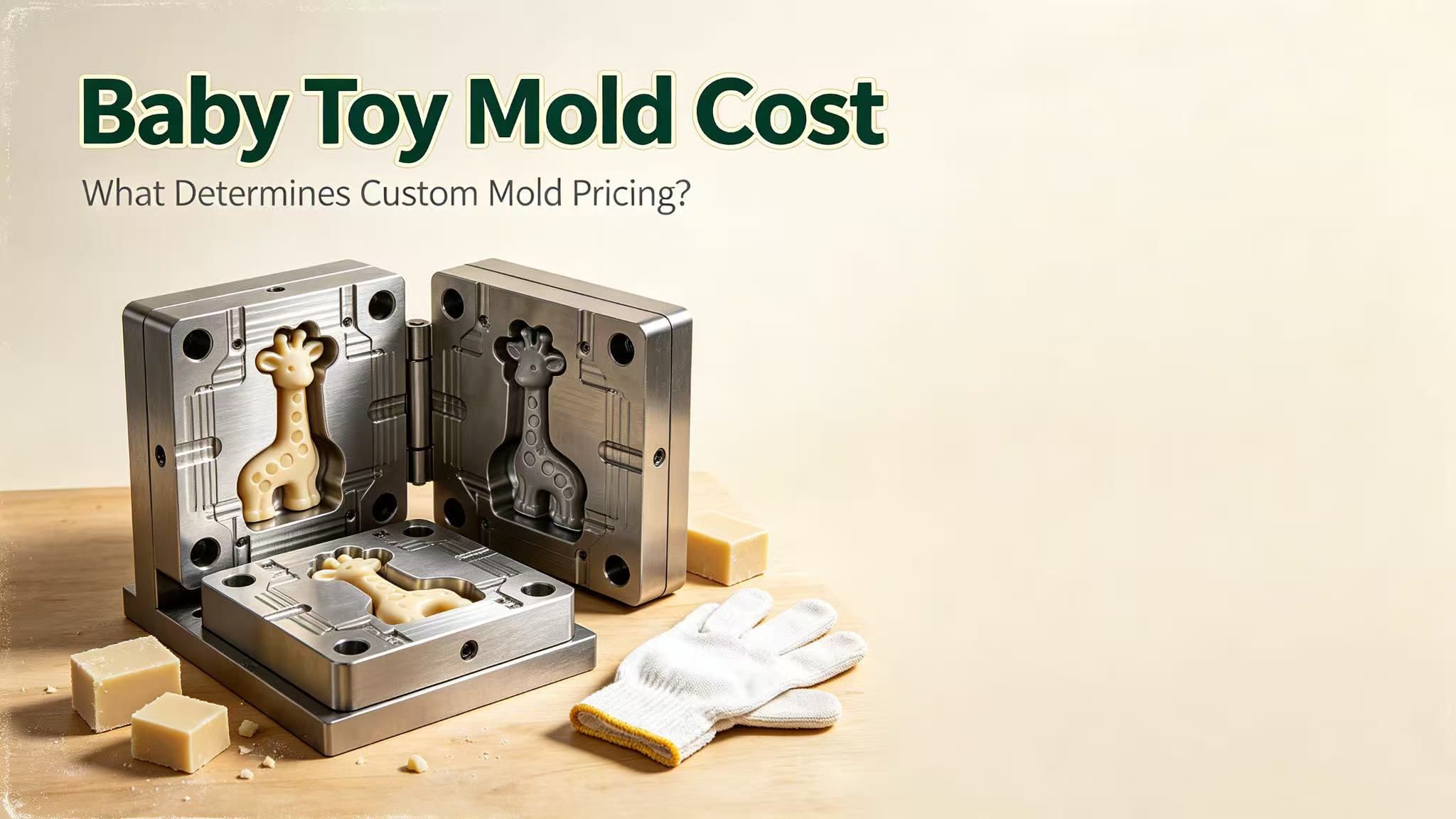
OEM — Custom mold. Because your product is unique, the factory must cut a new mold specifically for your design. Mold making for baby toys typically involves CNC machining of aluminum or P20 steel molds, with precision polishing for the smooth, safe surfaces babies contact. Custom molds for natural rubber toys can cost $1,500–$5,000+ depending on complexity and size.
ODM — Existing or modified mold. The factory already has the mold. You may be able to request minor modifications (e.g., adding your logo cavity to the mold for embossing, or adjusting a texture insert), but the core mold is shared across the factory's clients. This means the same base product may be available to other brands — though your branding and packaging differentiate it.
Why it matters for baby toys: Mold quality directly affects product safety. A poorly made mold can leave flash (excess material along parting lines) that creates sharp edges or small detachable pieces — both serious choking hazards for babies. OEM lets you specify mold quality standards. ODM relies on the factory's existing mold maintenance.
5. Cost: Higher vs. Lower
OEM — Higher total cost. OEM projects carry several cost layers that ODM does not:
- Product design and engineering (if you do not have in-house capability)
- Custom mold making ($1,500–$5,000+ per mold)
- Prototype iterations and safety testing ($300–$800+ per test round)
- Longer production setup time
- Typically higher MOQ (because the factory needs to amortize mold setup across more units)
ODM — Lower total cost. ODM eliminates the biggest upfront expenses:
- No design and engineering cost (factory has already invested)
- No custom mold cost (existing mold)
- Pre-validated safety test reports (though you should still test your branded version)
- Faster setup means lower labor allocation per unit
- Typically lower MOQ (factory can combine your order with other clients using the same mold)
Why it matters for baby toys: The baby toy category has relatively low price points and high safety compliance costs. For a new brand with limited capital, ODM's lower upfront cost reduces risk. For an established brand with proven sales volume, OEM's higher per-unit cost is offset by stronger margins and competitive differentiation.
6. Speed: Slower vs. Faster
OEM — Slower time-to-market. A typical OEM baby toy project timeline:
- Design finalization: 2–4 weeks
- Mold making: 2–3 weeks
- Prototype and sample approval: 1–2 weeks
- Safety testing: 1–2 weeks
- Mass production: 15–25 days
- Shipping: 25–35 days (sea freight)
Total: approximately 10–16 weeks from design start to delivery.
ODM — Faster time-to-market. A typical ODM baby toy project timeline:
- Product selection and customization details: 1–2 weeks
- Pre-production sample (logo, color, packaging): 5–10 days
- Safety testing (if needed): 1–2 weeks (can run parallel with production)
- Mass production: 10–20 days
- Shipping: 25–35 days (sea freight)
Total: approximately 6–10 weeks from selection to delivery.
Why it matters for baby toys: The baby product market is seasonal and trend-driven. Missing a Q4 holiday window or a spring gifting season can mean lost revenue. ODM's faster speed lets you capitalize on trends and seasons. OEM's slower pace requires longer-term planning and inventory forecasting.
7. Best for: Established Brands vs. New Brands
OEM — Best for established brands. OEM is the right choice when:
- You have a unique product concept or patented design
- You have proven sales volume and can absorb higher upfront costs
- Product differentiation is your core competitive advantage
- You have in-house design and engineering resources
- You want full control over materials, features, and quality
- You are building a long-term product line with brand-exclusive products
ODM — Best for new brands. ODM is the right choice when:
- You are launching your first baby toy line and want to minimize risk
- You do not have in-house design or engineering capability
- Speed-to-market is critical (seasonal launches, trend response)
- Your brand competes on marketing, packaging, and customer experience rather than product form
- You want to test the market before investing in custom tooling
- You need a broad product range with limited capital
Private Label: The Third Option
Before we move on, it is worth mentioning a third model that sits between OEM and ODM: private label. In private label, you select from the factory's existing catalog (like ODM) but with even lighter customization — typically just logo and packaging. The product is essentially the factory's standard product with your label.
Private label is the fastest and lowest-cost entry point, but offers the least differentiation. For baby toy brands just starting and wanting to validate demand before investing in ODM modifications or OEM designs, private label is a smart first step. Many successful brands start with private label, graduate to ODM, and eventually develop OEM-exclusive products once proven.
For a complete guide to building a private label baby toy line, including branding, packaging, MOQ, and testing, read our companion article on private label baby toys. And if OEM is the direction you are leaning, our OEM Baby Toys: Complete Guide for International Brands walks through the full nine-step manufacturing process.
How to Choose Between OEM and ODM for Your Baby Toy Brand
Still unsure which model is right for you? Ask yourself these five questions:
Question 1: Do You Have a Unique Product Idea?
If you have designed a baby toy that does not exist on the market — a novel teether shape, a patented sensory mechanism, a unique bath toy concept — OEM is your only option. If your product is a variation of something already available (different color, modified texture, branded version of a standard teether), ODM can likely accommodate it.
Question 2: What Is Your Budget?
Be honest about your total capital. An OEM baby toy project requires at least $5,000–$15,000 upfront (mold, design, testing, MOQ) before you see a finished product. An ODM project can launch with $2,000–$5,000 (lower MOQ, no mold cost, existing test reports). If your budget is under $5,000, ODM or private label is the practical choice.
Question 3: How Fast Do You Need to Launch?
If targeting a specific season — holiday gifting, back-to-school, baby shower season — calculate backward from your launch date. ODM delivers in 6–10 weeks. OEM needs 10–16 weeks or more. If your window is under 12 weeks, ODM is the safer bet.
Question 4: How Important Is Product Exclusivity?
If selling on Amazon alongside 50 other brands with the same ODM teether, your only differentiators are price, reviews, and listing quality. With an OEM-exclusive product, you own the listing and the market for that item. For brands targeting premium boutiques or building a proprietary portfolio, OEM exclusivity is worth the investment.
Question 5: Do You Have Design and Engineering Resources?
OEM requires managing the design process. You need either in-house industrial design capability or a budget to hire a freelance designer who understands baby product safety standards. If you lack these resources and cannot afford them, ODM's factory-led development is a significant advantage.
Real-World Examples: OEM and ODM in the Baby Toy Category
To make this concrete, here are two scenarios showing how OEM and ODM play out for actual baby toy brands.
Scenario A: Established Brand Launches OEM-Exclusive Teether
A mid-sized natural baby brand with $2M in annual revenue wants a signature teether as their hero product. They hire an industrial designer to create a unique organic shape with a patented texture. They select OEM, commission a custom P20 steel mold ($3,500), and go through three prototype rounds. Total development cost: $8,000. MOQ: 3,000 units. Lead time: 14 weeks. The product launches exclusively under their brand, becomes a bestseller, and no competitor can copy it. The $8,000 investment amortizes across 20,000+ units in year one — less than $0.50 per unit.
Scenario B: New Brand Launches ODM Bath Toy Set
A first-time entrepreneur launches a baby bath toy brand with $4,000 startup budget. They select ODM, choosing an existing natural rubber bath toy set from the factory's catalog. They customize colors (earth tone palette), add their logo via pad printing, and design custom kraft packaging. Total upfront cost: $3,200 (500 sets at MOQ, packaging, logo setup). Lead time: 7 weeks. The product launches on Shopify and Etsy. While the base toy is available to other brands, their branding and marketing create a distinct experience. After 6 months of proven sales, they invest in ODM modifications and eventually plan an OEM-exclusive product.
Finding the Right Manufacturer for OEM or ODM
Whether you choose OEM or ODM, the manufacturer determines your success. A factory that excels at ODM may lack the engineering capability for complex OEM projects, and vice versa.
For OEM projects, look for a factory with:
- In-house mold making and tooling capability
- Industrial design or engineering support
- Experience with custom baby product development
- Strong quality control for custom-molded products
- Willingness to sign NDAs and protect your IP
For ODM projects, look for a factory with:
- A broad, well-designed catalog of baby toys
- Existing valid test reports (ASTM F963, EN 71, CPSIA)
- Flexible customization (logo, color, packaging)
- Low MOQ options for new brands
- Consistent quality across repeated orders
For a detailed checklist of what to evaluate, read our guide on how to choose a baby toy manufacturer — it covers 12 critical questions every buyer should ask before placing an order.
If you are specifically sourcing natural rubber baby toys, our article on how to choose a natural rubber baby toy supplier dives into material-specific considerations like latex compounding, nitrosamine testing (EN 71-12), and mold maintenance for rubber products.
For brands still evaluating their sourcing strategy, our wholesale baby toys complete sourcing guide covers product selection, supplier vetting, MOQ negotiation, pricing margins, and shipping logistics.
Finally, regardless of which model you choose, safety testing is non-negotiable. Our guide on non-toxic baby toys explains the safety standards, material red flags, and certification checks every international buyer needs before placing an order.
Final Thoughts
The OEM vs ODM decision is not about which model is "better" — it is about which fits your brand's current stage, budget, and strategic goals.
Choose OEM when you have a unique design, sufficient capital, and a long-term vision for a proprietary product line. The higher upfront cost buys you exclusivity, full control, and a competitive moat no ODM product can match.
Choose ODM when you are launching a new brand, working with limited capital, or need to move fast. The lower cost and faster speed let you validate the market, build recognition, and generate revenue — all while leveraging the factory's design expertise.
Many successful baby toy brands follow a hybrid path: start with ODM (or private label) to prove demand, reinvest into ODM modifications for differentiation, and eventually develop OEM-exclusive hero products once established. There is no shame in starting small — the key is starting with a model that matches your resources and evolving as you grow.
Ready to discuss OEM or ODM options for your baby toy brand?
Contact us today to explore our natural rubber baby toy catalog, custom mold capabilities, and flexible branding options.
Contact Us TodayLow MOQ Baby Toys: How New Brands Can Test Products with Less Risk
Private Label Baby Toys: How to Build Your Own Product Line