Low MOQ Baby Toys: How New Brands Can Test Products with Less Risk
Low MOQ Baby Toys: How New Brands Can Test Products with Less Risk
A practical guide for new brands, small businesses, startups and DTC brands that want to test a baby toy before betting the business on it.
You have a teether idea you are certain parents will love. You have a name, a logo, a rough color palette, and roughly zero stockroom space. Then you talk to a factory and hear the number: a minimum order of two thousand pieces per design. For a brand that has not sold a single unit yet, that number does not feel like an opportunity. It feels like a bet you cannot afford to lose.
That is the wall most new baby brands hit in their first sourcing conversation. The good news is that the market has changed. Low MOQ baby toys are now a realistic entry point for small businesses, startups, and DTC brands that want to test a product before they commit real money to it. This guide walks through why minimums exist, what a low minimum actually gives you, and how to move from a small trial run to a full production line without betting the company on the first order.
Why MOQ Exists in the First Place
It is easy to read "minimum order quantity" as a gatekeeping move by factories. It is not arbitrary. A manufacturer sets a MOQ because every production run carries fixed costs that do not shrink just because you order less.
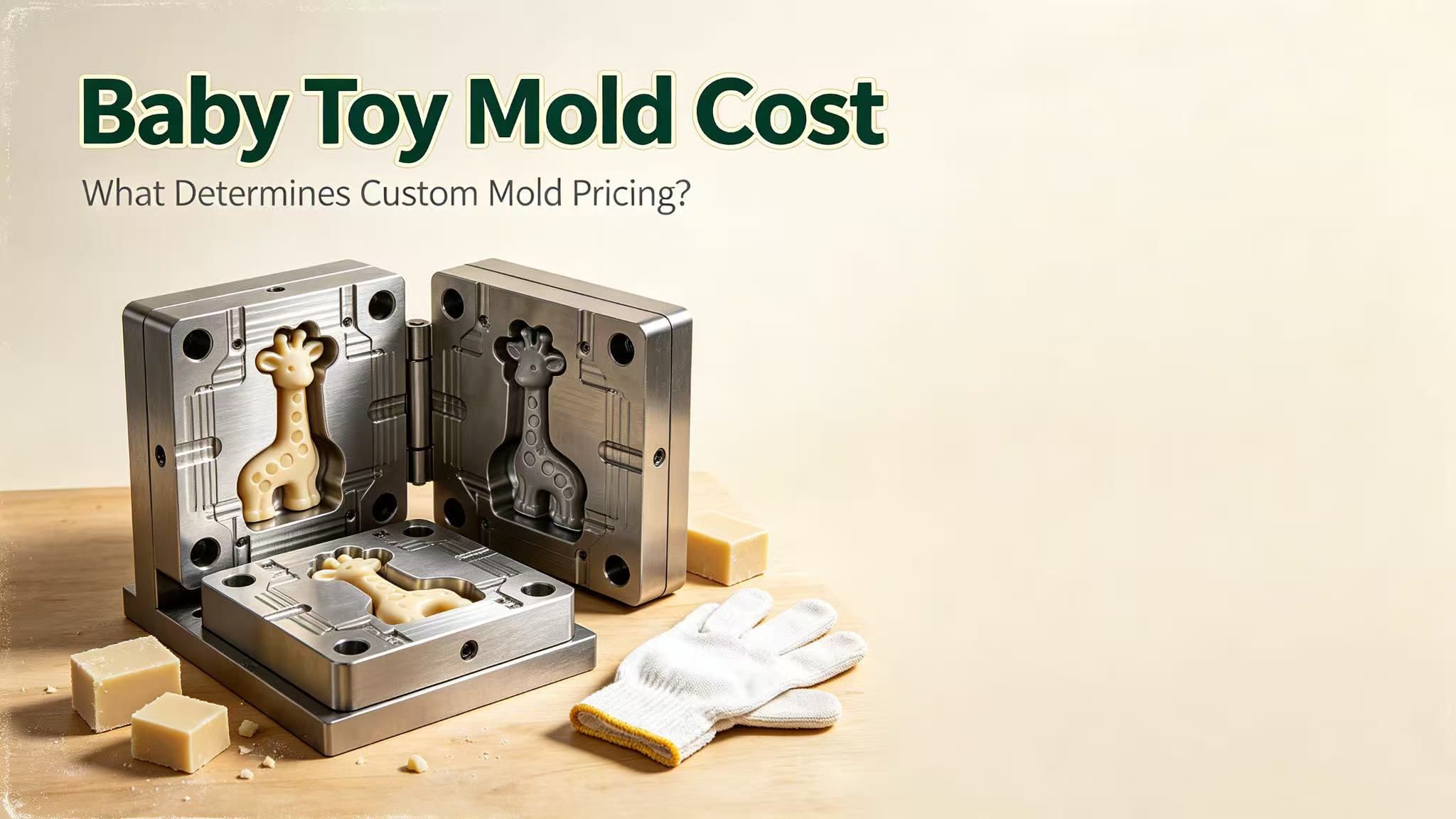
For a natural rubber or latex baby toy, the biggest fixed cost is the mold. Every teether, bath toy, or pacifier shape starts as a metal or resin mold machined to your design. That mold costs the same whether the factory runs it once or a thousand times. Mold costs, tooling setup, color mixing, the dipping line calibration, the vulcanization cycle time, and the packaging setup all have to be spread across the units in a single run. Order too few, and the per-unit price explodes; the factory would rather turn away a tiny order than lose money on it.
There is also a practical floor on how small a batch can be. A dipping line that coats a rack of molds needs a minimum volume of liquid latex mixed at once, and the batch has to be stable through the whole cycle. Below a certain size, the process itself becomes unreliable. That is why a factory's MOQ is rarely a negotiation trick — it is usually a real production constraint dressed up as a sales policy.
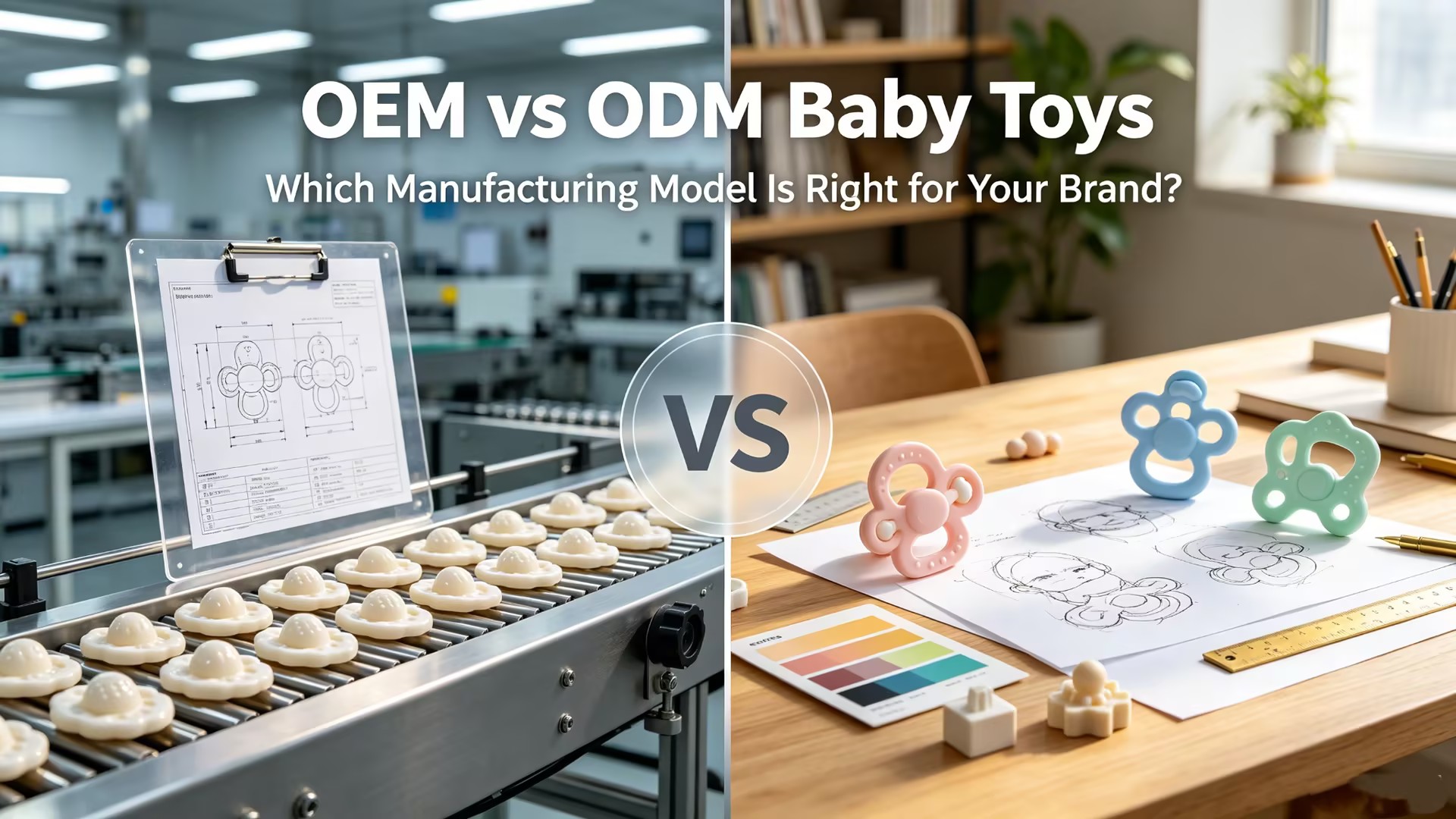
The key insight for a new brand is that MOQ is not a single number. It depends on three things: the product's complexity, the materials involved, and the factory's equipment. A simple single-piece teether with one color will always have a lower minimum than a two-tone bath toy with multiple components. When you compare quotes, you are not just comparing prices; you are comparing different production economics. Understanding this is the first step to finding a supplier whose numbers fit a startup budget. If you want a deeper look at how the two main manufacturing models differ and which one suits a brand that is still finding its feet, our breakdown of OEM vs ODM baby toys walks through the trade-offs in plain language.
What a Low MOQ Actually Buys a Startup
A low minimum order quantity changes the entire risk profile of a new product launch. When a factory quotes you a small starting order, you are effectively buying an option, not a warehouse full of obligation. Here is what that option gives you.
Cash stays in your account. A small first order means your startup capital is not locked inside a container of inventory that might not move. You can run two or three product tests with the same money it would take to commit to one large run.
You can afford to be wrong. Every new baby brand gets some product decisions wrong — a color that does not resonate, a size that is slightly off, a shape that does not get grabbed in photos. A low MOQ makes being wrong cheap. You learn, adjust, and try again without burning the business.
You keep negotiating power. Suppliers are more responsive to brands that come back with repeat orders than to one-time big spenders. Starting small lets you build a track record, prove you can sell, and then negotiate better pricing on volume later.
You move faster. A small batch has a shorter lead time. Instead of waiting months for a big run to clear the line, you get samples and a test batch in your hands sooner, which means you can start gathering real customer feedback before a competitor even launches.
For a new brand, these four advantages are worth more than the slightly higher per-unit cost of a small order. The per-unit price matters once you have demand; before you have demand, flexibility matters more. If you are at the very start of building your product line, our guide on private label baby toys and how to build your own product line covers the full path from idea to shelf.
Product Testing: Prove the Toy Before You Commit
The smartest way to use a low MOQ is to treat the first batch as an extended product test, not as your launch inventory. A baby toy is a safety-critical product, so testing has two separate layers: regulatory compliance and real-world performance.
Compliance testing is non-negotiable. Baby toys sold in North America and Europe have to meet strict standards. Buyers and marketplaces will ask for evidence that your product complies with standards like ASTM F963, EN 71, and CPSIA in the US and Europe, and many factories also hold quality certifications such as ISO 9000, BSCI audits, and FDA-registered food-contact compliance. A factory that already holds these certifications and tests every batch saves you a huge amount of time, because you are not starting from zero on documentation. When you review a supplier, ask to see their test reports and certification scope, not just their marketing claims. A low-MOQ factory that still runs proper compliance checks on small batches is worth far more than a big-volume plant that treats testing as an afterthought.
Performance testing happens in the real world. Compliance tells you a toy is legal; performance tells you whether babies actually like it. Send your first batch to real families. Watch how a baby grips the teether, whether the texture soothes gums during teething, whether the bath toy floats the way you imagined, whether the pacifier stays clean and holds up after weeks of washing. That feedback is the difference between guessing and knowing.
This is where working with a manufacturer that specializes in natural rubber and latex matters. A teether made from 100% natural rubber behaves differently from a silicone one — it has a softer, warmer texture that many parents prefer, and it is biodegradable. But natural latex also demands careful processing, from filtering the raw sap to a controlled vulcanization step at around 120–140°C for 20 to 30 minutes, which gives the toy its durability and elasticity. A supplier that understands these materials can help you make a better product, not just a cheaper one. If you want to see the range of shapes a low-batch run can cover, our natural rubber baby teether collection shows the kind of designs that are practical to test in small quantities.
Market Testing: Let Buyers Cast the Vote
Once the product works in the hands of a few families, the next test is the market itself. A low MOQ lets you run a genuine market test instead of an expensive gamble. Here is how small brands typically use it.
Run a small-batch pilot. Launch a limited quantity through your own online store, a marketplace, or a few wholesale accounts. Track real conversion data: who clicks, who buys, who comes back. A pilot of a few hundred units tells you far more than any focus group.
Use pre-orders as a demand signal. Some DTC brands take pre-orders before manufacturing their first full batch. If customers pay in advance for a product you have already proven in a pilot, you have validated demand without carrying any inventory risk. This works especially well for small businesses with an engaged early audience.
Watch the return rate, not just the sales rate. Baby products get returned for many reasons — wrong size, duplicate gifts, personal preference. A high return rate on a pilot is a red flag about fit or expectations; a low one tells you the product matches what you promised.
Test different channels with the same batch. Split your small order across your website, a retail trial, and one social channel. Each channel will teach you something different about how to position, price, and photograph the product. The same teether that stalls on a marketplace can fly off your own site when the story is told well.
A low MOQ is the tool that makes all of this possible, because it lets you put real product in front of real buyers without betting your whole budget on the outcome. For a fuller picture of how retailers and smaller brands approach buying natural rubber toys wholesale, our article on wholesale natural rubber baby toys for retailers and baby brands lays out the practical buying patterns.
Inventory Risk and the Cash-Flow Trap
Inventory is where young brands die quietly. It is easy to feel pressure to buy big because the per-unit price looks better, but the math changes completely once you add storage, capital tied up, and the risk of dead stock.
Think about what a large order actually costs you beyond the invoice. If you order three thousand units and sell through slowly, you are paying for warehousing, insurance, and the opportunity cost of money stuck in boxes. Baby toys also age — a teether in a seasonal pastel palette that does not sell by next spring is worth less than what you paid for it. And the hardest cost to see is the one that never happens: the new product you could not develop because your cash was frozen in slow-moving inventory.
A low MOQ protects you from this trap in three ways. It caps your worst-case loss, because you simply cannot over-order. It keeps your cash circulating, so you can fund the next test while the first one is still selling. And it keeps your catalog lean, which matters because a tight range of proven sellers beats a wide range of guesses.
The discipline that matters most is refusing to let a good per-unit price talk you into a bad order size. If a factory offers you a volume discount you cannot justify with real demand, the discount is not a saving; it is a cost in disguise. Order what you can honestly sell, learn from it, and reorder when the data supports it.
Reordering: When and How to Reorder
A reorder is the strongest signal a baby brand gets. It means a product has moved past the test stage and into real demand. Knowing when and how to reorder is where low-MOQ strategy turns into a growth engine.
The reorder trigger should be data, not optimism. A good rule of thumb is to reorder when you have sold through most of your first batch and the sales rate is steady or climbing — not when you are down to your last few units and panicking, and not because you like the product yourself. If your pilot sold at a consistent pace and repeat customers are asking for more, that is the signal.
Time your reorder around the lead time. Small-batch production has shorter lead times, but there is still a cycle: confirmation, material preparation, dipping, vulcanization, quality control, and shipping. If your supplier needs several weeks from order to delivery, you want to reorder while you still have safety stock, so you never hit a gap where the product is out of stock exactly when demand is peaking.
Use the reorder to negotiate. The second order is your leverage point. You have now proven two things the factory cares about: your design sells, and you pay on time. That track record is the basis for asking about better pricing, faster lead times, or more flexible minimums on the next batch. A supplier who worked with you at a low MOQ wants to keep you as a customer, and a growing order is the natural moment to ask what else they can do.
Consider a ladder of order sizes. Instead of jumping straight from a small test batch to a huge run, climb a ladder: test batch, pilot, then a medium order, then volume. Each rung validates the next. For practical guidance on structuring your buying as you grow, our complete wholesale baby toys sourcing guide covers order planning, communication with suppliers, and how to keep quality consistent as quantities rise.
Scaling Production Without Breaking What Works
Scaling is not the opposite of starting small; it is the reward for doing it well. The brands that scale successfully are the ones that treat every stage — test, pilot, reorder — as a lesson that shapes the next stage. Here is how the transition usually works.
Scale the winners first. You do not need to scale your whole range. Scale the two or three products that the data says are winners, and keep testing new designs in small batches alongside them. This gives you a growing revenue base and a constant pipeline of experiments at the same time.
Lock in quality as volume grows. The risk of scaling is that quality drifts when a factory runs larger quantities or adds new equipment. This is why choosing the right partner matters from day one. A manufacturer that holds certifications like ASTM F963, EN 71, CPSIA, ISO 9000, BSCI, and FDA-registered food-contact compliance, and that tests every batch, gives you confidence that the larger run matches the quality of your pilot. As you grow, keep samples from every batch and check them against your pilot standard — consistency is the asset you are actually selling.
Use shared tooling to lower cost. Many suppliers offer product families built around shared molds and common components. A teether and a matching bath toy that share the same base shape or the same color system can be produced more cheaply together than as two unrelated designs. Designing a family of products around shared tooling is one of the most effective ways a small brand can cut per-unit costs without sacrificing the benefits of low-MOQ flexibility.
Plan the production calendar, not just the order. Scaling means ordering with intent — matching production schedules to seasonal demand, launch dates, and cash flow. A good supplier will help you plan a calendar that smooths out peaks, rather than forcing you to guess and gamble.
The transition from startup to established brand is not a single big jump. It is a sequence of smaller, proven steps. The brands that make it are rarely the ones with the biggest first order; they are the ones that tested honestly, reordered on evidence, and scaled only what had already earned the right to grow.
Start Small, Test Honestly, Scale on Evidence
A new baby brand does not need a warehouse full of inventory to prove itself. It needs a product that is safe, a supplier it can trust, and the ability to test cheaply. Low MOQ baby toys give you exactly that: a way to put a real product in front of real customers with your worst-case loss capped at a number you can survive.
The formula is simple. Find a factory that genuinely supports small starting orders and holds the safety certifications parents will ask about. Treat your first batch as a test, in the lab and in the hands of real families. Watch the market data, not your enthusiasm. Reorder on evidence. Scale only the winners.
If you are ready to explore what a low minimum order can do for your brand, the fastest way to start is to send an inquiry with your product idea and ask about sample options and small-batch pricing. The first step is small on purpose — that is the whole point.
Baby Toy MOQ Explained: What Determines Minimum Order Quantity?
OEM vs ODM Baby Toys: Which Manufacturing Model Is Right for Your Brand?