How to Choose a Baby Toy Manufacturer: 12 Questions to Ask
Selecting the right baby toy manufacturer is the single most consequential decision for any brand, distributor, or retailer entering the juvenile products market. The manufacturer you choose determines not just your cost structure and lead times, but your product quality, regulatory compliance, brand reputation, and ultimately your ability to grow. A great manufacturer becomes a strategic partner that protects your margins and de-risks your supply chain; a poor one can trigger recalls, customs seizures, chargebacks, and customer attrition.
This guide is the pillar resource for evaluating baby toy manufacturers. It presents 12 questions that every buyer should ask before committing to a production partner — covering manufacturing experience, material capability, product development, testing, MOQ, OEM/ODM, quality control, packaging, lead time, communication, factory capability, and after-sales support. Each question includes why it matters, what to look for, and red flags to avoid. Whether you are launching your first SKU or auditing an existing supply base, this framework will help you make a confident, data-driven decision.
Question 1: What Is Your Manufacturing Experience?
Experience matters disproportionately in the baby toy industry because the learning curve is steep and the cost of mistakes is high. A manufacturer with five or more years of dedicated baby toy production has encountered and resolved the issues that sink newer factories: inconsistent wall thickness in dipped latex, mold flash in complex geometries, cure cycle optimization, color migration in natural pigments, and batch-to-batch consistency in soft materials.
When evaluating experience, look beyond the company's founding date. Ask specifically about:
- Category specialization: A factory that makes 80% baby teethers and bath toys will be more proficient than a generalist factory that dabbles in 20 product categories.
- Export markets: Experience selling to the US, EU, UK, Australia, or Japan indicates familiarity with those markets' regulatory frameworks and retailer quality expectations.
- Client references: Request 2–3 references from current or past clients in similar categories and markets. Follow up with these references — ask about consistency, issue resolution, and whether they would reorder.
- Longevity of key staff: A factory with high turnover in production managers and QC leads loses institutional knowledge. Ask how long the core production and QC team has been with the company.
Red flag: A manufacturer that cannot provide specific examples of baby toy products they have produced, or that deflects requests for client references, may be newer to the category than they claim. Generalist toy factories that primarily produce older children's toys may not understand the stricter safety and material requirements for infant products.
Question 2: What Materials Can You Work With?
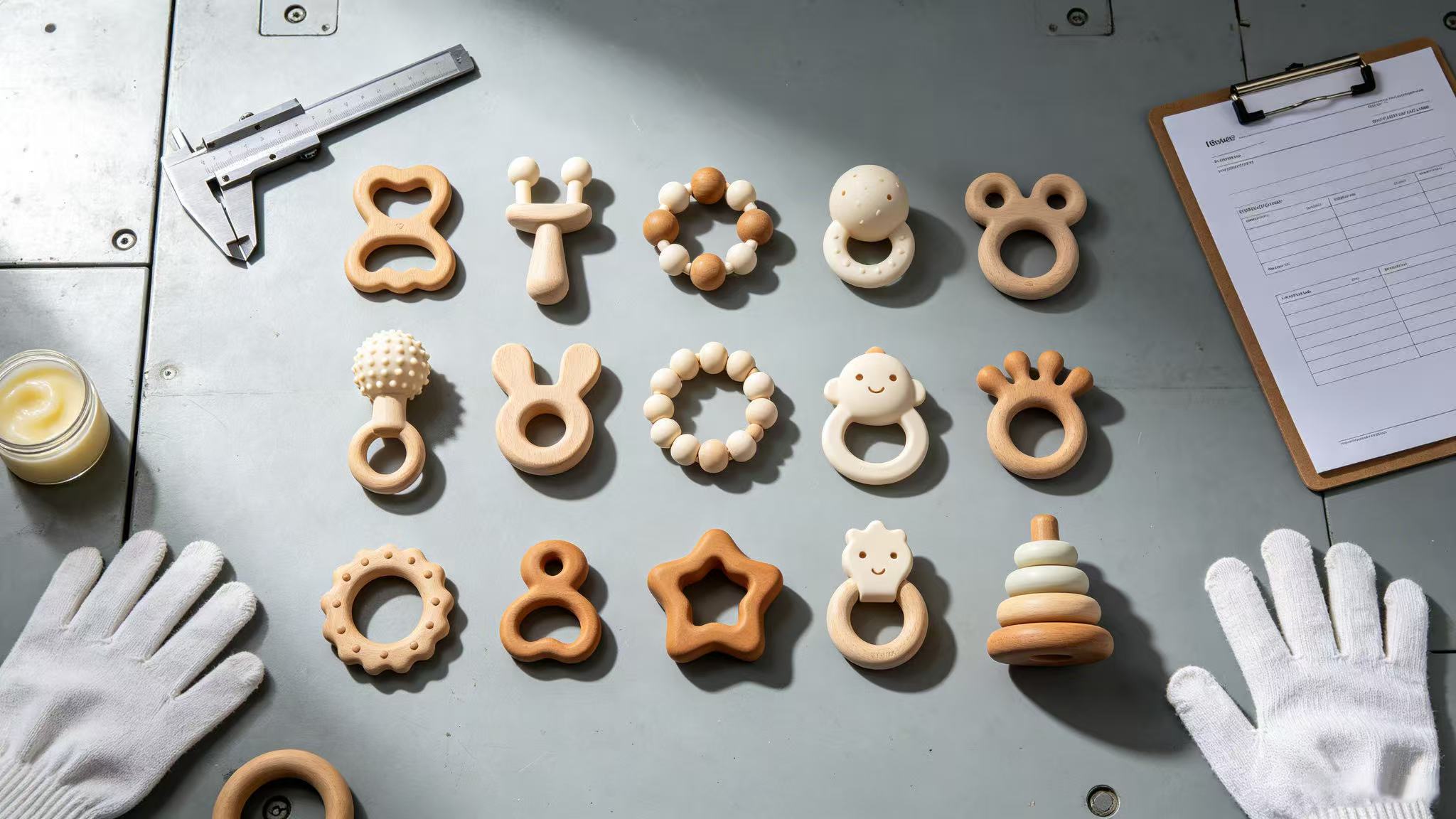
Baby toys are produced from a wide range of materials — natural rubber latex, food-grade silicone, polypropylene (PP), polyethylene (PE), ABS, wood, organic cotton, and various fabric blends — and each requires different manufacturing technology, processing expertise, and safety testing. A manufacturer that excels at injection-molded plastic toys may struggle with dipped natural latex, and vice versa.
Key material considerations:
- Natural rubber latex: Requires dipping or molding lines, vulcanization ovens, deproteinization capability, and low-nitrosamine accelerator systems. Specialized expertise is essential.
- Food-grade silicone: Requires compression or injection molding with medical/food-grade raw material and precise temperature control.
- Plastics (PP, PE, ABS, TPE): Requires injection molding machines, material drying systems, and color masterbatch management.
- Wood: Requires CNC machining, sanding, non-toxic finishing (water-based paints, natural oils), and formaldehyde-free adhesive controls.
- Fabric / textile: Requires cutting, sewing, filling, and textile-specific safety testing (flammability, fiber content, small parts).
For brands focused on natural and sustainable materials, it is especially important to verify that the manufacturer has genuine expertise — not just a marketing claim. Ask for material safety data sheets (MSDS), raw material supplier information, and examples of products made from your target material. If you are sourcing natural rubber toys specifically, understanding the material's sustainability profile and production process will help you ask more informed questions.
Question 3: What Is Your Product Development Process?
Product development capability separates a true manufacturing partner from a simple production vendor. A manufacturer with strong in-house R&D can help you refine designs, identify manufacturability issues early, reduce tooling costs, and accelerate time-to-market. A manufacturer that only executes provided designs will cost you more in tooling revisions, delayed launches, and suboptimal products.
A robust product development process should include:
- Concept review & DFM (Design for Manufacturability): The manufacturer reviews your design (sketches, 3D files, or descriptions) and provides feedback on wall thickness, draft angles, mold parting, texture feasibility, and material selection.
- 3D prototype / rapid prototyping: Using 3D printing or silicone prototyping to produce a physical sample for form, fit, and tactile evaluation before committing to hard tooling.
- Mold design & fabrication: In-house mold shop with CNC machining and EDM capabilities. Mold material selection (aluminum for low-volume, P20 steel for high-volume) and mold maintenance policy.
- Pilot run / T1 sample: First production samples from the actual mold, evaluated for dimensions, appearance, function, and safety. Iterative revisions (T2, T3) until approved.
- Mass production: Final process parameters locked, production schedule set, and QC inspection plan established.
Ask about typical development timelines: 3–7 days for stock samples, 20–30 days for custom mold + first samples, and 45–70 days for first mass production. Also ask who owns the mold after payment — you should own your custom tooling, with the option to transfer it to another factory if needed.
For brands developing screen-free and sensory-focused products, product development expertise is especially critical because tactile features, texture patterns, and multi-sensory design elements require specialized mold and process knowledge.
Question 4: How Do You Handle Testing and Compliance?
Safety compliance is non-negotiable in the baby toy industry. A manufacturer that cannot provide valid, current test reports from accredited third-party laboratories is a manufacturer you should not work with — regardless of price. Non-compliant products can be detained at customs, recalled from retail shelves, and expose your brand to legal liability.
The core standards every baby toy manufacturer should support:
| Standard | Market | What It Covers |
|---|---|---|
| ASTM F963-23 | United States | Mechanical/physical safety, flammability, heavy metal migration, total lead (100 ppm substrate / 90 ppm paint), phthalates (6 restricted), small parts, age grading. Mandatory under 16 CFR Part 1250. Third-party testing + CPC required for ages 12 and under. |
| EN 71 series | European Union | EN 71-1 (mechanical/physical), EN 71-2 (flammability), EN 71-3 (migration of 19 elements), EN 71-12 (nitrosamines for rubber). CE marking + EU Declaration of Conformity required. Also subject to REACH. |
| CPSIA | United States | Total lead content, phthalate restrictions, tracking labels, third-party testing, Children's Product Certificate (CPC). |
| UKCA / UK Toys Regulations | United Kingdom | Post-Brexit UK toy safety framework, aligned with EN 71 but with UK responsible person requirement. |
| CCPSA | Canada | Canada Consumer Product Safety Act, Toys Regulations (SOR/2011-17), bilingual labeling. |
| AS/NZS ISO 8124 | Australia / NZ | Harmonized with ISO 8124 (aligned with EN 71), mandatory warning labels. |
When evaluating a manufacturer's testing capability, ask:
- Which laboratories do you work with? (Look for SGS, Intertek, Bureau Veritas, TÜV — all ISO/IEC 17025 accredited.)
- Are test reports tied to specific production batches, or only generic product-level samples?
- What is your retesting frequency? (Best practice: every 6 months or after any material/process change.)
- Do you issue CPC (US) / DoC (EU) documentation with each shipment?
- Do you have an in-house QC lab for routine testing (tear strength, hardness, color fastness, dimensional checks)?
- How do you handle product recalls and regulatory notifications?
Question 5: What Are Your MOQ Requirements?
Minimum Order Quantity (MOQ) is often the first hurdle for new brands and first-time importers. Baby toy manufacturing involves mold setup, compound formulation, and production line scheduling that create fixed costs per run, so manufacturers naturally prefer larger orders. But a high MOQ can lock out new brands, force excessive inventory, and increase financial risk.
Typical MOQ benchmarks for baby toys:
- Stock / catalog items: 500–2,000 pieces per SKU. Some suppliers offer mixed-SKU MOQs across a category (e.g., 3,000 pieces total across 5 SKUs).
- Custom color / logo on existing mold: 1,000–3,000 pieces per SKU.
- Fully custom mold / new product: 3,000–10,000 pieces per SKU, plus mold fees ($500–$5,000 depending on complexity and material).
When evaluating MOQ, look beyond the headline number and ask about:
- Mixed-container or mixed-SKU options for trial orders.
- Mold fee amortization or refund after reaching volume milestones.
- Sample order terms (many suppliers offer free samples with buyer-paid freight).
- Repeat order MOQs (often lower than first-order MOQ).
- Private label / white label MOQs for quick market entry without custom tooling.
- Volume discount tiers and pricing breaks at higher quantities.
Red flag: A manufacturer that refuses any MOQ flexibility, or that charges exorbitant mold fees with no amortization path, may not be a good fit for growing brands. Conversely, an unusually low MOQ may indicate the manufacturer is a trading company rather than a direct factory, or that quality will suffer from small-batch inconsistency.
Question 6: What OEM / ODM Services Do You Offer?
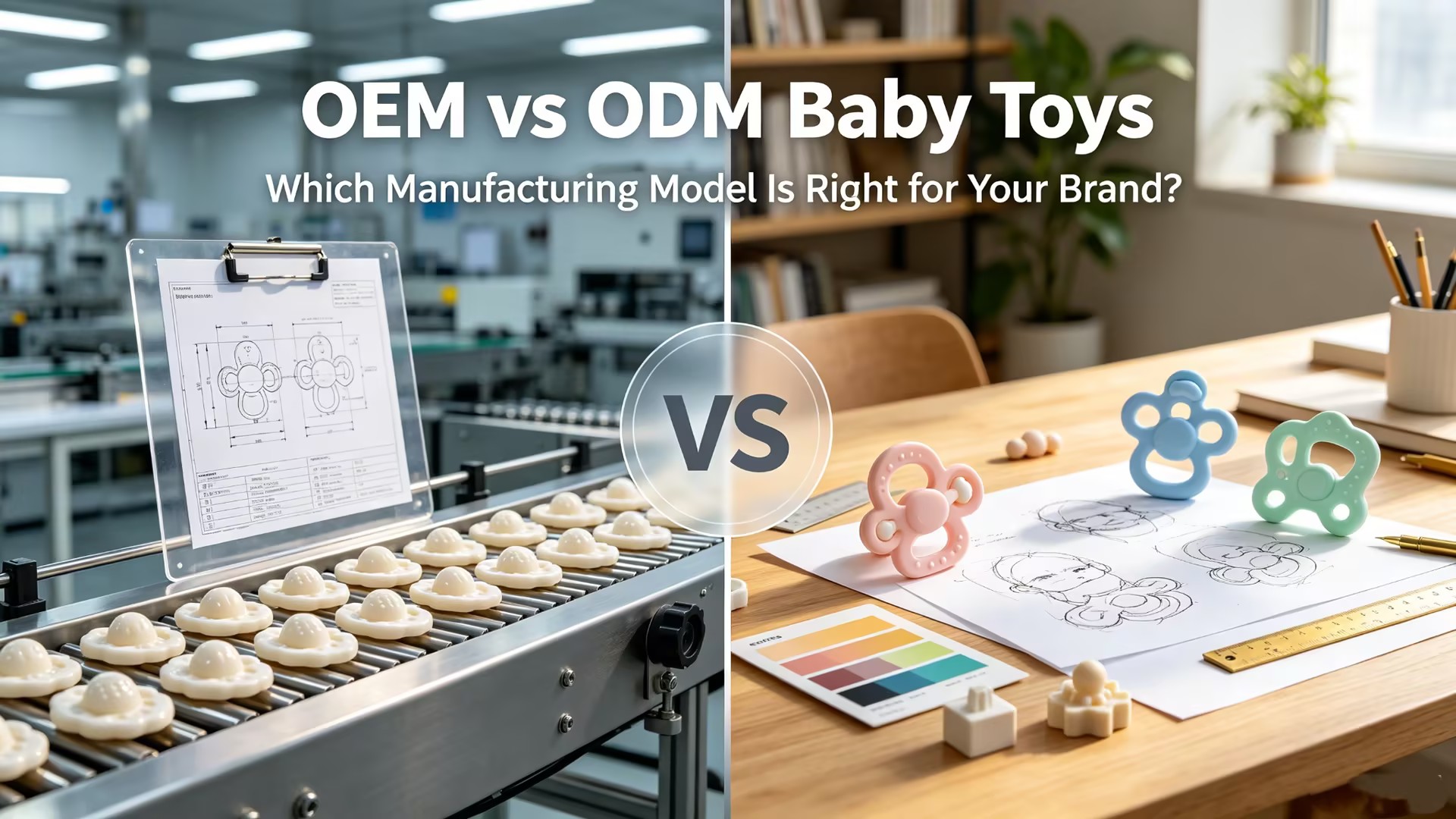
OEM (Original Equipment Manufacturing) and ODM (Original Design Manufacturing) are the two primary collaboration models for private label baby toy brands. Understanding which model a manufacturer supports — and the depth of their customization — determines whether you can build a proprietary product line or are limited to reselling stock items.
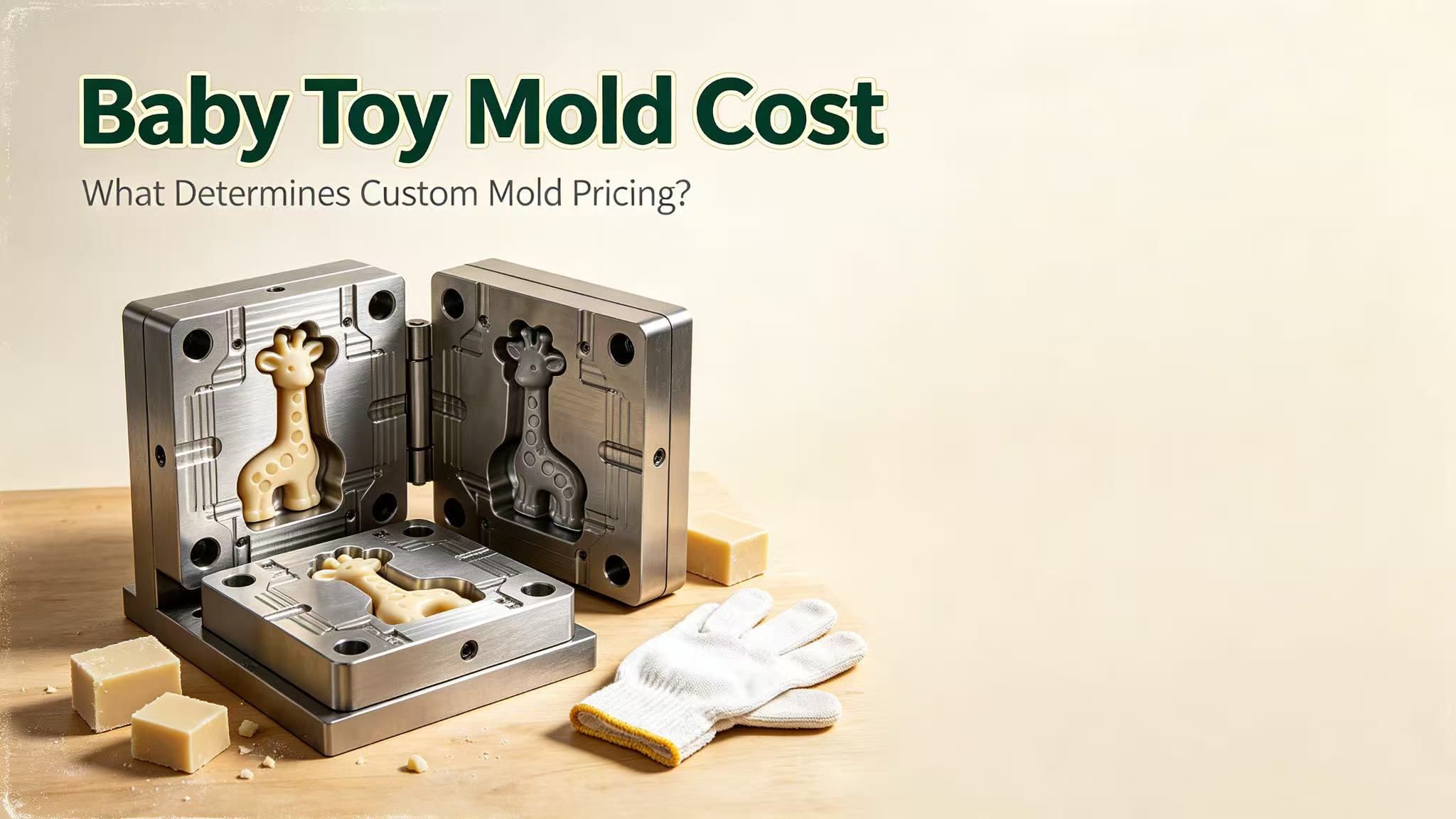
OEM means you provide the design (or product specification), and the manufacturer produces it to your requirements. This includes custom molds, custom colors, custom logos, and custom packaging. OEM is how you build a unique, differentiated product line.
ODM means the manufacturer has existing designs and product molds, and you customize them (branding, colors, packaging) under your label. ODM is faster and lower-cost than OEM because tooling already exists, but your products will be less unique.
A strong baby toy manufacturer should offer both models, with customization at every level:
- Product shape & structure: Fully custom mold development from your 3D files, sketches, or concept descriptions (OEM).
- Existing mold modifications: Minor design changes to existing ODM products (e.g., adding a texture, changing a handle shape).
- Color: Pantone color matching using food-safe pigments, with custom color development for unique brand palettes.
- Logo & branding: Embossed, debossed, or printed logos on the product; custom hang tags, header cards, labels, and printed packaging.
- Packaging: Custom retail boxes, blister packs, gift sets, eco-friendly packaging (kraft, molded pulp, organic cotton bags).
- Product combinations: Custom gift sets, multi-packs, and category bundles.
- Functional features: Custom rattle sounds, squeaker mechanisms, texture patterns, size variations.
Ask to see a portfolio of custom OEM/ODM products developed for other brands. A manufacturer with a strong track record will walk you through their development process and advise on intellectual property protection — mold ownership, design confidentiality agreements (NDAs), and exclusive production arrangements for your custom products.
Question 7: What Are Your Quality Control Systems?
A manufacturer that produces one excellent sample but cannot replicate that quality across 10,000 units is not a reliable partner. Quality control (QC) is the system that ensures consistency — and it is where many low-cost manufacturers reveal their weaknesses. In the baby toy industry, inconsistent quality can lead to safety failures, customer complaints, and retailer chargebacks.
A robust QC system should cover four stages:
1. Incoming Quality Control (IQC): Inspection and testing of raw materials upon arrival — latex concentration, pigment purity, packaging material integrity, component dimensions. Non-conforming materials are rejected before entering production.
2. In-Process Quality Control (IPQC): Regular checks during production — wall thickness measurement, visual inspection for defects (flash, bubbles, discoloration, tears), dimensional verification, functional testing (rattle sound, squeaker function, texture integrity). IPQC catches issues early, before they become entire batches of defective product.
3. Final Random Inspection (FRI): AQL (Acceptable Quality Limit) sampling of finished goods before shipment. Standard baby toy inspection uses AQL 2.5 for major defects and 4.0 for minor defects. Inspection covers appearance, dimensions, functionality, packaging, labeling, and safety warnings.
4. Laboratory testing: In-house QC lab for routine tests (tear strength, elongation-at-break, Shore A hardness, color fastness, leak testing for bath toys) and third-party lab testing for regulatory compliance (ASTM F963, EN 71, CPSIA).
Additional QC elements to evaluate:
- Traceability: Batch/lot coding on every product and carton, linking finished goods to raw material batches, production dates, and test reports — essential for targeted recalls.
- Corrective action process: A documented system for identifying root causes of defects, implementing corrective actions, and verifying effectiveness — not just rejecting bad units but preventing recurrence.
- Defect rate data: Ask for historical reject rates by category and by customer. A manufacturer that tracks and shares this data is one that takes QC seriously.
- Pre-shipment inspection (PSI): Will they accommodate your own third-party inspector (or your representative) to conduct a final inspection before shipment? A confident manufacturer will welcome this.
Red flag: A manufacturer that cannot explain their QC process, that does not have an in-house lab, or that refuses third-party pre-shipment inspections is likely cutting corners on quality.
Question 8: What Packaging Solutions Do You Offer?
Packaging is where your product becomes a retail-ready brand experience. It is also where many manufacturers fall short — offering only generic polybags or plain boxes, leaving buyers to source packaging separately (adding cost, complexity, and lead time). A strong baby toy manufacturer should offer integrated packaging solutions that match your brand positioning and target market requirements.
Packaging capabilities to evaluate:
- Retail-ready boxes: Custom-printed cardboard boxes with your branding, product imagery, safety warnings, age grading, and regulatory markings (CE, UKCA, CPC tracking label, Country of Origin, recycling symbols).
- Blister & clamshell packs: For hang-sell retail display, with custom printed backer cards.
- Eco-friendly packaging: Kraft paper boxes, molded pulp inserts, FSC-certified paper, soy-based inks, organic cotton drawstring bags, and plastic-free options for eco-conscious brands.
- Gift sets & bundles: Custom multi-product packaging with inserts, ribbons, and premium finishes for gifting and holiday seasons.
- Bulk / wholesale packaging: Plain polybags or corrugated cartons for distributors who do their own retail packaging.
- Design support: Dieline templates, structural design, and graphic design coordination — or the ability to work with your designated packaging designer.
Critical packaging questions:
- Can you provide dieline templates and design support for custom packaging?
- What printing methods are available (offset, flexo, digital, hot stamp, emboss)?
- Can you handle multi-language packaging for different markets?
- What are your minimums for custom packaging vs. stock packaging?
- Do you offer packaging testing (drop test, compression test) for e-commerce fulfillment?
- Can you source eco-certified packaging materials (FSC, GOTS, ASTM D6400, EN 13432)?
For eco-focused brands, packaging is increasingly a point of differentiation — and a regulatory concern. The EU's Packaging and Packaging Waste Regulation (PPWR) imposes recycled content requirements and restricts certain packaging formats, while US states are expanding packaging-related EPR (Extended Producer Responsibility) laws. A manufacturer that stays current on these regulations will save you from costly packaging redesigns down the line.
Question 9: What Are Your Lead Times and Production Capacity?
Lead time directly affects your cash flow, inventory planning, and ability to capitalize on seasonal demand. A manufacturer with excellent products but unreliable lead times will leave you with empty shelves during peak selling seasons — or force you to carry excessive safety stock, tying up capital.
Typical lead time benchmarks for baby toy manufacturing:
- Stock samples: 3–7 days (often free, buyer pays freight).
- Custom samples (new mold): 20–35 days, including mold fabrication.
- First production order: 45–75 days after sample approval and deposit.
- Repeat orders: 30–60 days (faster because molds and tooling are ready).
- Expedited / rush orders: Possible with surcharge, depending on factory load and product complexity.
Production capacity is equally important. Ask about:
- Number of production lines and monthly output capacity (in units or 40-foot containers).
- Ability to scale for large orders — can they add shifts, open additional lines, or prioritize your order?
- Peak season capacity (Q4 holiday rush) — do they have a plan for October–December demand surges?
- Raw material inventory policy — do they stock concentrated latex, resin, and packaging materials to avoid supply delays?
- Contingency plans for labor shortages, power disruptions, or raw material price volatility.
- On-time delivery rate for the past 12 months — ask for data, not assurances.
A manufacturer that is already at 90%+ capacity will struggle to accommodate your growth or urgent reorders. Look for suppliers with 20–30% headroom, and ask whether they can provide a production schedule with milestone dates (mold completion, T1 sample, production start, QC inspection, shipment) after order confirmation.
Question 10: How Do You Handle Communication?
Communication is the most underrated factor in manufacturer selection — and the one that causes the most day-to-day frustration. A manufacturer with excellent capabilities but poor communication will cause missed deadlines, misunderstood specifications, and unresolved quality issues. Conversely, a manufacturer with strong communication can compensate for minor capability gaps by being transparent, responsive, and solution-oriented.
Evaluate communication on these dimensions:
Responsiveness: How quickly do they respond to emails, messages, and calls? During business hours in your time zone, a 24-hour response time is reasonable. For urgent issues, they should have an escalation path. If a manufacturer is slow to respond during the sales process, they will be even slower once you are a customer.
Language capability: Is there a dedicated English-speaking (or your language) sales/project manager? Miscommunication due to language barriers is a leading cause of specification errors in offshore manufacturing. Look for manufacturers with sales teams fluent in your language and experienced in communicating with buyers in your market.
Project management: Will you have a dedicated account manager or project coordinator who follows your order from sample through shipment? Or will you be passed between departments? A single point of contact who knows your products, specifications, and preferences dramatically reduces errors and delays.
Transparency: Do they proactively share production updates, photos, and inspection reports? Or do you have to chase them for information? A transparent manufacturer will send you in-process photos, QC results, and shipping documentation without being asked. They will also tell you promptly if there is a problem — rather than hiding it until the shipment is late.
Issue resolution: Ask how they handle quality issues, production delays, or specification discrepancies. A good manufacturer takes ownership, proposes solutions, and implements corrective actions to prevent recurrence. A bad manufacturer blames the buyer, denies the issue, or goes silent.
Communication tools: What platforms do they use? (Email, WhatsApp, WeChat, Skype, Zoom.) Can they accommodate video calls for design reviews and factory tours? Do they use a shared project management system or order tracking portal?
Red flag: If your initial inquiries receive generic, copy-pasted responses that do not address your specific questions, or if the salesperson disappears after taking your deposit, walk away. Communication quality during the sales process is the best predictor of communication quality during production.
Question 11: What Is Your Factory Capability?
A manufacturer's factory infrastructure is the physical reality behind their marketing claims. While you may not be able to visit every factory in person during initial evaluation, you can assess capability through documentation, virtual tours, and targeted questions. For baby toys, the key infrastructure elements are:
Production technology:
- Dipping lines (for thin-walled natural latex bath toys and squeeze toys) — with automated dipping arms, temperature-controlled latex tanks, and curing ovens.
- Compression / injection molding (for teethers, structured toys, silicone products) — with precision temperature control and automated ejection.
- Rotational molding (for hollow toys and balls).
- Woodworking (CNC machining, sanding, finishing lines) for wooden toy components.
- Sewing / filling lines for fabric and plush components.
- A factory with multiple production technologies can serve your full product range rather than forcing you to manage multiple suppliers.
Mold shop: In-house mold design and fabrication (CNC machining, EDM, mold polishing) reduces cost and lead time vs. outsourcing. Ask about mold material (aluminum for low-volume, P20 or H13 steel for high-volume), mold maintenance policy, and mold storage.
Post-processing: Trimming, deflashing, washing, drying, and inspection stations. Automated trimming and washing improve consistency and reduce labor costs and contamination risk.
Packaging line: In-house packaging assembly, printing, and cartoning — avoids the quality risk and lead time of outsourced packaging.
Warehousing: Temperature-controlled raw material storage (critical for latex concentrate, which degrades at high temperatures), WIP staging, and finished goods storage with FIFO (first-in-first-out) inventory management.
Facility standards: Clean, well-lit production floors, proper ventilation (especially for curing and chemical areas), worker PPE, fire safety systems, and organized material flow. These reflect operational discipline and reduce safety and quality risks.
Management system certifications:
- ISO 9001: Quality management — the baseline for consistent processes.
- ISO 14001: Environmental management — increasingly important for eco-focused brands and EU market access (GPSR, CSRD).
- ISO 45001: Occupational health and safety — indicates a safe, well-managed workplace.
- BSCI / SMETA: Social compliance audits — required by many major EU and US retailers.
Request a virtual factory tour or a detailed factory profile document with photos of each production stage. A confident manufacturer will be eager to show you their facility; one that resists or provides only generic marketing photos may have something to hide.
Question 12: What After-Sales Support Do You Provide?
After-sales support is the difference between a transactional vendor and a long-term manufacturing partner. Many manufacturers are attentive during the sales and production process but disappear once the goods ship — leaving you to handle quality complaints, retailer returns, and product issues alone. A manufacturer that stands behind their products will invest in your long-term success.
Key after-sales support elements to evaluate:
Defect resolution: If a batch has quality issues, what is the process? A good manufacturer will: investigate the root cause, provide a corrective action report, offer replacement units, credit, or rework, and implement process changes to prevent recurrence. Ask about their defect tolerance policy — will they replace units above the agreed AQL? What is the claim submission process and timeline?
Warranty / guarantee: Does the manufacturer offer any product warranty? For baby toys, common warranty terms cover manufacturing defects for 3–12 months after shipment. Clarify what is covered (material defects, workmanship) and what is not (normal wear and tear, misuse, storage damage).
Reorder support: Do they maintain your molds and tooling for future reorders? Is there a mold storage fee? How quickly can they restart production for a repeat order? A manufacturer that archives your molds, specifications, and color standards makes reorders fast and consistent.
Product development partnership: Will they support your ongoing product development — new SKUs, line extensions, design iterations? A strategic partner will proactively suggest improvements, cost reductions, and new product opportunities based on their manufacturing expertise and market knowledge.
Regulatory updates: Do they monitor regulatory changes in your target markets and notify you when standards update? Toy safety regulations evolve — ASTM F963 is updated periodically, EN 71 parts are revised, and new chemical restrictions (REACH SVHC, Prop 65) are added regularly. A manufacturer that keeps you informed protects you from compliance gaps.
Inventory and logistics support: Can they hold finished goods inventory for you? Do they offer drop-shipping or direct-to-retailer shipping? Can they support your Amazon FBA or 3PL requirements (labeling, palletization, ASN documentation)?
Responsiveness post-shipment: This is the ultimate test. If you email them with a question after the goods have shipped and been paid for, do they respond? The best indicator is to ask current clients about their post-shipment experience — specifically, how the manufacturer handled any issues that arose after delivery.
Red flag: A manufacturer that cannot explain their after-sales process, or that offers no warranty or defect resolution policy, is signaling that they view your relationship as one-time. For a brand building long-term equity, this is unacceptable.
Scoring and Shortlisting Manufacturers
Once you have gathered answers to all 12 questions, use a weighted scoring system to compare manufacturers objectively. Assign weights based on your priorities — for example, a new brand may weight MOQ and communication more heavily, while an established brand may prioritize factory capacity and after-sales support.
| Evaluation Factor | Suggested Weight | Score (1–5) |
|---|---|---|
| Manufacturing Experience | 8% | ___ |
| Material Capability | 10% | ___ |
| Product Development | 10% | ___ |
| Testing & Compliance | 12% | ___ |
| MOQ Flexibility | 8% | ___ |
| OEM / ODM Capability | 8% | ___ |
| Quality Control | 12% | ___ |
| Packaging | 6% | ___ |
| Lead Time & Capacity | 8% | ___ |
| Communication | 8% | ___ |
| Factory Capability | 6% | ___ |
| After-Sales Support | 4% | ___ |
| Total | 100% | ___ |
A score of 4.0+ (out of 5.0) indicates a strong potential partner. A score below 3.0 suggests significant risks. Always shortlist at least 2–3 manufacturers and request quotes and samples from each before making a final decision. And whenever possible, conduct an in-person or virtual factory audit before committing to a large first order.
Remember that the cheapest quote is rarely the best long-term value. A manufacturer that charges 10–15% more but delivers consistent quality, on-time shipments, and proactive support will save you far more in reduced defects, fewer chargebacks, and lower operational overhead than the lowest-cost option will cost in problems.
Ready to Find Your Baby Toy Manufacturing Partner?
Choosing the right baby toy manufacturer is the foundation of a successful baby product brand. By systematically evaluating all 12 factors — manufacturing experience, material capability, product development, testing, MOQ, OEM/ODM, quality control, packaging, lead time, communication, factory capability, and after-sales support — you can identify a manufacturer that is not just a vendor but a long-term strategic partner invested in your growth.
The best manufacturers will welcome these questions. They will be transparent about their capabilities, share data and references, and engage in a genuine dialogue about your product needs. They will also be honest about their limitations — a manufacturer that says "yes" to everything without qualification is either inexperienced or overpromising.
If you are ready to move from evaluation to action, the next step is to connect with a manufacturer that can demonstrate all 12 capabilities — and that specializes in the natural rubber, sensory, and eco-friendly baby toy categories that are driving growth in 2026 and beyond.
Ready to Source Baby Toys?
Connect with an experienced OEM baby toy manufacturer specializing in natural rubber, sensory, and eco-friendly products. Request a customized quote with pricing, MOQ, lead time, and OEM options.
Request a QuoteWholesale Baby Toys: Complete Sourcing Guide for Retailers & Brands
How to Choose a Natural Rubber Baby Toy Supplier