Baby Toy MOQ Explained: What Determines Minimum Order Quantity?
You found the factory. You love the sample. The colors are right, the price is close. Then the sales rep drops the number: MOQ is 2,000 pieces. For a brand that is still figuring out what actually sells, that number can feel like a door slamming shut.
We hear this story a lot. It is one of the most common questions buyers bring us when they start sourcing baby toys, and it deserves a straight answer.
MOQ stands for minimum order quantity — the smallest batch a factory will agree to produce in a single run. It is not an arbitrary number a salesperson picks to make your life difficult. It is the point where the factory can still cover its fixed costs and make a sensible profit. Once you understand where that number comes from, you stop treating it as a wall and start treating it as a math problem.
This guide explains what determines a baby toy MOQ, walks through the seven cost drivers behind it, and then — the part most guides skip — shows you practical ways to reduce MOQ risk without wrecking your margins.
What Is a Baby Toy MOQ (and Why Does It Exist)?
A minimum order quantity is the lowest volume a supplier will manufacture in one order. Run the numbers on a batch of 100 teethers and you will see why factories push for more: every run carries fixed costs that stay the same whether you order 100 pieces or 5,000.
The mold has to be set up. The line has to be scheduled. The latex compound has to be mixed to spec. Someone has to pack the cartons and book the lab test. None of those costs shrink with a smaller order — they just get spread across fewer units, which pushes the per-unit price up fast. At 50 pieces, setup labor that costs $0.10 per unit at 5,000 units can add $10 or more to every single toy.
Baby toys sit in a tricky spot here. They are small, low-priced products with heavy safety compliance requirements, so the fixed-cost share of each unit is unusually high. That is why baby toy MOQ questions come up so often: the economics are genuinely different from textiles or simple accessories. And when the product is natural rubber, the process adds another layer — dipped molding, vulcanization, and batch-level testing all carry their own minimums.
Where Does Your MOQ Come From? The Seven Cost Drivers
Before you negotiate a baby toy MOQ, you need to know what is actually driving the number. In natural rubber baby toys, seven factors do most of the work. Walk through them one by one and the MOQ suddenly stops looking random.
Material
The raw material sets the floor. Natural rubber baby toys start with latex sap tapped from Hevea brasiliensis trees, and that sap is bought by the drum or the batch. Once vulcanizing agents and food-grade pigments are added, the compound has a shelf life — a factory cannot mix a two-liter test batch and call it a day. Compounds are prepared in minimum mix quantities and have to be used before they degrade.
Certification-grade material raises the bar further. Organic or certified natural latex costs more per kilo and is usually purchased in larger minimum lots. If your toy needs a specific Shore A hardness or a custom color matched to your Pantone, the factory may order a dedicated pigment or compound batch just for you — and that purchase has its own minimum. Batch records for ASTM F963 and EN71 traceability mean the factory also wants enough units to justify a full compound run. Our organic natural latex teethers show what that material standard looks like in practice.
For a closer look at how the sap becomes a finished toy — from tapping to molding to final inspection — our manufacturing walkthrough follows the whole journey from tree to toy.
Mold
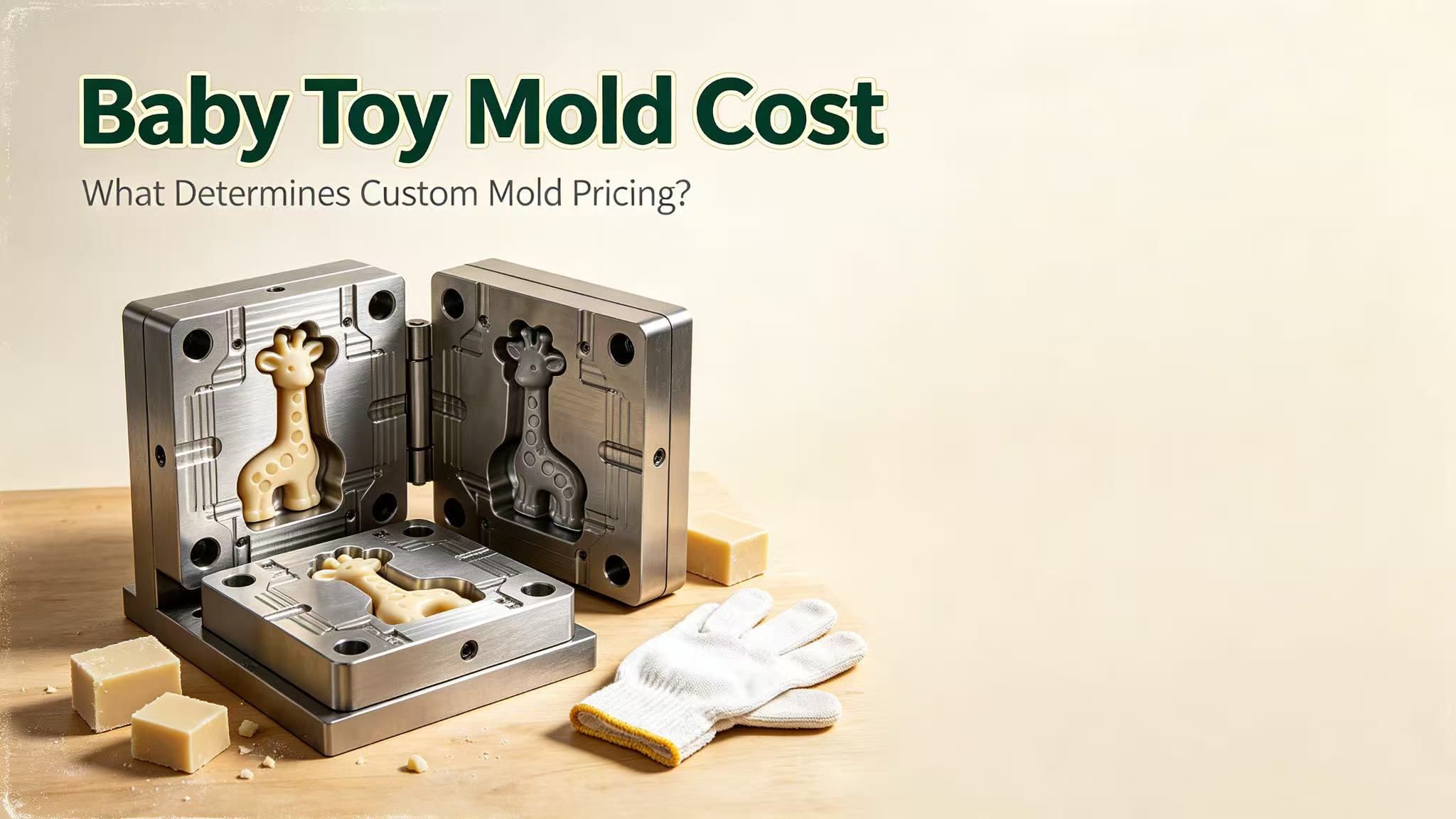
The mold is usually the single biggest fixed cost in a custom baby toy project. For natural rubber toys, a custom mold typically runs $1,500 to $5,000+, and a multi-cavity steel mold for higher volumes can land between $3,000 and $8,000. That is a significant amount the factory has to recover from your orders.
Two things matter here. Mold material first: aluminum molds are cheaper and fine for lower volumes; steel lasts longer and holds detail better but costs more to machine. Cavity count second: a mold with eight cavities produces eight toys per cycle, but it costs more to build. Factories set their MOQ partly to amortize that tooling cost over a realistic volume.
Here is the key twist: if you are paying for a new mold, the factory can sometimes run a much smaller initial batch, because they have already recovered their tooling cost through your mold fee. If the factory owns the mold — the ODM scenario — they need a bigger run to justify tying up that asset for your brand, often 2,000 to 5,000 units. This single fact explains why the same toy can carry very different MOQs depending on who owns the tooling.
Production
Every production run carries setup costs that have nothing to do with how many toys you order. The line has to be stopped, cleaned, and reconfigured. For dipped latex products, the molds have to be cleaned and sterilized, the dipping line calibrated, and the vulcanization ovens brought to temperature — natural rubber cures at 120–140°C for 20–30 minutes. The first pieces off the line are checked before full speed.
On a small run, all that setup spreads over very few units. On a 3,000-piece run, setup is a rounding error per toy. On a 300-piece run, it can dominate the unit cost. A factory also gives up production capacity for your job — and if your batch is small, that slot could have gone to a bigger customer. Batch scheduling is one reason MOQ minimums exist in the first place.
Packaging
Packaging is the cost driver buyers forget most often. Custom retail packaging has its own MOQ, often set by the printing house rather than the toy factory. Printed cartons, color boxes, hang tags, inserts, and barcode stickers all come with minimum print runs, and a custom die-cut box for an unusual toy shape is expensive at low volume.
If your packaging is standard — a stock carton with a printed label, say — the MOQ drops a lot. If you insist on a custom rigid box with a unique insert for your first 200-piece order, do not be surprised when the packaging MOQ alone exceeds your toy quantity. Smart brands separate these decisions: run the toy at a pilot MOQ, but keep packaging simple until the product proves itself.
Testing
Baby toys live under the strictest safety regimes in the consumer world. US-bound batches need to comply with ASTM F963 and CPSIA; the EU market means EN71. These are not one-time certificates — they are batch-level obligations, and third-party lab testing runs $300–$800+ per test round depending on scope.
The catch: a lab test costs the same whether it covers 100 toys or 5,000 toys. Certification, testing, and documentation are fixed costs, so the smaller your order, the heavier the per-unit testing burden. Change a color or a material blend and you often trigger retesting, which is another reason factories prefer you to freeze your spec before production rather than tweak it mid-run. This compliance load is baked into why baby toy MOQ numbers sit where they do.
Labor
Natural rubber toys are not a fully automated product. Even in a well-equipped factory, the process involves hand dipping or demolding, trimming excess flash along the parting lines, surface inspection, and often hand-painted details and manual packaging. That is real labor per unit, and labor behaves predictably.
Small orders hit labor costs twice. First, there is training and setup — teaching operators the new spec, adjusting the dipping cycle, calibrating the trim. Second, handwork per unit does not benefit from scale the way machine costs do. A factory quoting a low MOQ on a labor-heavy design is essentially eating that inefficiency, which is why they would rather run a bigger batch where the hand-finishing cost gets amortized. Designs with fewer manual steps — seamless one-piece molding, no separate small parts — are cheaper to run at lower volume.
Production efficiency
The last driver is the factory's own economics. A production line is most profitable when it runs steadily at high utilization. Changeovers eat time, and a factory juggling dozens of small custom orders loses more to setup than one running two or three large, predictable orders.
That is why factories reward volume and predictability with better prices, and why low MOQs come with a unit-price premium. It is not punishment — it is the honest cost of flexibility. The practical takeaway: the more you can look like a steady, predictable customer — forecasted reorders, consistent specs, grouped products — the more room a factory has to flex on MOQ.
The Math: How MOQ Sets Your Unit Price
Here is a simplified look at how fixed costs reshape unit price as volume climbs. Say the fixed cost for a production run is $1,800 (mold amortization, setup, testing, packaging setup) and the variable cost per unit is $0.90.
| Order size | Fixed cost per unit | Variable cost per unit | Approx. unit cost |
|---|---|---|---|
| 300 | $6.00 | $0.90 | $6.90 |
| 1,000 | $1.80 | $0.90 | $2.70 |
| 3,000 | $0.60 | $0.90 | $1.50 |
| 5,000 | $0.36 | $0.90 | $1.26 |
Jump from 500 to 1,000 units and per-unit cost typically drops 15–25%, because those fixed costs spread thinner. That is the whole story in one table: MOQ exists to keep unit cost sane, and your negotiation is about where you are willing to land on that curve.
How to Reduce MOQ Risk: What Actually Works
The strategies below are the ones that consistently work in practice for baby toy MOQ negotiation, especially for natural rubber baby toys. Some will surprise you, because they are not really about haggling harder — they are about changing what you are asking the factory to do.
Start with ODM, not OEM, for your first launch
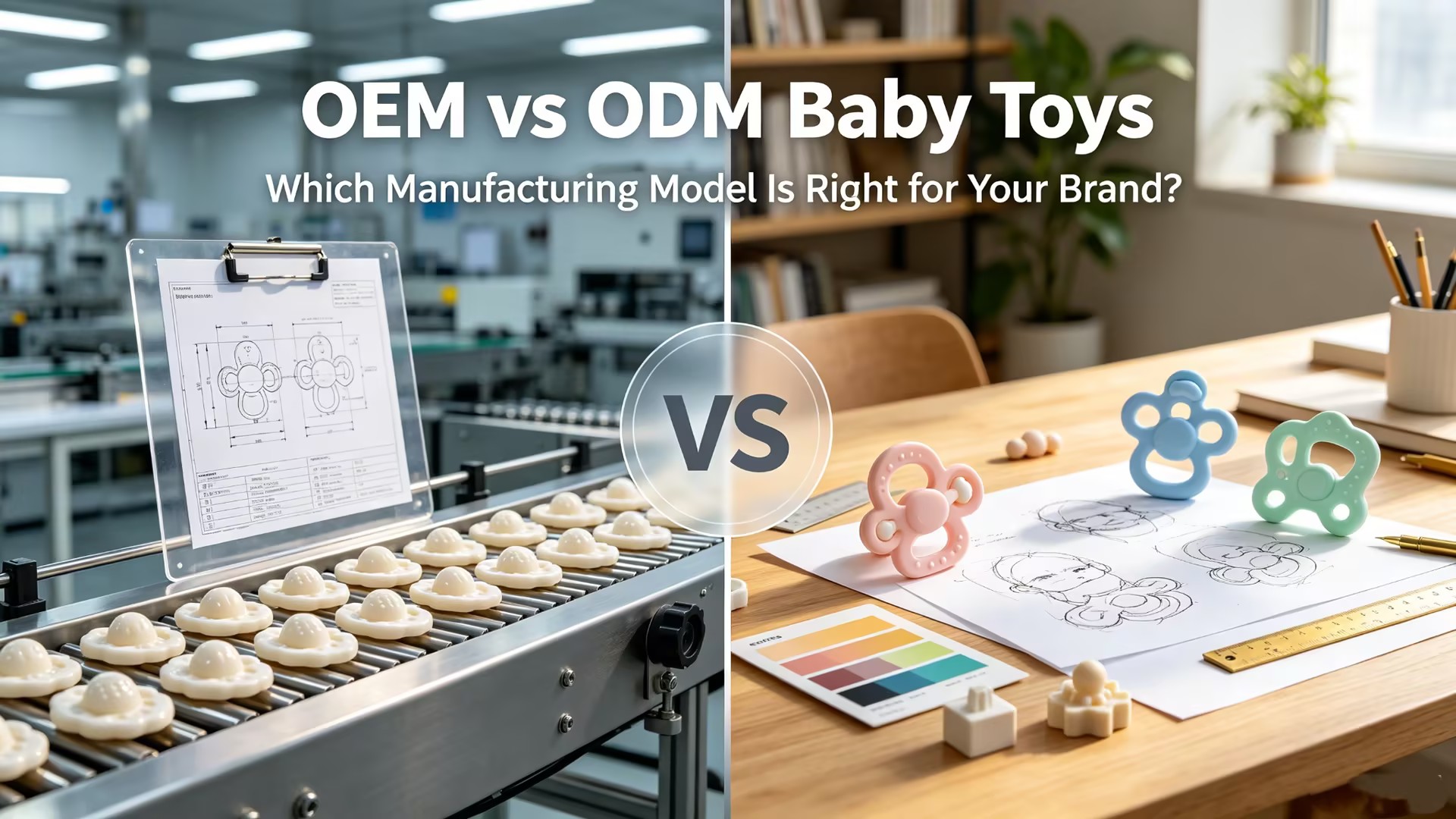
The fastest way to cut MOQ risk is to stop demanding a brand-new product. Choose an existing factory design, customize the branding, and you skip the custom mold cost entirely — the factory can combine your order with other clients using the same mold. That is why ODM MOQs run dramatically lower than OEM MOQs. Our guide to OEM vs ODM baby toys walks through the tradeoffs in detail, including how the choice shapes your mold, cost, speed, and MOQ.
For most first-time buyers, the smart sequence is: launch on ODM, validate demand, then invest in an exclusive OEM mold once you have reorder data.
Design for the mold you are already using
If you do go OEM, you can still keep tooling cheap. A simple design with one cavity family, standard sizes, and no undercuts costs far less to tool than a complex sculpt. Every extra cavity, texture, or moving part in the mold adds machining time and cost — and those costs show up as a higher MOQ. Work with the factory's engineers early on material hardness and shape simplification. A small design adjustment can save thousands in tooling and hundreds of units in MOQ.
Combine colors and SKUs into one batch
This is the most underused trick in toy sourcing. Instead of asking for a low MOQ on each color or each style, ask whether the factory will accept a combined quantity across your full product range. One order of 2,000 units across four colors — same mold, same compound — costs the factory barely more than a single 2,000-unit run. Many factories will accept a per-SKU minimum of 300–500 if your total order clears the overall threshold. You get market variety; they get production efficiency.
Keep packaging standard in phase one
Remember the packaging MOQ problem. In your first order, use stock cartons and a printed label rather than a custom rigid box. Once a SKU proves itself, upgrade the packaging. This is one of the fastest ways to lower both your MOQ and the cash you tie up in packaging that might not sell.
Offer a staged commitment instead of one big order
Factories are more flexible when they can see future volume. An annual volume agreement — say, 6,000 units across four quarterly orders — lets the factory plan capacity, and they will often accept a much smaller first shipment than they would for a one-off order. The first batch is a test; the commitment is the real order. This "test now, commit later" structure is how many new brands get to pilot MOQs of a few hundred units.
Negotiate around materials and deposits
Ask what is driving the factory's specific MOQ number. If it is the raw latex compound batch, offering a deposit on material can unlock a smaller run. If it is the mold, paying the tooling fee separately (as most OEM projects do) usually drops the per-order minimum. If it is packaging, trim it as described above. Find the constraint, and you have found the negotiation lever. Most MOQ numbers are actually a bundle of smaller minimums — material, mold, packaging, testing — and each one can be addressed on its own.
Diversify: one hero SKU, a wider ODM range
Finally, do not bet everything on one custom product. Carry one or two exclusive hero SKUs at a higher MOQ, balanced by a broader range of ODM or stock products at low MOQs. Your catalog gets depth, your cash is not locked in one tooling bet, and you build reorder leverage with the factory. Categories like newborn toys 0-3 months are popular low-MOQ starting points because the designs are proven and demand is steady.
Realistic MOQ Benchmarks for Baby Toys
To give you a sense of the landscape, here are typical ranges for natural rubber baby toys. Exact numbers vary by factory, but these are realistic planning figures for your baby toy MOQ:
| Model | Typical MOQ | Upfront cost | Lead time |
|---|---|---|---|
| Stock / ready-to-ship | 1–500 | Lowest | Fastest |
| ODM (existing mold + branding) | 300–1,000 | Low–medium | 6–10 weeks |
| OEM (custom mold, simple design) | 1,000–3,000 | High (tooling) | 10–16 weeks |
| OEM (custom mold, complex design) | 2,000–5,000 | Highest | 12+ weeks |
As a reference point, a Hevea rubber teething toy from a Guangdong factory lists an MOQ of 1,440 pieces, and many natural rubber teether listings on B2B platforms sit at 500 pieces. The lower end is usually ODM or stock; the higher end is custom tooling. If you are planning a first order, budget for the middle of the range and use the strategies above to pull it down.
Baby Toy MOQ FAQs
What is a good MOQ for baby toys?
For a first order, a realistic baby toy MOQ depends on the model. Stock or ODM products can start at 300–500 pieces; custom OEM projects usually need 1,000–3,000. If a factory quotes you under 300 on a fully custom toy, ask what they are sacrificing — it might mean a shared mold, simpler packaging, or a higher unit price.
Can I get a low MOQ for custom baby toys?
Yes, usually by paying the mold cost separately. When you own the tooling, the factory has already recovered their mold investment, so they can run a smaller batch — sometimes 500 units or less. The tradeoff is a higher per-unit price until volume climbs.
Does the MOQ apply per color or across my whole order?
That depends on the factory, so ask. Many will accept a combined MOQ across colors and styles if the products share the same mold and compound. This is one of the easiest ways to get more variety at a manageable minimum.
Why is my baby toy MOQ so high?
The usual suspects: a custom mold that is expensive to amortize, batch-level lab testing with fixed costs, minimum compound and packaging runs, and the factory's production efficiency. How the mold is owned alone can swing your MOQ by thousands of units.
What can I start with if I want a low-MOQ baby toy?
Look for ODM or stock items that are already in production, so you add your branding without paying for a new mold. A proven design such as our textured natural latex sensory ball is a typical starting point.
Before You Place Your First Order: A Quick Checklist
- Confirm who owns the mold — this single fact determines most of your MOQ.
- Ask for the MOQ breakdown: material, mold, packaging, testing. Negotiate each line.
- Start ODM or stock if you are new; reserve OEM for proven SKUs.
- Combine colors and SKUs into one batch to clear the overall threshold.
- Keep phase-one packaging standard.
- Offer a staged annual commitment to unlock a smaller first shipment.
- Freeze your spec before production to avoid retesting costs.
- Remember that a low MOQ means a higher unit price — make sure your margin can absorb it.
Conclusion
A baby toy MOQ is not a gatekeeping trick. It is the factory's honest math: molds cost money, latex compounds come in minimum batches, labs charge the same for 100 units as for 5,000, and a production line needs volume to run efficiently. Once you can see each of those costs, MOQ stops being a mystery and becomes something you can plan around.
The good news is the industry has built ways around it. ODM ranges, combined SKUs, staged commitments, and smart packaging choices all let a small brand start with a sensible risk profile and scale up as demand proves out. We have helped brands at every stage — from first 500-piece pilot orders to exclusive OEM lines — and we are happy to walk you through what is realistic for your product. We are a natural rubber toy manufacturer with in-house mold making, dipping molding, and testing, so we can show you the actual numbers behind your quote.
If you are staring at a MOQ that feels too high, send us your product idea and target quantity. We will break down the cost drivers, tell you honestly what is flexible, and help you find a first order you can actually absorb.
Custom Natural Rubber Baby Toys: From Product Idea to Mass Production
Low MOQ Baby Toys: How New Brands Can Test Products with Less Risk
Related Article