Wholesale Baby Toys: Complete Sourcing Guide for Retailers & Brands

Sourcing wholesale baby toys is one of the highest-impact decisions for retailers, distributors, e-commerce brands, and baby product companies. The right products, sourced from the right supplier at the right price, can drive repeat purchases, premium margins, and loyal customers. The wrong sourcing decisions — poor quality, compliance gaps, inflated costs, or unreliable shipping — can lead to stockouts, returns, regulatory penalties, and eroded brand trust.
This guide is a complete end-to-end resource for sourcing wholesale baby toys in 2026. It walks through every stage of the procurement process: product selection, supplier evaluation, MOQ, pricing, safety testing, packaging, and shipping logistics. Whether you are a boutique retailer placing your first order or an established brand scaling into new markets, this framework will help you source with confidence, control costs, and build a supply chain that grows with you.
1. Product Selection: Choosing the Right Products for Your Market
Before you contact a single supplier, you need a clear product strategy. Wholesale baby toys span dozens of categories, and the right mix depends on your target customer, price point, sales channel, and market trends.
Core Wholesale Baby Toy Categories
| Category | Typical Age | Key Materials | Why It Sells |
|---|---|---|---|
| Teethers & teething toys | 3–18 months | Natural rubber, silicone, wood | High repeat demand, essential baby item, strong natural-material trend |
| Sensory toys | 0–24 months | Natural rubber, fabric, silicone | Screen-free movement, developmental benefits, gift appeal |
| Bath toys | 6–36 months | Natural rubber, plastic | Daily-use category, strong repeat purchase, gifting |
| Stacking & nesting toys | 6–24 months | Wood, silicone, plastic | Open-ended play, developmental value, long product life |
| Rattles & shakers | 0–12 months | Natural rubber, wood, fabric | Classic newborn gift, low price point, high attach rate |
| Activity gyms & play mats | 0–12 months | Fabric, wood, plastic | Higher ticket item, strong gifting, nursery essential |
| Plush & soft toys | 0+ months | Organic cotton, fabric | Emotional connection, gift staple, brand loyalty driver |
How to Select Products for Wholesale
Start with market research. Identify which categories are growing in your target region — in 2026, screen-free sensory toys, natural rubber and organic material products, and eco-friendly packaging are showing the strongest growth across the US, EU, and UK. Analyze competitor assortments, read customer reviews on Amazon and other marketplaces to identify unmet needs, and pay attention to what boutique baby stores and premium retailers are featuring.
Then evaluate each potential product on five criteria:
- Demand: Is there proven consumer demand, or is this an untested concept? Look for search volume, marketplace sales data, and trend signals.
- Margin potential: Can you achieve a 2.5–4x markup at retail? Products with high perceived value (natural materials, developmental design, premium packaging) typically support stronger margins.
- Compliance risk: Does the product category have complex safety requirements? Toys for under-36 months face the strictest small parts and chemical testing requirements.
- Shipping efficiency: Is the product dense and stackable, or bulky and fragile? Shipping cost as a percentage of product value dramatically affects landed cost.
- Differentiation: Can you differentiate through branding, packaging, material choice, or design? Commodity products compete on price alone; differentiated products build brand equity.
For brands focused on natural and sustainable positioning, natural rubber latex toys are an especially strong wholesale category — they combine material safety, eco-friendly credentials, tactile sensory benefits, and premium perceived value in a single product.
2. Supplier Selection: Finding the Right Wholesale Partner
Your supplier is the foundation of your wholesale baby toy business. The right supplier protects your margins, ensures compliance, delivers on time, and grows with you. The wrong supplier causes delays, defects, compliance failures, and customer complaints.
Types of Suppliers
There are three primary supplier models for wholesale baby toys:
1. Direct manufacturers / factories: The company that actually produces the toys. Working direct gives you the lowest unit cost, maximum customization (OEM/ODM), and direct control over quality and production. However, factories typically have higher MOQs and require more hands-on management from the buyer.
2. Trading companies / exporters: Intermediaries that source from multiple factories and handle export logistics. Trading companies offer lower MOQs, one-stop sourcing across multiple product categories, and often better English communication and customer service. But they add a margin layer (typically 10–20%), and you have less visibility into the actual factory.
3. Wholesale distributors (in your country): Local or regional distributors that import in bulk and resell in smaller quantities. This model offers the lowest MOQs, fastest shipping (no ocean freight), and simplest logistics. But unit prices are significantly higher, and customization/private label options are limited.
For most brands and retailers, the optimal strategy is a hybrid: start with a trading company or domestic distributor for trial orders and market testing, then transition to direct factory sourcing once you have validated demand and can meet factory MOQs.
How to Evaluate a Wholesale Supplier
When evaluating potential suppliers, assess them on these core dimensions:
- Manufacturing experience: How long have they produced baby toys? Do they specialize in your target categories?
- Material capability: Can they work with your required materials (natural rubber, silicone, wood, organic cotton)?
- Product development: Do they offer in-house R&D, 3D prototyping, and mold making?
- Safety testing: Can they provide ASTM F963, EN 71, CPSIA, and other required test reports from accredited labs?
- Quality control: What is their IQC/IPQC/FRI process? Do they have an in-house lab?
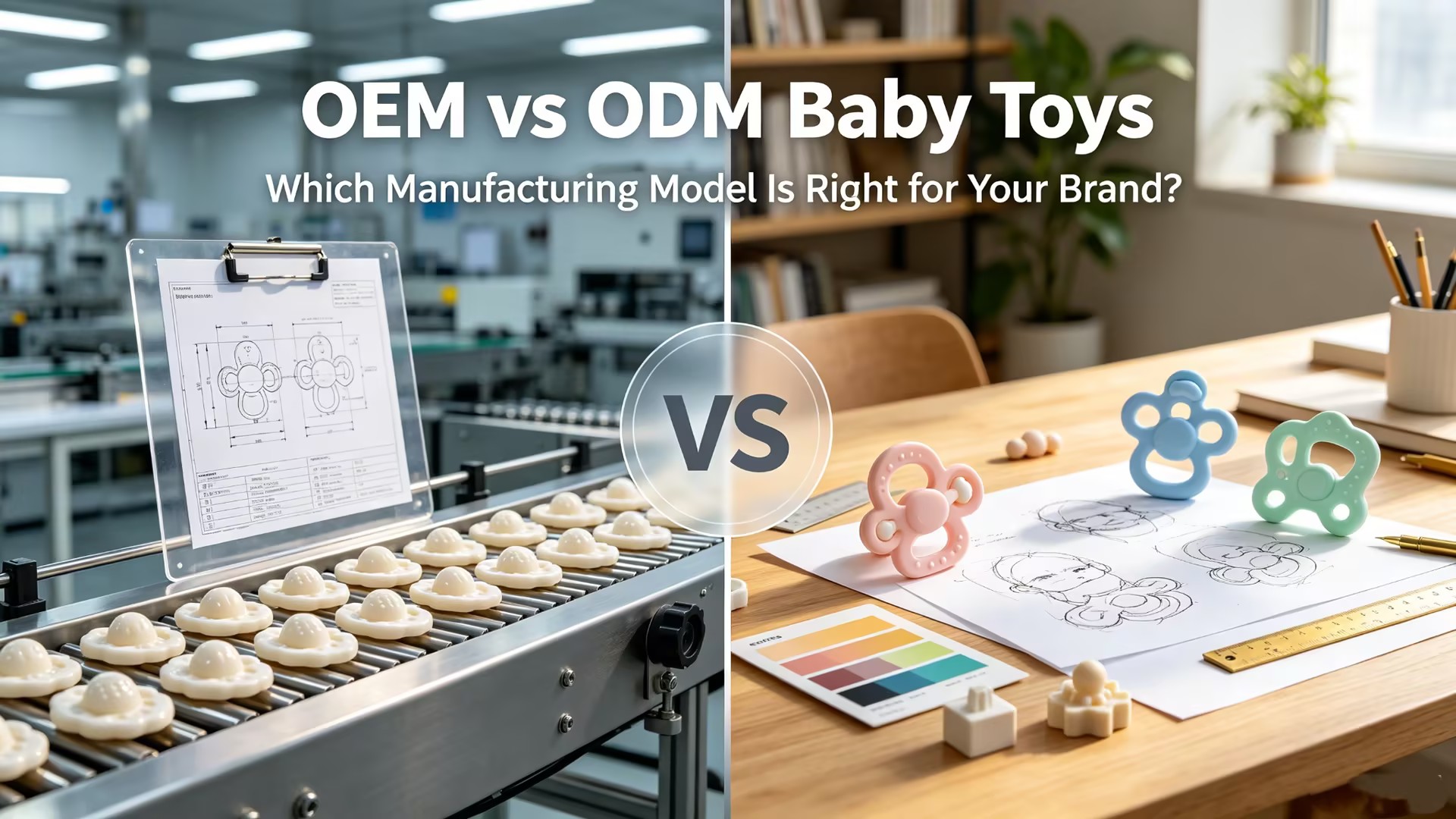
- OEM/ODM capability: Can they support custom molds, colors, logos, and packaging?
- Production capacity: What is their monthly output, and can they scale for peak season?
- Communication: Is there a dedicated English-speaking contact? How responsive are they?
- Certifications: ISO 9001, ISO 14001, BSCI/SMETA, and product safety certifications.
- References: Can they provide 2–3 client references in similar markets?
Always request samples before placing a wholesale order. Evaluate the sample for material quality, workmanship, dimensions, weight, texture, and packaging. Compare samples from 2–3 suppliers side by side — the difference in quality is often visible and tangible.
3. MOQ & Order Size: Finding the Right Volume
Minimum Order Quantity (MOQ) is one of the most negotiated terms in wholesale baby toy sourcing. Understanding MOQ dynamics helps you place the right-sized order — large enough to get good pricing, small enough to manage inventory risk.
Typical MOQ Ranges
| Order Type | Typical MOQ | Notes |
|---|---|---|
| Stock / catalog items (direct factory) | 500–2,000 pcs/SKU | Some factories offer mixed-SKU MOQs (e.g., 3,000 pcs total across 5 SKUs) |
| Custom color / logo on existing mold | 1,000–3,000 pcs/SKU | Color matching and custom printing require minimum runs |
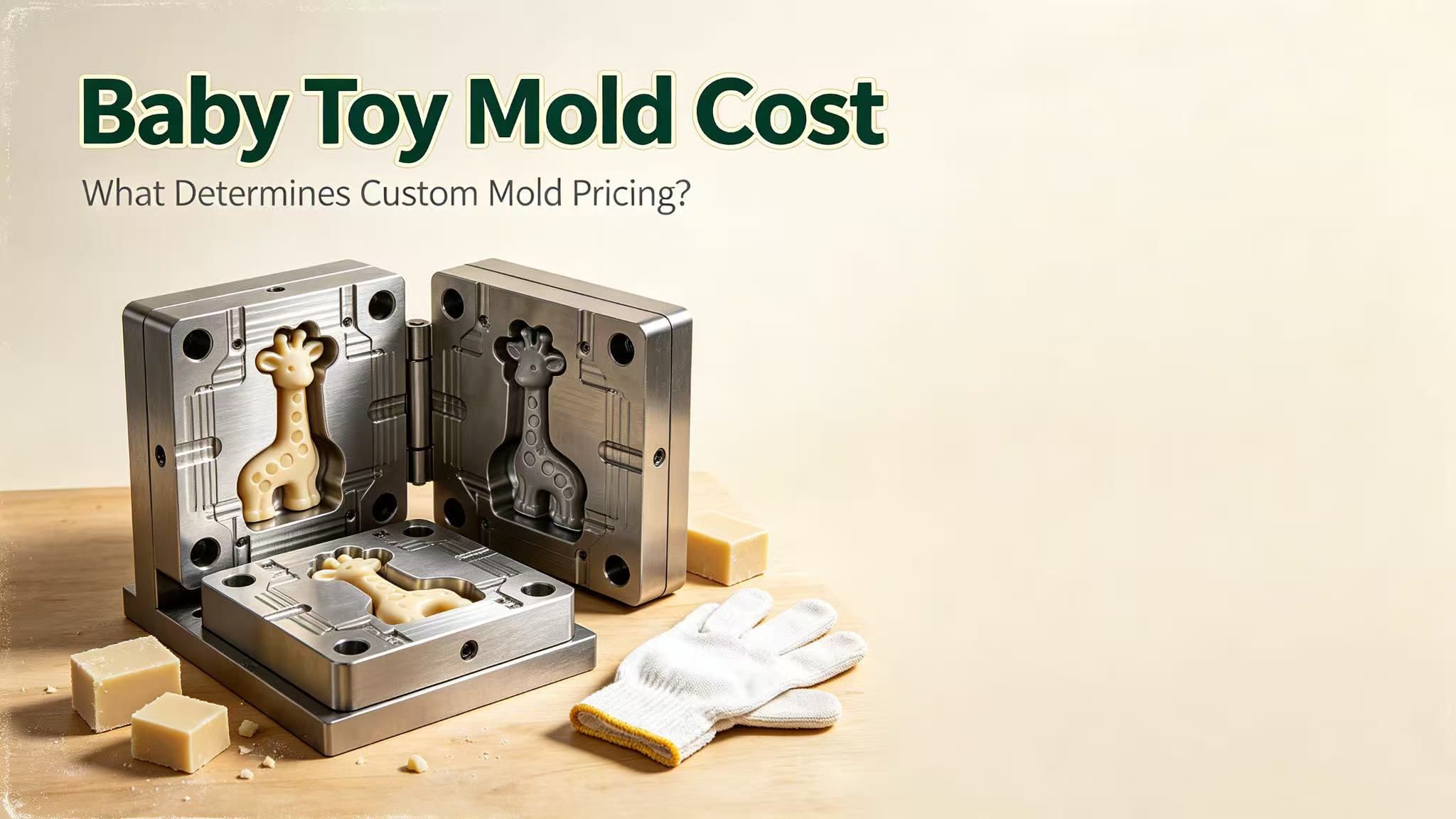
| Fully custom mold / new product | 3,000–10,000 pcs/SKU | Plus mold fees ($500–$5,000 depending on complexity) |
| Trading company | 100–500 pcs/SKU | Higher unit price but lower minimums |
| Domestic distributor | 10–100 pcs/SKU | Highest unit price, no ocean freight, fastest delivery |
MOQ Negotiation Strategies
- Start with trial orders: Many suppliers will accept a smaller first order if you commit to larger repeat orders. Ask for a "trial MOQ" explicitly.
- Mix SKUs: If a supplier requires 3,000 pieces per order but you only want 500 of each SKU, ask if you can mix 6 SKUs to meet the total.
- Use existing molds: Choosing from the supplier's existing product catalog eliminates mold fees and often lowers MOQ.
- Amortize mold fees: Negotiate mold fee refunds or credits after reaching volume milestones (e.g., mold fee credited after 10,000 units).
- Phase your orders: Place a smaller first order to validate market demand, then scale up on reorders when you have sales data.
- Leverage competition: Get quotes from 2–3 suppliers and use competing MOQ terms as negotiation leverage.
For new brands, the most common mistake is ordering too much inventory upfront. Start conservatively — a sell-out is better than a warehouse full of slow-moving stock. You can always reorder; you cannot easily return excess inventory.
4. Pricing & Margins: Understanding the True Cost
The unit price quoted by a supplier is only the beginning of your cost calculation. To price your products profitably, you need to understand the full landed cost — the total cost to get the product into your warehouse or fulfillment center — and build your retail pricing from there.
Cost Components of Wholesale Baby Toys
| Cost Component | Typical Range | Notes |
|---|---|---|
| Product unit cost (FOB) | $1.50–$8.00 | Varies by material, complexity, and order volume. Natural rubber teethers: $2–$5. Bath toys: $1.50–$4. Activity gyms: $8–$20. |
| Mold fee (custom only) | $500–$5,000 | One-time, amortized over total production volume |
| Custom packaging | $0.30–$2.00/unit | Retail boxes, inserts, printing. Stock packaging is often included or minimal. |
| Third-party testing | $300–$1,500/test | Per product, per market. May be shared across similar SKUs. |
| Ocean freight (LCL) | $0.20–$1.50/unit | Depends on volume, route, and season. FCL is cheaper per unit. |
| Insurance | 0.5–2% of cargo value | Always insure ocean shipments |
| Customs duties & tariffs | 0–15%+ of product value | Varies by HS code and country. US: toys typically 0–5%. Check current rates. |
| Customs broker / fees | $100–$300/shipment | Plus any exam or storage fees |
| Inland transport (port to warehouse) | $0.10–$0.80/unit | Trucking from port to your facility or 3PL |
| Quality inspection (third-party) | $150–$300/inspection | Pre-shipment inspection by companies like SGS or QIMA |
Margin Calculation
Once you have the full landed cost per unit, calculate your target retail price using the standard markup formula:
Landed Cost × Markup = Wholesale Price × Markup = Retail Price
Typical markups in the baby toy industry:
- Brand to retailer (wholesale): 2.0–2.5x landed cost
- Retailer to consumer (retail): 2.0–2.5x wholesale price
- Direct-to-consumer (brand sells retail): 3.0–5.0x landed cost
For example: a natural rubber teether with a landed cost of $3.50 could wholesale for $7.00–$8.75 and retail for $14.00–$21.99. DTC brands selling the same product directly could price at $14.99–$19.99 with significantly higher margins.
Pricing Negotiation Tips
- Always get quotes from at least 3 suppliers for comparison.
- Ask for tiered pricing (price breaks at 1k, 3k, 5k, 10k units).
- Negotiate payment terms — 30% deposit / 70% before shipment is standard; established buyers may get Net 30 or Net 60.
- Factor in currency risk if paying in USD or EUR — consider hedging for large orders.
- Ask about annual rebates or volume incentives for committed annual spend.
5. Testing & Compliance: Non-Negotiable for Baby Toys
Baby toys are among the most heavily regulated consumer products in the world. Non-compliant products can be detained at customs, recalled from retail, and expose your business to legal liability. Testing and compliance are not optional cost centers — they are the price of market access.
Key Safety Standards by Market
| Market | Core Standards | Key Requirements |
|---|---|---|
| United States | ASTM F963-23, CPSIA | Mechanical/physical safety, heavy metals, lead (100 ppm substrate / 90 ppm paint), 6 phthalates, small parts, third-party testing + CPC for ages 12 and under |
| European Union | EN 71 series, Toy Safety Directive 2009/48/EC, REACH | EN 71-1 (mechanical), EN 71-2 (flammability), EN 71-3 (19 elements migration), EN 71-12 (nitrosamines for rubber), CE marking + DoC |
| United Kingdom | UK Toys (Safety) Regulations 2011 | UKCA marking, UK responsible person, aligned with EN 71 |
| Canada | CCPSA, Toys Regulations (SOR/2011-17) | Bilingual labeling, mechanical/chemical safety |
| Australia / NZ | AS/NZS ISO 8124 | Mandatory warning labels, aligned with EN 71 |
Testing Best Practices for Wholesale Buyers
- Require test reports up front: Any supplier you work with should provide current test reports from accredited labs (SGS, Intertek, Bureau Veritas, TÜV). Reports should be less than 12 months old and cover your specific product and material.
- Verify batch-level testing: Generic product-level test reports are a starting point, but for high-volume orders, ask for testing tied to your specific production batch.
- Budget for independent testing: For your first order with a new supplier, conduct your own independent third-party testing. The cost ($300–$1,500 per product) is cheap insurance against compliance failures.
- Retest after material changes: If a supplier changes raw material sources, pigments, or processing, require retesting. Material substitutions are the #1 cause of compliance failures.
- Maintain documentation: Keep all test reports, CPCs, DoCs, and supplier declarations on file for the legally required retention period (5 years in the US, 10 years in the EU).
- Label correctly: Ensure age grading, choking hazard warnings, tracking labels (CPSIA), CE/UKCA marks, and Country of Origin are all present and correct.
6. Packaging: Retail-Ready, E-commerce-Ready, and Compliant
Packaging serves three critical functions in wholesale baby toys: it protects the product during shipping, it communicates brand and product information at retail, and it must comply with regulatory labeling requirements. Getting packaging right affects your logistics costs, your conversion rate, and your compliance standing.
Packaging Options for Wholesale
Bulk / polybag packaging: The simplest and cheapest option. Each toy is in a plain polybag, shipped in master cartons. Suitable for distributors who do their own retail packaging, or for products sold unpackaged (e.g., bath toys in bin displays). Lowest cost, but no retail readiness.
Header card / hang tag: A printed card stapled or folded over the polybag, with a hang hole for retail display. Low cost, retail-ready, but limited branding space and less protection.
Retail box: A printed cardboard box (tuck-end, hang box, or window box) with full-color graphics, product information, and regulatory markings. Premium appearance, best for retail shelves and gifting, but higher cost and larger shipping volume.
Blister / clamshell pack: A plastic blister sealed to a printed backer card. Excellent product visibility, tamper-evident, but higher cost and less eco-friendly.
Eco-friendly packaging: Kraft paper boxes, molded pulp inserts, FSC-certified paper, soy-based inks, organic cotton bags, and plastic-free options. Growing consumer demand, premium positioning, and increasingly required by major retailers and EU regulations (PPWR).
Gift set / multi-pack: Curated combinations of multiple toys in a single package. Higher average order value, strong gifting appeal, but higher unit cost and more complex logistics.
Packaging Requirements by Sales Channel
| Channel | Packaging Priorities |
|---|---|
| Physical retail | Shelf appeal, hang hole or stackable, clear age grading, regulatory markings, brand visibility |
| Amazon FBA | Frustration-free packaging (FFP), barcodes, suffocation warnings on polybags, durable for fulfillment, no excess void |
| Shopify / DTC | Unboxing experience, premium materials, brand storytelling, protective for direct shipping |
| Wholesale / distributor | Master carton labeling, SKU codes, case pack quantities, UPC/EAN barcodes |
| Marketplace (eBay, Etsy) | Clear product labeling, protective packaging, low shipping volume |
Packaging Cost-Saving Tips
- Right-size your packaging — excess air increases shipping cost and environmental impact.
- Use standard box sizes to avoid custom tooling costs.
- Consolidate printing runs — print packaging for multiple SKUs together if designs share elements.
- Ask your supplier for packaging design support — many offer free dieline templates and structural design.
- For Amazon FBA, follow FFP guidelines to avoid prep fees and qualify for premium badges.
7. Shipping & Logistics: From Factory to Your Warehouse
Shipping and logistics are where many wholesale buyers encounter unexpected costs and delays. Understanding your shipping options, Incoterms, and the full import process will help you plan accurately and avoid surprises.
Shipping Methods
Ocean freight (FCL — Full Container Load): The most cost-effective method for large orders. A 40-foot container holds roughly 5,000–20,000 baby toys depending on size. Transit time: 25–40 days (Asia to US/EU). Best for established brands with predictable volume.
Ocean freight (LCL — Less than Container Load): Your shipment shares a container with other cargo. More expensive per unit than FCL but accessible for smaller orders. Transit time: 30–45 days (includes consolidation and deconsolidation). Best for orders that don't fill a container.
Air freight: Fast (5–10 days) but significantly more expensive (3–5x ocean cost per kg). Best for urgent restocks, high-value low-weight products, or first orders to beat a seasonal deadline.
Express courier (DHL, FedEx, UPS): Fastest (3–7 days), door-to-door, but most expensive. Best for samples, small trial orders, or emergency restocks.
Rail freight (China to Europe): A middle ground between ocean and air — 15–20 days transit, cost between ocean and air. Available for EU-bound shipments via the China-Europe rail network.
Incoterms: Who Pays for What
Incoterms define the responsibilities of buyer and seller in international shipping. The most common terms for wholesale baby toys:
| Incoterm | Seller Responsibility | Buyer Responsibility |
|---|---|---|
| EXW (Ex Works) | Make goods available at factory | Everything from factory pickup onward (most control, most work) |
| FOB (Free On Board) | Deliver goods to port, load on vessel, pay export clearance | Ocean freight, insurance, import clearance, delivery (most common) |
| CIF (Cost, Insurance, Freight) | FOB + ocean freight + insurance to destination port | Import clearance, duties, delivery from port |
| DDP (Delivered Duty Paid) | Everything — door-to-door, including duties and taxes | Receive goods (simplest, highest cost, least control) |
FOB is the most common and recommended term for experienced buyers — it gives you control over freight costs and shipping choice while the supplier handles export logistics. DDP is simplest but typically the most expensive and gives you the least visibility into actual costs.
Import Process Checklist
- Confirm HS code: Determine the correct Harmonized System code for your products to calculate duties and ensure compliance.
- Book freight: Work with a freight forwarder 2–3 weeks before production completion.
- Arrange insurance: Always insure cargo — ocean freight insurance costs ~0.5–2% of cargo value.
- Prepare documentation: Commercial invoice, packing list, bill of lading, certificate of origin, test reports/CPC/DoC.
- Hire a customs broker: A licensed broker handles clearance, duty payment, and compliance with import regulations.
- Track shipment: Monitor vessel ETA and prepare warehouse/3PL receiving.
- Inspect on arrival: Check carton counts, condition, and verify against packing list before signing off.
Shipping Cost-Saving Strategies
- Plan orders 3–4 months ahead to use ocean freight instead of air.
- Optimize packaging dimensions to maximize carton and container fill rate.
- Consolidate multiple SKUs from one supplier into a single shipment.
- Compare freight forwarders — rates vary significantly, and loyalty discounts are available.
- Avoid peak season (August–October) when ocean rates spike and capacity is tight.
- Use FCL once your order volume fills a container — it is dramatically cheaper per unit than LCL.
Wholesale Baby Toys Sourcing Checklist
Use this checklist for every wholesale order:
Product Selection ☐ Market research completed ☐ Category demand validated ☐ Margin potential calculated ☐ Compliance risk assessed ☐ Differentiation strategy defined
Supplier ☐ 2–3 suppliers shortlisted ☐ Samples ordered and evaluated ☐ Factory audit or virtual tour completed ☐ Client references checked ☐ Certifications verified (ISO 9001, BSCI/SMETA)
MOQ & Order ☐ MOQ confirmed (and negotiated if needed) ☐ Trial order option explored ☐ Mixed-SKU possibility confirmed ☐ Mold fee policy understood ☐ Payment terms agreed (30/70 or better)
Pricing ☐ 3+ quotes compared ☐ Tiered pricing obtained ☐ Full landed cost calculated (product + packaging + testing + freight + duties + broker) ☐ Retail/wholesale pricing model validated ☐ Currency risk considered
Testing & Compliance ☐ Supplier test reports reviewed (ASTM F963, EN 71, CPSIA) ☐ Independent testing budgeted for first order ☐ Labeling requirements confirmed (age, warnings, tracking, CE/UKCA, Country of Origin) ☐ Documentation retention plan in place
Packaging ☐ Packaging type selected (polybag, header, retail box, eco) ☐ Dieline templates obtained ☐ Regulatory markings included ☐ Channel-specific requirements met (FBA, retail, DTC) ☐ Packaging sample approved before mass production
Shipping ☐ Shipping method selected (FCL/LCL/air/express) ☐ Incoterms agreed (FOB recommended) ☐ Freight forwarder engaged ☐ Customs broker engaged ☐ Cargo insurance arranged ☐ HS codes confirmed ☐ Warehouse/3PL receiving scheduled
Ready to Source Wholesale Baby Toys?
Sourcing wholesale baby toys is a multi-stage process that rewards preparation and due diligence. By systematically working through product selection, supplier evaluation, MOQ, pricing, testing, packaging, and shipping, you can build a supply chain that delivers quality products, healthy margins, and reliable delivery — while staying compliant with the strict safety regulations that govern the juvenile products industry.
The most successful wholesale buyers treat sourcing as an ongoing partnership rather than a one-time transaction. They invest time in finding the right supplier, they communicate clearly, they inspect quality at every stage, and they build long-term relationships that yield preferential pricing, priority production slots, and collaborative product development. The cheapest quote is rarely the best long-term value — the right supplier, at a fair price, with consistent quality and reliable communication, will outperform a low-cost competitor on every metric that matters.
Whether you are a retailer curating your first baby toy assortment, a distributor expanding into natural and sensory categories, or a brand building a private label line, the principles in this guide will help you source with confidence and build a product line that parents trust and retailers want to stock.
Ready to Source Wholesale Baby Toys?
Connect with an experienced OEM natural rubber baby toy manufacturer offering wholesale, private label, and custom OEM services. Request a quote with pricing, MOQ, lead time, and packaging options.
Request a Wholesale QuoteWholesale Natural Rubber Baby Toys for Retailers & Baby Brands
How to Choose a Baby Toy Manufacturer: 12 Questions to Ask