How to Choose a Natural Rubber Baby Toy Supplier

For brands, distributors, and retailers entering the natural rubber baby toy market, the single most important decision is not which product to launch first — it is which natural rubber baby toy supplier to partner with. The right supplier becomes an extension of your brand: they protect your margins, ensure regulatory compliance, deliver consistent quality, and scale with you as you grow. The wrong supplier can trigger customs seizures, product recalls, chargebacks, and reputational damage that takes years to repair.
This guide walks B2B buyers through the ten critical factors to evaluate when selecting a natural rubber baby toy supplier: material quality, product design, safety testing, MOQ, OEM capability, packaging, quality control, lead time, factory capability, and certifications. We conclude with a practical evaluation checklist and a clear next step for buyers ready to move forward.
1. Material Quality: The Foundation of Every Product
Natural rubber baby toys live or die by the quality of their raw material. Not all natural rubber latex is equal — and the difference between premium and substandard latex shows up in product performance, safety test results, and customer satisfaction.
When evaluating a supplier, start by asking where their latex comes from. Premium suppliers source concentrated natural latex from certified plantations in Southeast Asia — primarily Thailand, Indonesia, and Vietnam — where climate and soil quality produce latex with high elasticity, low impurity levels, and consistent cure behavior. Lower-tier suppliers may use blended latex, recycled rubber, or synthetic rubber (SBR) mixed with natural rubber to reduce cost. These blends can fail tear strength tests, emit unpleasant odors, and degrade faster under UV exposure and repeated chewing.
Key material questions to ask every supplier:
- What is the source region and plantation certification for your natural latex?
- Do you use 100% natural rubber, or a blend with synthetic rubber?
- What is the deproteinization process, and what is the residual protein level (target: below 50 μg/g)?
- What preservation method do you use (ammonia level, low-ammonia, or ammonia-free)?
- Can you provide material safety data sheets (MSDS) and raw material test reports?
For a deeper understanding of why material quality matters for both safety and market positioning, Why Natural Rubber Baby Toys Are the Future of Safe Parenting Choices compares natural rubber with synthetic materials and explains the properties that make premium latex the gold standard for baby toys.
2. Product Design & Development: From Concept to Prototype
A supplier's design and development capability determines whether you can bring unique, market-differentiated products to life — or whether you are limited to choosing from a catalog of generic stock items. For brands building a proprietary product line, in-house R&D and mold-making capability are non-negotiable.
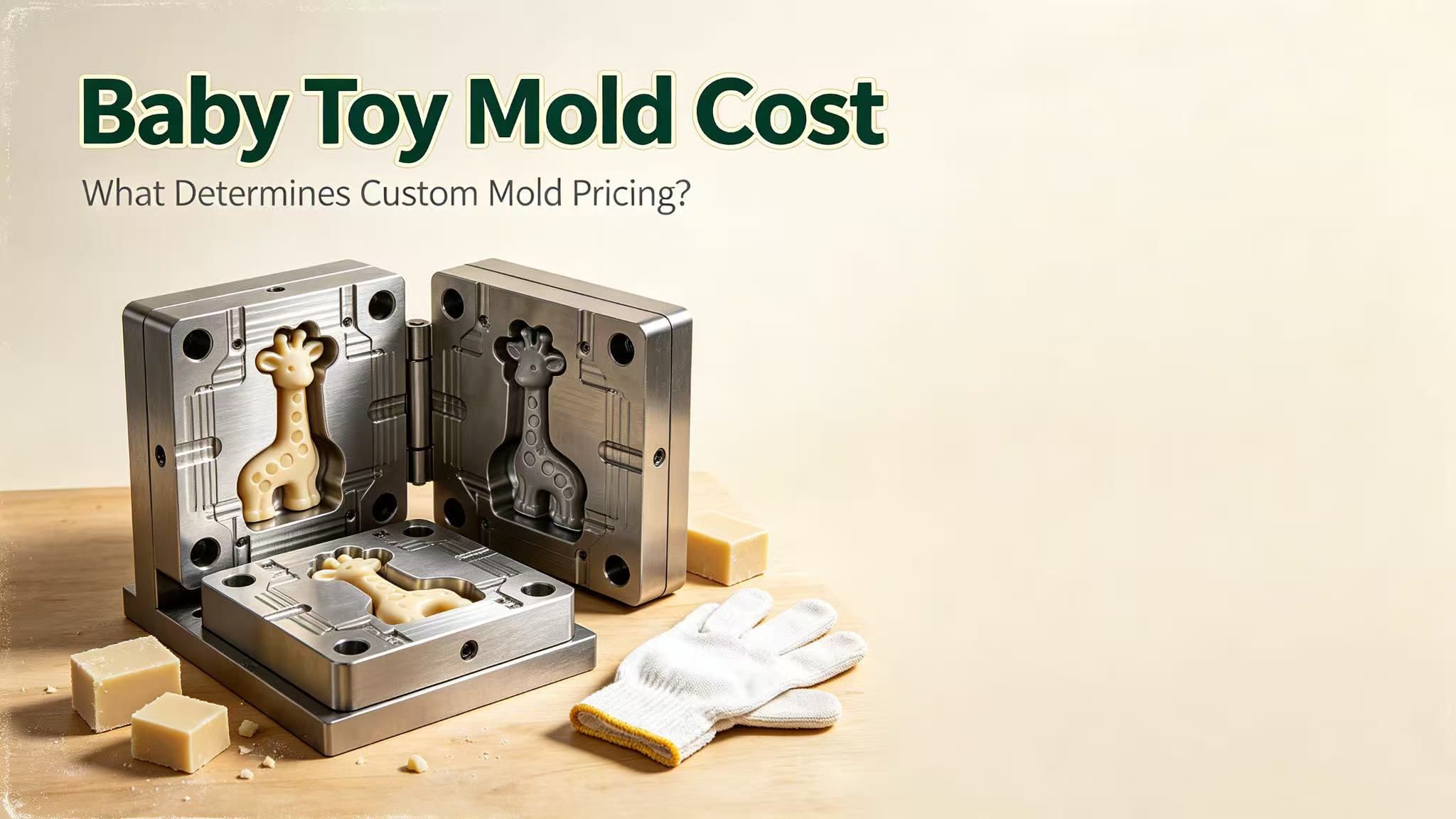
Strong natural rubber toy suppliers offer end-to-end product development: 3D modeling, prototype fabrication (often using 3D printing or silicone prototyping for rapid iteration), mold design and fabrication, and pilot production runs. They should be able to advise on design for manufacturability (DFM) — wall thickness recommendations, draft angles, mold parting line placement, and texture feasibility — before you commit to expensive tooling.
Design considerations specific to natural rubber baby toys include:
- Wall thickness: Too thin and the product tears; too thick and it becomes rigid and heavy. Typical range: 1.5–3.0 mm depending on product type.
- Seamless construction: One-piece molded designs eliminate detachable parts and choking hazards — a major advantage for under-36-month products.
- Textured surfaces: Raised bumps, ribbed bands, and soft spurs support tactile exploration and teething relief, but must be designed to avoid sharp edges and trap points.
- Internal features: Rattle chambers, squeaker mechanisms, and crinkle elements require careful design to ensure they cannot be accessed or ingested.
- Color matching: Natural rubber accepts food-safe mineral pigments, but color saturation and opacity differ from plastic. Expect Pantone matching with a tolerance range.
As a product example of thoughtful natural rubber design, the Textured Natural Latex Sensory Ball for Babies demonstrates how multiple raised textures, a seamless one-piece construction, and a perfectly round, easy-to-grasp shape come together in a production-ready SKU — serving as a benchmark for evaluating a supplier's design output.
3. Safety Testing & Compliance: Non-Negotiable for Market Access
Safety compliance is not a marketing feature — it is the price of admission to every major baby toy market. A supplier that cannot provide valid, up-to-date test reports from accredited third-party laboratories is a supplier you should walk away from, regardless of price.
The two most important standards for natural rubber baby toys are:
| Standard | Market | Key Requirements |
|---|---|---|
| ASTM F963-23 | United States | Mechanical/physical safety, flammability, heavy metal migration, total lead (100 ppm substrate / 90 ppm paint), phthalates (6 restricted), small parts, age grading. Mandatory under 16 CFR Part 1250. Third-party testing + Children's Product Certificate (CPC) required for ages 12 and under. |
| EN 71 series | European Union | EN 71-1 (mechanical/physical), EN 71-2 (flammability), EN 71-3 (migration of 19 elements), EN 71-12 (nitrosamines). CE marking + EU Declaration of Conformity required. Also subject to REACH chemical restrictions. |
Additional market requirements include: UKCA marking (United Kingdom), CCPSA (Canada), AS/NZS ISO 8124 (Australia/New Zealand), and ST Mark / Food Sanitation Act (Japan). For natural rubber specifically, nitrosamine testing (EN 71-12) is particularly important because traditional vulcanization accelerators can form nitrosamines — a supplier using low-nitrosamine or nitrosamine-free accelerator systems will have a clear compliance advantage.
Critical safety questions for every supplier:
- Can you provide test reports from ISO/IEC 17025 accredited laboratories (SGS, Intertek, Bureau Veritas, TÜV)?
- Are test reports tied to specific production batches, or only to generic product-level samples?
- What is your retesting frequency? (Best practice: every 6 months or after any material/process change.)
- Do you issue CPC (US) / DoC (EU) documentation with each shipment?
- What is your nitrosamine control strategy?
- How do you handle product recalls and regulatory notifications?
4. MOQ Flexibility: Matching Order Size to Your Business Stage
Minimum Order Quantity (MOQ) is one of the most frequently negotiated terms in natural rubber toy sourcing — and for good reason. Natural rubber production involves mold setup, compound formulation, and production line scheduling that create fixed costs per run, so suppliers naturally prefer larger orders. But for new brands, first-time importers, or buyers testing a new category, a high MOQ can be a dealbreaker.
Typical MOQ ranges in the natural rubber baby toy industry:
- Stock / catalog items: 500–2,000 pieces per SKU (some suppliers offer mixed-SKU MOQs across a category).
- Custom color / logo on existing mold: 1,000–3,000 pieces per SKU.
- Fully custom mold / new product: 3,000–10,000 pieces per SKU, plus mold fees (typically $500–$3,000 depending on complexity).
When evaluating MOQ, look beyond the headline number. A supplier that offers a low MOQ but charges a significant unit price premium, or that requires you to absorb mold fees upfront with no amortization, may not be better than a supplier with a higher MOQ but lower unit cost and mold fee credits after volume thresholds. Ask about:
- Mixed-container or mixed-SKU MOQ options for trial orders.
- Mold fee amortization or refund after reaching volume milestones.
- Sample order terms (many suppliers offer free samples with buyer-paid freight).
- Repeat order MOQs (often lower than first-order MOQ).
- Private label / white label MOQs for quick market entry.
For reference on a supplier's actual MOQ, sample, and lead time terms, the Natural Baby World FAQ provides transparent answers to common B2B questions including custom logo capability, free sample policy, and production timelines.
5. OEM / Customization Capability: Building Your Brand, Not Someone Else's
OEM (Original Equipment Manufacturing) capability is what allows you to build a proprietary product line rather than reselling generic stock items. A strong OEM natural rubber baby toy supplier should offer customization at every level:
- Product shape & structure: Fully custom mold development from your 3D files, sketches, or concept descriptions.
- Color: Pantone color matching using food-safe mineral pigments, with custom color development for unique brand palettes.
- Logo & branding: Embossed, debossed, or printed logos on the product itself; custom hang tags, header cards, and labels.
- Packaging: Custom retail boxes, blister packs, poly bags, gift sets, and eco-friendly packaging options (kraft paper, molded pulp, organic cotton bags).
- Product combinations: Custom gift sets, multi-pack configurations, and category bundles tailored to your market.
- Functional features: Custom rattle sounds, squeaker mechanisms, texture patterns, and size variations.
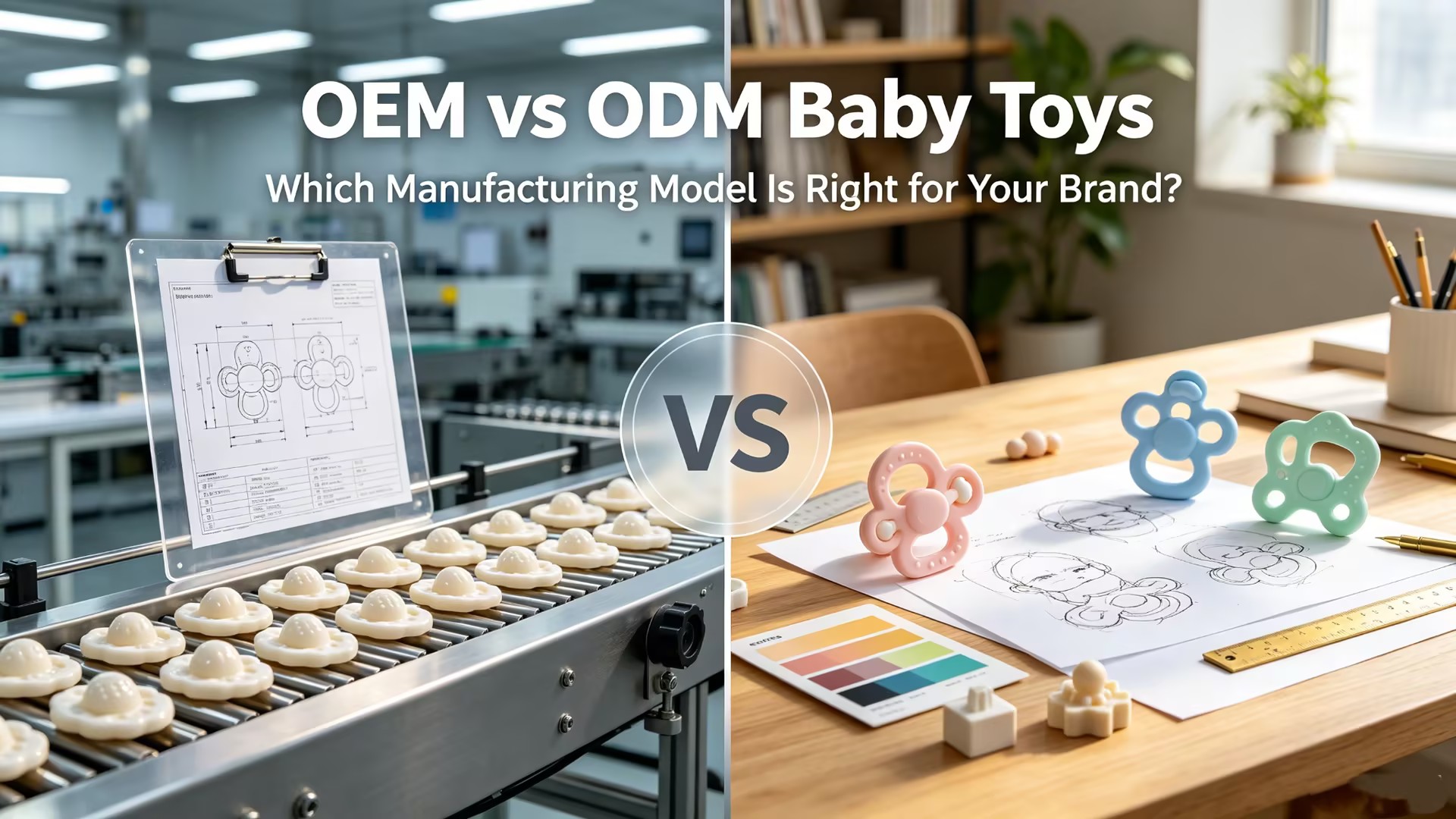
When evaluating OEM capability, ask to see a portfolio of custom products developed for other brands (respecting confidentiality, of course). A supplier with a strong OEM track record will be able to walk you through their development process: concept review → DFM feedback → 3D prototype → mold fabrication → pilot run → mass production. They should also be able to advise on intellectual property protection — mold ownership, design confidentiality agreements, and exclusive production arrangements for your custom products.
For an overview of a manufacturer's full OEM/ODM service scope and product categories, the OEM Natural Rubber Baby Toys Manufacturer homepage outlines end-to-end capabilities from R&D and mold-making through production, quality control, and packaging — all under one roof.
6. Packaging Solutions: First Impression and Retail Readiness
Packaging is where your product becomes a retail-ready brand experience. It is also where many suppliers fall short — offering only generic polybags or plain boxes, leaving buyers to source packaging separately (adding cost, complexity, and lead time). A strong natural rubber toy supplier should offer integrated packaging solutions that match your brand positioning and target market requirements.
Packaging options to evaluate:
- Retail-ready boxes: Custom-printed cardboard boxes with your branding, product imagery, safety warnings, age grading, and regulatory markings (CE, UKCA, CPC tracking label, Country of Origin).
- Blister & clamshell packs: For hang-sell retail display, with custom printed backer cards.
- Eco-friendly packaging: Kraft paper boxes, molded pulp inserts, FSC-certified paper, soy-based inks, organic cotton drawstring bags, and plastic-free options for eco-conscious brands.
- Gift sets & bundles: Custom multi-product packaging with inserts, ribbons, and premium finishes for gifting and holiday seasons.
- Bulk / wholesale packaging: Plain polybags or corrugated cartons for distributors and B2B customers who do their own retail packaging.
Critical packaging questions:
- Can you provide dieline templates and design support for custom packaging?
- What printing methods are available (offset, flexo, digital, hot stamp)?
- Can you handle multi-language packaging for different markets?
- What are your minimums for custom packaging vs. stock packaging?
- Do you offer packaging testing (drop test, compression test) for e-commerce fulfillment?
- Can you source eco-certified packaging materials (FSC, GOTS, ASTM D6400)?
7. Quality Control Systems: Consistency Across Every Shipment
A supplier that produces one excellent sample but cannot replicate that quality across 10,000 units is not a reliable partner. Quality control (QC) is the system that ensures consistency — and it is where many low-cost suppliers reveal their weaknesses.
A robust QC system for natural rubber baby toys should cover:
- Incoming Quality Control (IQC): Inspection and testing of raw latex, pigments, packaging materials, and components upon arrival. Rejection of non-conforming materials before they enter production.
- In-Process Quality Control (IPQC): Regular checks during production — wall thickness measurement, visual inspection for defects (flash, bubbles, discoloration), dimensional verification, and functional testing (rattle sound, squeaker function).
- Final Random Inspection (FRI): AQL (Acceptable Quality Limit) sampling of finished goods before shipment, typically at AQL 2.5 for major defects and 4.0 for minor defects. Inspection should cover appearance, dimensions, functionality, packaging, and labeling.
- Laboratory testing: In-house QC lab for routine tests (tear strength, elongation-at-break, hardness/Shore A, color fastness) and third-party lab testing for regulatory compliance (ASTM F963, EN 71).
- Traceability: Batch/lot coding on every product and carton, linking finished goods to raw material batches, production dates, and test reports — essential for targeted recalls.
- Corrective action: A documented process for identifying root causes of defects, implementing corrective actions, and verifying effectiveness — not just rejecting bad units but preventing recurrence.
When evaluating QC, ask for: defect rate data (reject rates by category), inspection reports from recent shipments, photos of the in-house lab and testing equipment, and references from current buyers who can speak to consistency across multiple orders. A supplier with a strong QC system will be transparent about their processes and data; a supplier that deflects or gives vague answers is a red flag.
For insight into how a manufacturer integrates QC with its overall production philosophy, About Tongxin describes an end-to-end operation — R&D, mold making, production, quality control, and packaging under one roof — with an in-house quality control lab and rigorous batch testing to international standards.
8. Lead Time & Production Capacity: Can They Deliver on Schedule?
Lead time directly affects your cash flow, inventory planning, and ability to capitalize on seasonal demand. A supplier with excellent products but unreliable lead times will leave you with empty shelves during peak selling seasons — or force you to carry excessive safety stock, tying up capital.
Typical lead time benchmarks for natural rubber baby toys:
- Samples (stock items): 3–7 days (often free, buyer pays freight).
- Custom samples (new mold): 20–30 days, including mold fabrication.
- First production order: 45–70 days after sample approval and deposit.
- Repeat orders: 30–60 days (faster because molds and tooling are ready).
- Expedited / rush orders: Possible with surcharge, depending on factory load and product complexity.
Production capacity is equally important. Ask about: number of production lines, monthly output capacity (in units or containers), ability to scale for large orders, peak season capacity (Q4 holiday rush), and contingency plans for raw material shortages or labor disruptions. A supplier that is already at 90%+ capacity will struggle to accommodate your growth or urgent reorders — look for suppliers with 20–30% headroom.
Key lead time and capacity questions:
- What is your current monthly output and maximum capacity?
- What is your typical first-order and repeat-order lead time?
- How do you handle peak season (Q4) capacity planning?
- What is your on-time delivery rate for the past 12 months?
- What is your raw material inventory policy — do you stock concentrated latex to avoid supply delays?
- Can you provide a production schedule with milestone dates after order confirmation?
9. Factory Capability & Infrastructure: Behind the Scenes
A supplier's factory infrastructure is the physical reality behind their marketing claims. While you may not be able to visit every factory in person (especially during initial evaluation), you can assess capability through documentation, virtual tours, and targeted questions.
Key factory capability factors:
- Production technology: Dipping lines (for thin-walled bath toys and squeeze toys), compression molding / injection molding (for teethers and structured products), and rotational molding capabilities. A factory with both dipping and molding can serve your full product range.
- Mold shop: In-house mold design and fabrication (CNC machining, EDM) reduces cost and lead time vs. outsourcing. Ask about mold material (aluminum for low-volume, P20 steel for high-volume) and mold maintenance policy.
- Vulcanization / curing: Oven and autoclave capacity, temperature control precision, and cure cycle monitoring. Consistent curing is critical for product performance and safety.
- Post-processing: Trimming, deflashing, washing, drying, and inspection stations. Automated trimming and washing improve consistency and reduce labor costs.
- Packaging line: In-house packaging assembly, printing, and cartoning — avoids the quality risk and lead time of outsourced packaging.
- Warehousing: Raw material storage (temperature-controlled for latex concentrate), WIP staging, and finished goods storage with FIFO (first-in-first-out) inventory management.
- Facility standards: Clean, well-lit production floors, proper ventilation (especially for curing and chemical areas), worker PPE, and fire safety systems. These reflect operational discipline and reduce safety/quality risks.
Request a virtual factory tour or a detailed factory profile document with photos of each production stage. A confident supplier will be eager to show you their facility; a supplier that resists or provides only generic marketing photos may have something to hide.
10. Certifications & Social Compliance: Trust and Market Access
Certifications are the objective evidence of a supplier's claims. They fall into three categories: product safety certifications, management system certifications, and social compliance audits.
Product safety certifications & test reports: ASTM F963, EN 71 (parts 1, 2, 3, 12), CPSIA (lead, phthalates), REACH (SVHC), RoHS, Prop 65 (California), and food contact safety (FDA 21 CFR 177 for rubber, EU 1935/2004). These should be from accredited third-party labs and current within the past 12 months.
Management system certifications:
- ISO 9001: Quality management system — the baseline for consistent processes and documentation.
- ISO 14001: Environmental management system — increasingly important for eco-focused brands and EU market access (GPSR, CSRD).
- ISO 45001: Occupational health and safety — indicates a safe, well-managed workplace.
Social compliance audits: BSCI (Business Social Compliance Initiative), SMETA (Sedex Members Ethical Trade Audit), SA8000, or WRAP. These audits cover wages, working hours, child labor prevention, forced labor, health and safety, freedom of association, and environmental practices. Major EU and US retailers increasingly require BSCI or SMETA audit reports as a condition of doing business.
Additional certifications that add credibility:
- GOLS (Global Organic Latex Standard): For organic natural latex products — verifies organic content and responsible processing.
- FSC (Forest Stewardship Council): For wooden components and paper packaging.
- GOTS (Global Organic Textile Standard): For fabric components (organic cotton).
- ISO 14067: Product carbon footprint verification — a differentiator for sustainability-focused brands.
Always request current certificate copies and verify their validity with the issuing body. Expired certificates, certificates for a different legal entity, or certificates that cover only a subset of products are common red flags.
For a product line that demonstrates certified organic material sourcing combined with safety testing, the Organic Natural Latex Teethers collection shows how GOLS-certified organic latex, deproteinization, and comprehensive safety testing come together in a premium product line — a useful reference for evaluating what certification-ready products look like.
Supplier Evaluation Checklist
Use this checklist to score every natural rubber baby toy supplier you evaluate:
Material Quality ☐ 100% natural rubber (no synthetic blend) ☐ Certified plantation source ☐ Deproteinization <50 μg/g ☐ Low-ammonia / ammonia-free preservation ☐ MSDS & raw material test reports available
Product Design ☐ In-house R&D & 3D modeling ☐ In-house mold fabrication ☐ DFM feedback before tooling ☐ Prototype / 3D printing capability ☐ Custom product portfolio examples
Safety Testing ☐ ASTM F963-23 test reports (accredited lab) ☐ EN 71-1/2/3/12 test reports ☐ CPC (US) / DoC (EU) issued per shipment ☐ Batch-level test traceability ☐ Nitrosamine control (EN 71-12) ☐ Retesting every 6 months
MOQ & Pricing ☐ Transparent MOQ by product type ☐ Mixed-SKU / trial order options ☐ Mold fee policy & amortization ☐ Free sample policy ☐ Volume discount tiers
OEM Capability ☐ Custom mold development ☐ Pantone color matching ☐ Embossed/debossed/printed logo ☐ Custom packaging design support ☐ IP protection / mold ownership ☐ Exclusive production options
Packaging ☐ Retail-ready custom boxes ☐ Eco-friendly options (kraft, molded pulp, FSC) ☐ Multi-language capability ☐ Packaging dieline & design support ☐ In-house packaging assembly
Quality Control ☐ IQC / IPQC / FRI process ☐ AQL inspection standards ☐ In-house QC lab ☐ Batch traceability coding ☐ Defect rate data available ☐ Corrective action process
Lead Time & Capacity ☐ Sample lead time ≤7 days (stock) / ≤30 days (custom) ☐ Production lead time 45–70 days (first) / 30–60 days (repeat) ☐ Monthly capacity with 20%+ headroom ☐ On-time delivery rate >95% ☐ Peak season capacity plan
Factory Capability ☐ Dipping + molding lines ☐ In-house mold shop ☐ In-house packaging line ☐ Temperature-controlled latex storage ☐ Virtual tour available ☐ Clean, well-maintained facility
Certifications ☐ ISO 9001 (quality) ☐ ISO 14001 (environment) ☐ BSCI or SMETA audit ☐ GOLS (organic latex, if applicable) ☐ FSC (wood/paper, if applicable) ☐ All certificates current & verified
Ready to Source? Request a Quote
Choosing the right natural rubber baby toy supplier is the most important decision you will make for your product line. It determines your product quality, your compliance risk, your margin structure, and your ability to scale. By systematically evaluating material quality, design capability, safety testing, MOQ, OEM, packaging, QC, lead time, factory capability, and certifications, you can identify a supplier that is not just a vendor but a long-term strategic partner.
If you are ready to move from evaluation to action, the next step is a detailed quote tailored to your product specifications, target markets, and volume requirements. A good supplier will respond with a clear breakdown of unit pricing, mold fees, MOQ, lead time, packaging options, and included services — giving you everything you need to make an informed sourcing decision.
Ready to Source Natural Rubber Baby Toys?
Get a customized quote with pricing, MOQ, lead time, and OEM options for your product line.
Request a QuoteHow to Choose a Baby Toy Manufacturer: 12 Questions to Ask
Screen-Free Baby Toys: Why Sensory Play Is Growing in 2026