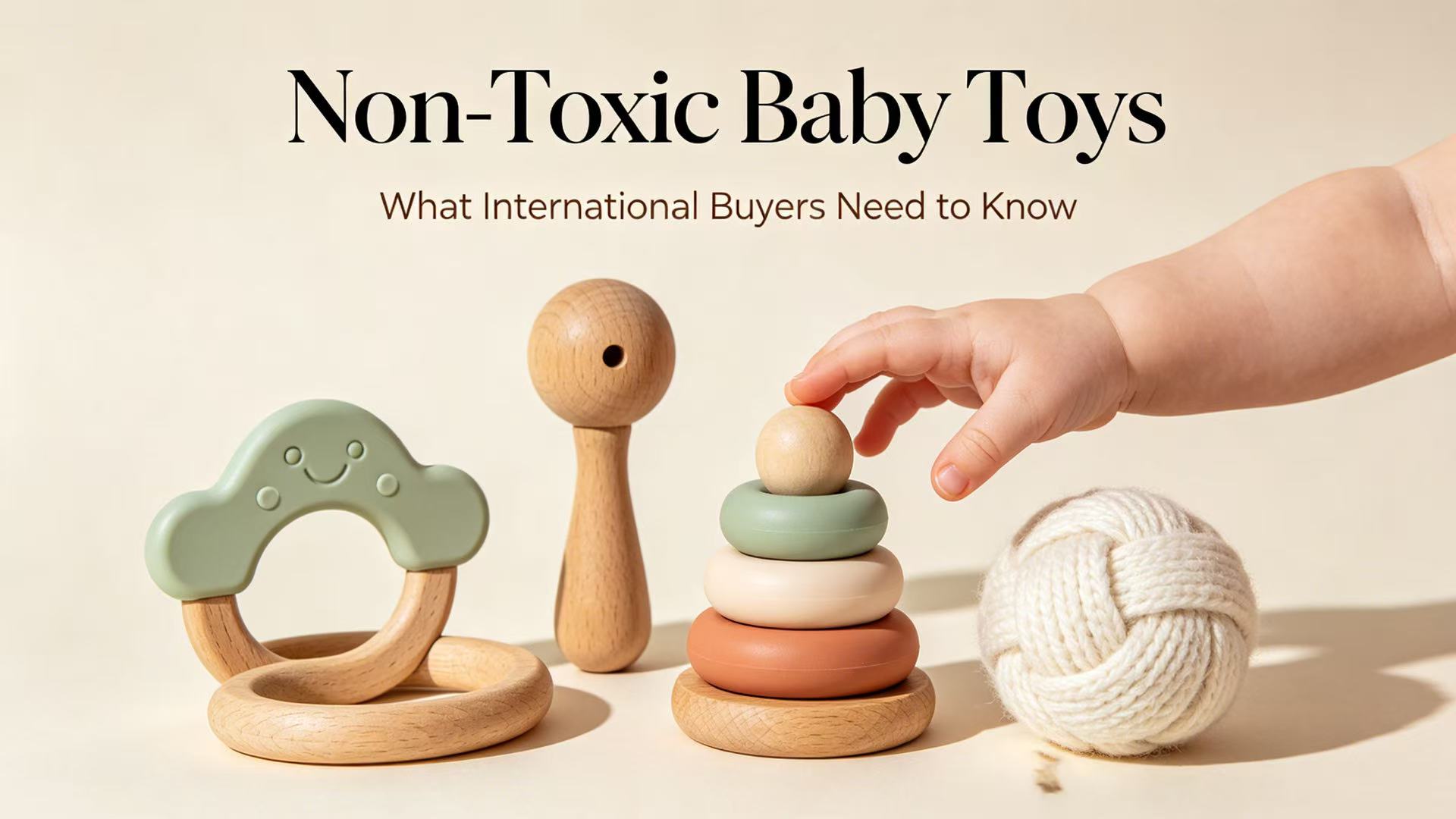
Non-Toxic Baby Toys: What International Buyers Need to Know
Walk any baby product trade show and the phrase "non-toxic" is everywhere. It appears on hangtags, in catalogs, across Alibaba listings, and in almost every supplier's opening pitch. But for an international buyer—whether you source for a retail chain, run a DTC brand, or build a private-label line—the real question is never whether a supplier says a toy is non-toxic. The question is what that claim is actually built on.
"Non-toxic baby toys" is not a regulated term in most jurisdictions. There is no global standard that defines exactly which chemicals must be absent, at what limits, and verified by which test method. A supplier can print "non-toxic" on packaging without a single lab report to back it up. That gap is where recalls, customs seizures, and brand-damaging compliance failures begin.
This guide breaks the claim down into the components that actually matter: the chemicals buyers should understand, the testing that proves safety, the material choices that reduce risk at the source, and the supplier documentation that protects your business when a regulator or a customer asks for proof.
Why "Non-Toxic" Has Become a Buying Condition, Not a Bonus
Consumer expectations have shifted decisively. Parents research ingredients before they research prices. Retail buyers in North America, Europe, and Australia increasingly treat chemical safety as a non-negotiable entry requirement rather than a premium feature. Regulators have moved in the same direction: the EU Toy Safety Directive, the US CPSIA framework, and California's Proposition 65 all create real legal exposure for products that contain restricted substances above allowed limits.
For importers, the risk is not only financial. A single recall can erase years of brand equity. Amazon and other marketplaces now require compliance documentation before listing certain toy categories. Customs authorities in the EU and US can hold shipments pending test reports. In this environment, "non-toxic" is a claim you must be able to defend with paper, not just repeat in marketing copy.
BPA: The Chemical That Rewrote the Rulebook
Bisphenol A, better known as BPA, is an industrial chemical used primarily to make polycarbonate plastics and epoxy resins. For decades it appeared in baby bottles, sippy cups, and the linings of food cans. Research linking BPA to endocrine disruption—particularly its ability to mimic estrogen—drove a wave of regulatory action and consumer backlash.
The EU banned BPA in baby bottles in 2011 and extended the restriction to sippy cups and drinking cups for young children in 2018. The FDA effectively ended BPA use in baby bottles, sippy cups, and infant formula packaging through a rule change in 2012. California's Proposition 65 lists BPA as a reproductive toxicant, which means products containing it above a defined threshold must carry a warning label.
For toy buyers, the relevant point is that BPA is most commonly associated with hard, clear polycarbonate plastics. If a supplier's toy is made of natural rubber, food-grade silicone, or wood, BPA is essentially a non-issue by material composition. If it is made of rigid, transparent plastic, you should ask specifically for BPA testing and confirm whether the material is polycarbonate or a BPA-free alternative such as Tritan or polypropylene.
Buyer takeaway: A "BPA-free" claim on its own is not enough. It should be supported by a test report from an accredited laboratory, typically using HPLC or GC-MS methodology, and the report should identify the specific material tested.
PVC: Cheap, Flexible, and Loaded With Problems
Polyvinyl chloride, or PVC, is one of the most widely produced plastics in the world. It is cheap, durable, and easy to color, which makes it attractive to cost-sensitive toy manufacturers. The problem is that PVC in its raw form is rigid and brittle. To make it soft and flexible—the texture needed for bath toys, squeeze toys, and teething products—manufacturers add plasticizers. The most common plasticizers are phthalates.
PVC also creates chemical risks beyond plasticizers. Lead and cadmium have historically been used as stabilizers in PVC formulations, and recycled PVC can carry unpredictable contamination from previous use cycles. When PVC is produced or incinerated, it can release dioxins and other chlorinated compounds, creating environmental concerns that increasingly matter to buyers subject to ESG reporting requirements.
For a buyer evaluating a "non-toxic" claim, the simplest question is whether the product contains PVC at all. If the answer is yes, you immediately inherit a phthalate risk, a potential heavy-metal stabilizer risk, and a recycling-contamination risk. Many responsible brands now specify PVC-free as a baseline requirement, which is why natural rubber and food-grade silicone have become the dominant materials for mouth-contact toys such as teethers and bath toys.
Phthalates: The Hidden Softeners
Phthalates are a family of chemical compounds added to plastics to make them flexible and durable. They are not chemically bonded to the plastic, which means they can leach out over time—especially when the material is chewed, heated, or exposed to saliva. This is precisely the scenario baby toys are designed for.
The most scrutinized phthalates are DEHP, DBP, and BBP, which are classified as toxic to reproduction. A second group—DINP, DIDP, and DNOP—receives additional scrutiny for toys and childcare articles that can be placed in the mouth.
Regulatory limits are specific and worth knowing:
- In the EU, under the Toy Safety Directive 2009/48/EC, DEHP, DBP, and BBP are restricted to no more than 0.1% by weight in any toy or childcare article. DINP, DIDP, and DNOP are restricted to 0.1% in toys and childcare articles that can be placed in the mouth.
- In the US, under CPSIA and the Consumer Product Safety Commission's permanent rule, eight phthalates—DEHP, DBP, BBP, DINP, DIBP, DPENP, DCHP, and DIDP—are prohibited at concentrations exceeding 0.1% in children's toys and childcare articles.
- California's Proposition 65 lists several phthalates, including DEHP and DINP, requiring warning labels above specific exposure thresholds.
The 0.1% figure—1,000 parts per million—is the number most buyers memorize. But the more important point is that phthalate testing must be performed on the final product or the plasticized component, not just on a raw material sample. A supplier who provides a phthalate report for raw PVC pellets but not for the finished toy has not proven what the child actually encounters.
Testing note: Phthalate testing is typically performed by GC-MS. A valid report will identify each phthalate individually, state the method detection limit, and show a clear PASS against the applicable regulatory limit.
Heavy Metals: Lead, Cadmium, and the Invisible Risk
Heavy metals in baby toys do not come from a single source. They can appear in pigments and dyes, in PVC stabilizers, in surface coatings and paints, in metal components, and—insidiously—in recycled plastic where contamination from previous use cycles is difficult to control.
Lead is the most notorious. Even low-level exposure in children is associated with cognitive and behavioral effects, and there is no known safe blood lead level. Cadmium is a carcinogen associated with kidney and bone damage. Arsenic and mercury carry their own well-documented toxicity profiles.
Regulators address heavy metals through two distinct approaches: total content limits and migration limits.
- Total content measures how much of a metal is present in the material overall. Under CPSIA, the total lead content in children's products is limited to 100 parts per million, and lead in surface coatings is limited to 90 parts per million.
- Migration measures how much of a metal can actually be released from the toy under simulated conditions—saliva, sweat, stomach acid, or hand-to-mouth contact. Migration is the more child-relevant measure because a metal locked inside a material cannot harm a child, but a metal that leaches into saliva can.
The EU's EN 71-3 standard sets migration limits for 19 elements across three toy material categories: dry, brittle, powder-like, or pliable materials (Category I); liquid or sticky materials (Category II); and scraped-off materials (Category III). The limits are element-specific and vary by category. The US ASTM F963 standard includes migration requirements for eight elements: antimony, arsenic, barium, cadmium, chromium, lead, mercury, and selenium.
For buyers, the practical implication is that you should ask for both total-content testing (especially for lead) and migration testing under the standard relevant to your market. A toy that passes a total-lead screen can still fail a migration test if its surface coating releases soluble metals.
Chemical Testing: How Safety Is Actually Proven
A "non-toxic" claim is only as credible as the testing behind it. Responsible buyers do not accept supplier self-declarations; they require third-party laboratory testing performed by accredited facilities.
Accreditation matters. A laboratory accredited to ISO/IEC 17025 has demonstrated technical competence and impartiality to an independent accreditation body. Reports from unaccredited in-house labs, or from labs whose accreditation does not cover the specific test method, carry far less weight with regulators and retailers.
The core test panel for a non-toxic baby toy typically includes:
- Phthalates by GC-MS, covering the restricted phthalate list applicable to the target market.
- Heavy metals by ICP-MS or ICP-OES, including both total content and migration testing under EN 71-3 or ASTM F963.
- BPA by HPLC or GC-MS, particularly for any polycarbonate or rigid plastic components.
- Material identification by FTIR, to confirm that the material is what the supplier claims it to be—natural rubber, silicone, polypropylene, and so on.
- Formaldehyde testing for textile, wood, and composite components, where applicable.
Testing should be performed on the finished product as sold, or on the specific component that presents the risk. Raw-material testing is useful for supplier qualification but does not replace finished-product testing, because additives, colorants, and processing aids can introduce contaminants that were not present in the base resin.
For mouth-contact toys such as teethers and bath toys, additional food-contact standards may apply. Natural rubber articles intended for repeated food contact are referenced in FDA 21 CFR 177, and EU food-contact materials are regulated under Regulation (EC) 1935/2004 with specific measures for rubber and silicone. Even when a toy is not legally classified as a food-contact article, meeting food-contact material standards is a strong signal of material purity and is increasingly expected by premium buyers.
Material Safety: Reducing Risk at the Source
Testing catches problems. Material choice prevents them. The most reliable way to build a non-toxic baby toy is to start with materials that do not contain the chemicals of concern in the first place.
Natural rubber and natural latex are derived from the sap of rubber trees. They are inherently free of BPA, PVC, phthalates, and synthetic plasticizers. High-quality natural rubber toys are biodegradable and renewable, and they meet the soft, flexible, chewable texture that babies need. The production process—from tapping to compounding to vulcanization—does involve processing aids, which is why responsible manufacturers control the formulation and provide material safety documentation. You can read more about how natural latex products are manufactured from raw sap to finished toy in our overview of the latex production process.
A common point of confusion is the distinction between "latex" and "rubber." The terms are sometimes used interchangeably, but they refer to different stages and forms of the same material. Understanding the difference helps buyers evaluate supplier claims about purity and composition, which we cover in detail in what is the difference between 100% latex and rubber?
Food-grade silicone is made from silica, not petroleum. It is chemically inert, heat-resistant, and does not leach phthalates or BPA. It is a common choice for teething beads, pacifier shields, and bath toys. Food-grade silicone should meet FDA 21 CFR 177.2600 in the US and the equivalent EU food-contact standards.
Organic cotton and natural textiles are used in soft toys, activity mats, and fabric books. Conventional cotton can carry pesticide residues and formaldehyde-based finishes. GOTS-certified organic cotton provides a verifiable chain of custody and restricted-substance control.
Wood is a classic toy material, but the risk moves to the surface finish. Non-toxic wood toys should use water-based, non-toxic paints and lacquers, and the wood itself should be free of added formaldehyde. FSC certification addresses sustainability; it does not by itself prove chemical safety.
For teething products specifically, the material choice is the single most important safety decision. Our guide to organic natural latex teethers walks through the material, design, and safety considerations that make a teether genuinely safe for infants.
Testing Reports: Reading Between the Lines
Not all test reports are equal. A buyer who cannot distinguish a meaningful report from a decorative one is vulnerable to suppliers who provide documentation that looks impressive but proves very little.
A valid test report should include:
- The name, address, and accreditation details of the testing laboratory, including the ISO/IEC 17025 accreditation number and scope.
- A unique report number and issue date.
- Clear identification of the sample tested—product name, model, SKU, color, and batch or lot number where applicable.
- The test standard and method used (for example, EN 71-3:2019+A1:2021, ASTM F963-17, CPSC-CH-C1001-09.4 for phthalates).
- The specific analytes tested, the detection limit, the result for each analyte, and the regulatory limit against which it is compared.
- A clear PASS or FAIL conclusion.
- Signature or authorization from the laboratory.
Several distinctions matter in practice. Type testing is performed on a representative sample and proves that the product design and formulation can meet the standard. Batch testing is performed on a specific production lot and proves that that particular lot meets the standard. For high-risk products or new suppliers, batch testing provides stronger assurance. For established, audited suppliers with stable formulations, type testing supplemented by periodic batch verification is often sufficient.
Reports also have a practical shelf life. A report that is several years old may not reflect the current formulation, especially if the supplier has changed material sources, colorants, or manufacturing partners. Most retailers and brands require test reports to be renewed annually or whenever a formulation change occurs.
Red flag: Be wary of reports that test only a subset of the product. A phthalate report on the plastic component of a toy does not cover the paint, the fabric, or the metal clasp. A complete safety file addresses every component and every applicable hazard.
Supplier Documentation: The Paper Trail That Protects You
Test reports are the centerpiece of a compliance file, but they are not the whole story. Professional buyers build a documentation package that covers the product from raw material to finished goods.
The core documents to request include:
- Certificate of Analysis (COA) for each material or batch, summarizing test results and confirming conformance to specification.
- Safety Data Sheet (SDS) for each material and chemical used in production, including colorants, vulcanizing agents, and release agents.
- Declaration of Conformity (DoC) issued by the manufacturer or importer, stating that the product meets all applicable regulatory requirements. In the EU, the DoC is a legal requirement under the Toy Safety Directive and must be kept for ten years.
- Material traceability records, linking finished goods to raw material lots and supplier batches.
- Factory quality certifications, such as ISO 9001 for quality management. For social compliance, BSCI or SMETA audits are increasingly required by European and North American retailers.
- Good Manufacturing Practice (GMP) documentation where applicable, particularly for products that meet food-contact material standards.
For natural latex and rubber toys specifically, buyers should also ask for documentation that supports material authenticity. The market contains products labeled "natural rubber" that are actually synthetic rubber or blended materials. Our practical guide to identifying natural latex toys covers the sensory and physical checks buyers can use, but these should always be backed by FTIR material identification and supplier documentation.
The documentation package should be collected before the first shipment and maintained throughout the supplier relationship. When a regulator, a retailer, or a customer asks for proof of compliance, you should be able to produce the complete file without delay.
A Buyer's Checklist: Questions to Ask Every Supplier
Pre-Order Compliance Checklist
Before you place an order for non-toxic baby toys, confirm that your supplier can answer yes to every question below.
- Can you provide third-party test reports from an ISO/IEC 17025 accredited laboratory for the finished product?
- Do the reports cover phthalates, heavy metals (total and migration), BPA where applicable, and any other restricted substances relevant to my market?
- Can you identify the exact material composition of every component, including colorants and processing aids?
- Do you maintain batch traceability from raw material to finished goods?
- Can you provide a Certificate of Analysis, Safety Data Sheets, and a Declaration of Conformity?
- What is your quality certification (ISO 9001) and social compliance audit status (BSCI/SMETA)?
- How often do you renew test reports, and what triggers a re-test?
- Can you support market-specific requirements, such as CPSIA for the US, EN 71 for the EU, and food-contact material standards for mouth-contact toys?
A supplier who hesitates on these questions, or who offers only a blanket "non-toxic" assurance without documentation, is a supplier worth walking away from.
The Bottom Line for International Buyers
"Non-toxic" is a marketing phrase. Safety is a documentation system. The difference between the two is the difference between a product that sells and a product that survives contact with regulators, retailers, and parents.
For international buyers, the path is clear: understand the chemicals, specify materials that avoid them at the source, require third-party testing on the finished product, and build a complete documentation file that you can defend on demand. The suppliers who can meet this standard are the ones worth building long-term partnerships with.
Natural rubber and natural latex toys have emerged as a leading choice precisely because they eliminate many of the chemical risks at the material level—no BPA, no PVC, no phthalates, no synthetic plasticizers. For buyers evaluating this category, our article on why natural rubber baby toys are the future of safe parenting choices explains the market dynamics and supplier selection criteria in depth, and our guide to newborn toys for 0–3 months shows how material safety translates into product design for the most vulnerable age group.
If you are sourcing non-toxic baby toys for your brand or retail business, start with the documentation, not the marketing. The suppliers who lead with test reports and material specifications are the ones who understand what non-toxic really means.
Keyword Extraction
Primary Keyword
Core Secondary Keywords
Long-Tail & Compliance Keywords (B2B Intent)
Semantic & Entity Keywords (Topic Cluster / EEAT)
Internal Link Distribution (6 Links)
- Anchor: latex production process →
//www.naturalbabyworld.com/latex-production-process.html(Material Safety section) - Anchor: what is the difference between 100% latex and rubber? →
//www.naturalbabyworld.com/article-5545516321153676.html(Material Safety section) - Anchor: organic natural latex teethers →
//www.naturalbabyworld.com/organic-natural-latex-teethers.html(Material Safety section) - Anchor: identifying natural latex toys →
//www.naturalbabyworld.com/tips-for-identifying-natural-latex-toys.html(Supplier Documentation section) - Anchor: why natural rubber baby toys are the future of safe parenting choices →
//www.naturalbabyworld.com/why-natural-rubber-baby-toys-are-the-future-of-safe-parenting-choices.html(Conclusion section) - Anchor: newborn toys for 0–3 months →
//www.naturalbabyworld.com/article-newborn-toys-0-3-months-a-guide-to-safe-and-sensory-rich-natural-latex-toy-development.html(Conclusion section)
Natural Rubber Sensory Toys for Babies: Benefits & Product Ideas
What Makes a Baby Toy Safe? A Guide for International Buyers