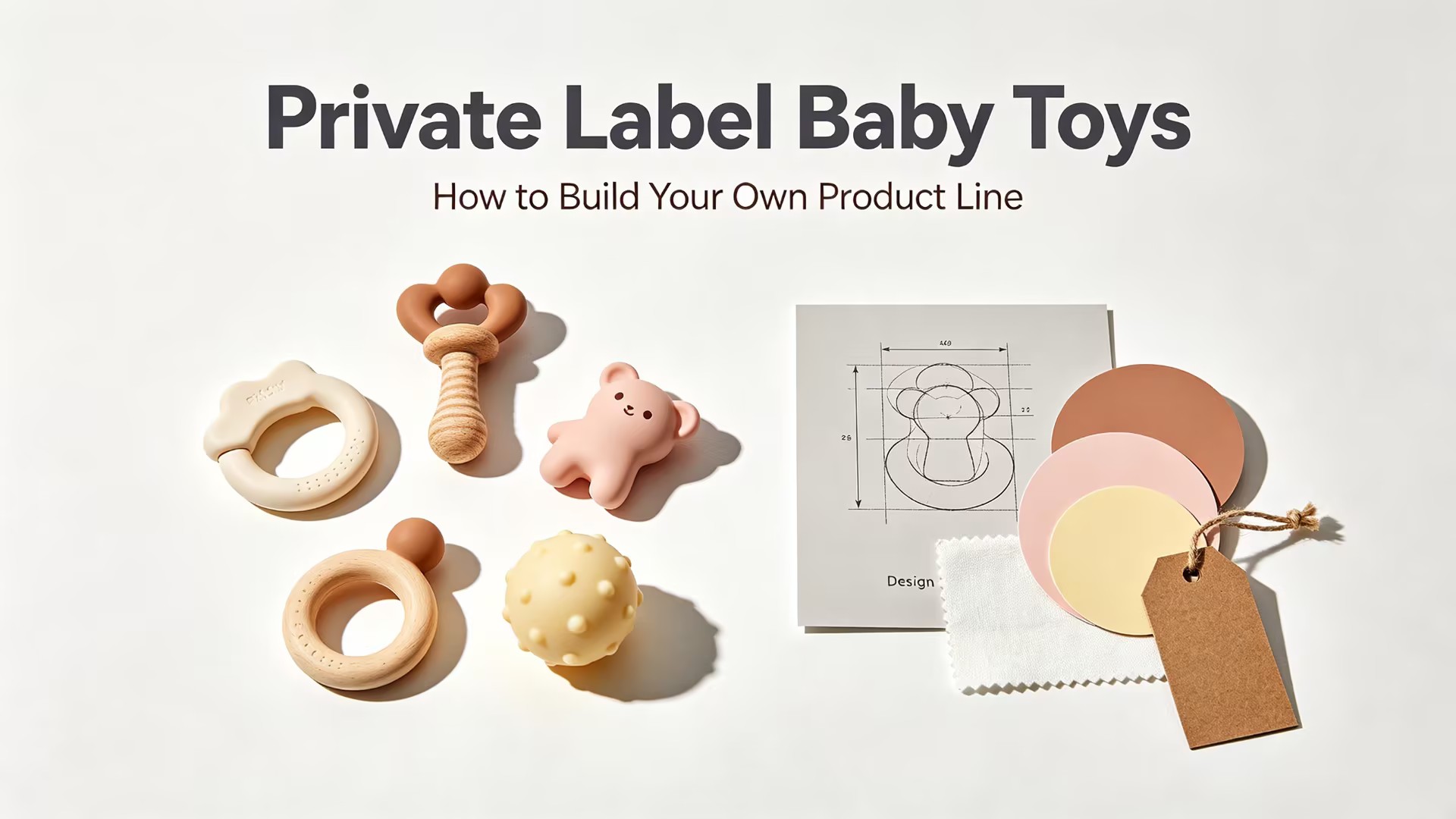
Private Label Baby Toys: How to Build Your Own Product Line
The global baby toy market keeps growing, and more retailers, e-commerce brands, and boutique owners are asking: how do I stop reselling someone else's products and start selling under my own brand? The answer, for many, is private label baby toys.
Private labeling lets you take proven, factory-developed products — natural rubber teethers, bath toys, sensory balls, stacking toys — and put your logo, packaging, and brand story on them. You skip the cost and risk of inventing a product from scratch, but still get a line that feels uniquely yours.
But building a private label baby toy line is not as simple as emailing a factory and saying "put my logo on this." You need to decide between private label, OEM, and ODM; understand MOQ; know which safety tests matter for the US and EU; and handle branding, colors, and packaging so your products stand out.
This guide walks through every step. Whether you are a first-time entrepreneur or established retailer, you will learn what it takes to build a private label baby toy line that sells.
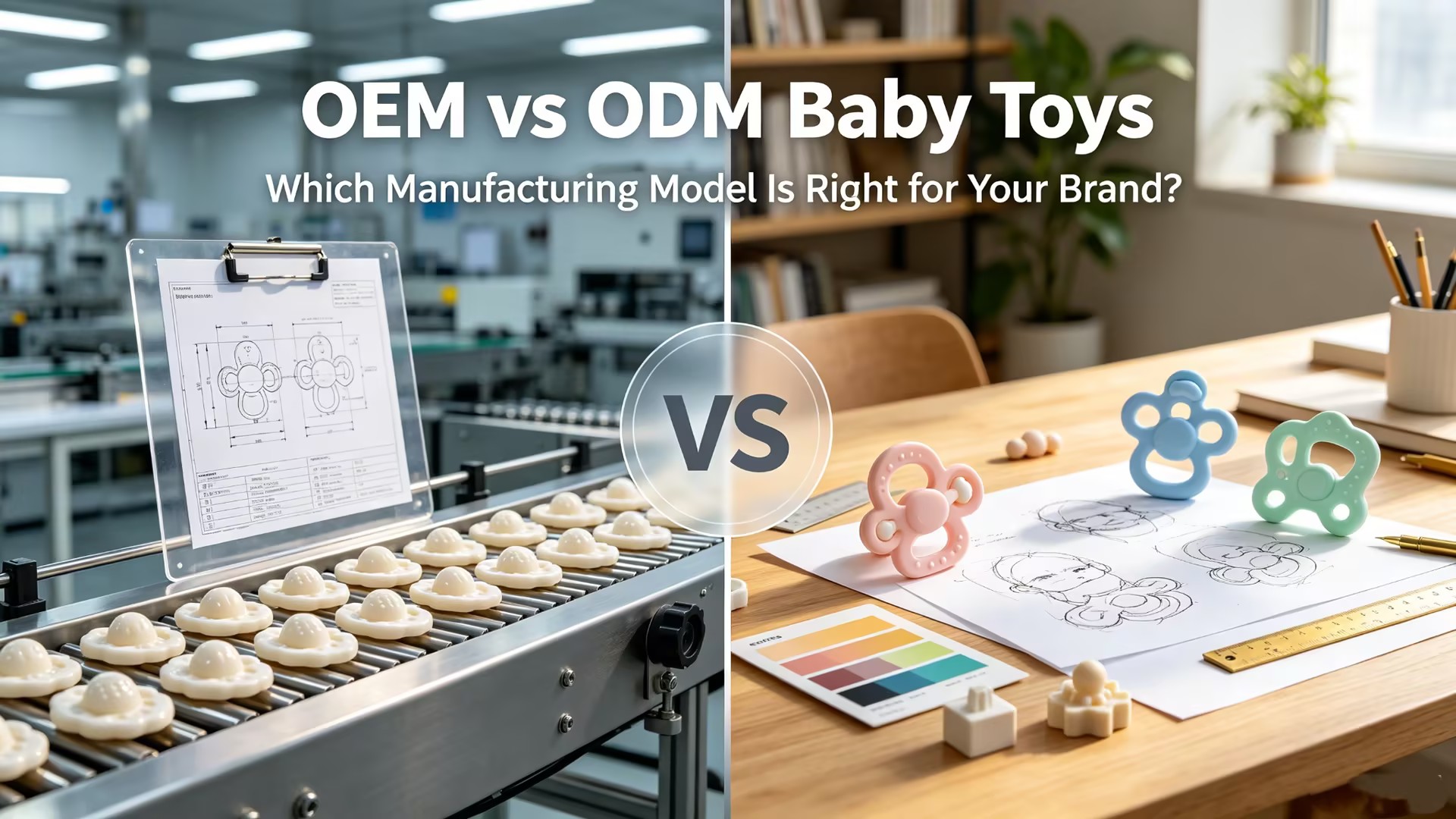
Private Label vs. OEM vs. ODM: Understanding the Differences
Before you contact a factory, understand the three most common manufacturing models. Mixing them up can lead to costly misunderstandings.
What Is Private Label?
Private label is the most accessible entry point for new brands. The manufacturer already has a catalog of existing products with molds, designs, and proven production processes. You select products, then customize branding elements: logo printing, packaging design, color choices, and sometimes minor feature tweaks.
The factory owns the design and mold, but the finished product carries your brand name. You set the retail price, control marketing, and own the customer relationship.
Best for: Startups, e-commerce brands, retailers, and boutiques wanting a branded line without high upfront tooling costs.
What Is OEM?
OEM (Original Equipment Manufacturer) means you — the brand — bring the complete product design: technical drawings, specifications, material requirements, and sometimes the mold. The factory manufactures to your exact specifications.
You own the IP, design, and mold. No competitor can sell the same product. This is the highest-control model but requires the most upfront investment in development, prototyping, and custom tooling.
Best for: Established brands with proprietary designs needing a fully unique product.
If you want to dive deeper into the OEM process from concept to mass production, our OEM Baby Toys: Complete Guide for International Brands walks through all nine steps.
What Is ODM?
ODM (Original Design Manufacturer) sits between private label and OEM. The factory designs and develops the product, but you work with them to modify an existing design or co-develop a new one based on their platform.
For example, a factory might have an existing natural rubber teether mold. Through ODM, you could request a modified shape, different surface texture, or custom color formula exclusive to your brand. More differentiation than private label, without the full cost of OEM.
Best for: Growing brands wanting uniqueness but not ready for fully custom tooling.
Quick Comparison
| Factor | Private Label | OEM | ODM |
|---|---|---|---|
| Design ownership | Factory | Brand (you) | Factory, with brand mods |
| Upfront cost | Low | High | Medium |
| MOQ | Lower | Higher | Medium |
| Lead time | 15–30 days | 45–60+ days | 30–45 days |
| Product uniqueness | Low–medium | High | Medium |
Which Model Is Right for You?
For most brands entering the baby toy space, private label is the smart starting point. It lets you test the market, build recognition, and generate revenue with minimal risk. Once you have proven demand, you can gradually move toward ODM modifications and eventually OEM custom designs.
The key is to work with a custom baby toys manufacturer that supports all three models, so you can scale without switching suppliers.
Step 1: Product Selection
Your product selection is the foundation of your private label line. Pick the wrong products, and no amount of branding will save you.
Start with Market Demand
Research what parents are actually buying. Look at bestseller rankings on Amazon, Etsy, and specialty baby retailers. Categories that consistently rank well:
- Teething toys — Always in demand, high repeat purchase potential, one of the first products new parents search for.
- Bath toys — Strong gifting category, visually appealing, easy to merchandise.
- Sensory toys — Fast-growing, driven by developmental play and screen-free parenting trends.
- Stacking and educational toys — Longer product lifespan, appeals to toddlers, supports early learning narratives.
Think in Collections
The strongest private label lines are built as connected collections. A parent who buys a natural rubber teether is likely to also want a sensory ball, bath toy set, and stacking toy. Offering all of these increases average order value and builds loyalty.
For guidance on building a connected product range, read our article on Natural Baby Toys That Support Early Growth — it explains how teething, sensory, and educational categories work together.
Prioritize Material Quality
In the baby toy category, material choice is everything. Parents increasingly avoid plastic toys containing BPA, PVC, phthalates, and artificial colorants. Natural rubber and organic latex toys are premium alternatives — biodegradable, non-toxic, and naturally soft for babies to mouth and chew.
Prioritize factories specializing in natural rubber or food-grade silicone. These products command higher retail prices, stronger margins, and appeal to safety-conscious parents most likely to buy from a new or boutique brand.
Step 2: Logo and Branding
Once you have selected your products, the next step is branding. Your logo is the most visible element, but effective branding goes far beyond just slapping a logo on a product.
Logo Application Methods
- Pad printing — Most common for rubber and silicone. A silicone pad transfers ink onto the surface. Good for detailed logos, durable, low cost.
- Embossing/debossing — Logo pressed into the material during molding, creating a raised or recessed design. No ink means no flaking risk, premium tactile feel. Requires logo in the mold.
- Laser engraving — Laser etches the logo. Precise and permanent, best for harder materials and flat surfaces.
- Packaging-based branding — If direct printing is too expensive for your MOQ, branding lives primarily on the hang tag, box, or insert card.
For natural rubber baby toys, embossing and pad printing are most popular. Embossing gives a clean, organic look; pad printing allows full-color logos and detailed designs.
Brand Consistency
Apply your logo consistently across every product — same size, placement, and color on all teethers, bath toys, and sensory products. This consistency is what makes a collection feel like a real brand. Create a simple style guide specifying logo dimensions, approved colors (Pantone/CMYK), placement, fonts, and key messaging.
Beyond the Logo: Brand Story
A logo is necessary but not sufficient. Your brand needs a story. Why did you create this line? What makes your toys different — sustainability, child development, non-toxic materials, or supporting new parents?
Weave your brand story into every touchpoint: product descriptions, packaging copy, social media, and customer communications. This is what turns a commodity product into a brand parents remember and recommend.
Step 3: Packaging
In the baby toy industry, packaging is your silent salesperson, first impression, and a critical part of the unboxing experience that drives social sharing and brand loyalty.
Packaging Options
- Hang tags — Most cost-effective. Printed cardstock tag attached with string or loop. Good for peg display.
- Poly bags with header cards — Clear bag with printed cardboard header. Affordable, shows the product, works for e-commerce.
- Retail boxes — Folded cardboard with window or full-color printing. Premium feel, ideal for gift sets and shelf display.
- Kraft paper tubes — Cylindrical recycled kraft tubes. Eco-friendly, on-trend for natural brands, distinctive unboxing.
For natural rubber brands, kraft packaging, recycled cardboard, and minimal plastic are increasingly preferred — they align with eco-conscious values and reinforce non-toxic positioning.
What Every Package Needs
- Brand logo and name — Prominently displayed.
- Product name and description — Clear, benefit-driven copy.
- Age recommendation — e.g., "0 months+" or "3 months+."
- Material information — "100% natural rubber," "BPA-free," "non-toxic."
- Safety warnings — Required by law. For toys under 3, include choking hazard warnings.
- Care instructions — How to clean and maintain the toy.
- Origin and manufacturer info — Country of manufacture, importer details, contact info.
- Certification marks — CE, ASTM F963, CPSIA (only if actually certified).
Packaging as a Marketing Tool
Include a small insert card with a thank-you message, your social handles and a sharing hashtag, a QR code linking to care tips or a welcome discount, and your sustainability commitments. These touches turn a simple purchase into a brand experience and encourage repeat buying and referrals.
Step 4: Colors and Customization
Color is one of the most powerful tools for differentiating your private label line from competitors selling the same factory base products. The right palette can make your toys instantly recognizable on a shelf or in an Instagram feed.
Color Options
Natural rubber toys start as an off-white or pale beige base. Manufacturers add food-grade or toy-safe pigments to achieve a range of colors:
- Pastel palette — Soft pinks, mint greens, baby blues, butter yellows. Classic baby aesthetic, appeals to traditional parents and gift buyers.
- Earth tones — Terracotta, sage, mustard, dusty rose, cream. Very on-trend for modern, minimalist, and Scandinavian-style nurseries. Commands a premium price.
- Bold primaries — Red, blue, yellow, green. High contrast, good for visual stimulation, appeals to educational toy buyers.
- Monochrome/natural — Uncolored natural rubber with minimal branding. Appeals to the most eco-conscious and minimalist parents.
When choosing colors, consider your target customer and brand positioning. Earth tones and pastels currently dominate the premium natural baby toy segment.
Color Customization
Most manufacturers offer two levels:
- Standard colors — Pre-formulated pigment recipes. No extra cost, available at standard MOQ.
- Custom Pantone colors — You provide a Pantone number, factory formulates custom pigment. May require a development fee and higher MOQ.
For your first run, stick with standard colors to keep costs low. Once you have proven sales, introduce custom brand-exclusive colors.
Color Consistency
Request a pre-production sample (PPS) before mass production to verify color. Keep the approved sample as a reference for future orders, and ask your manufacturer to perform color comparison checks during QC.
MOQ: Understanding Minimum Order Quantities
MOQ is one of the most important — and most intimidating — numbers for any brand starting a private label line. Understanding how MOQs work and how to negotiate them can save you thousands.
Why Factories Have MOQs
Factories set minimums because production has fixed costs: mold setup and teardown, material preparation and pigment mixing, labor allocation, QC setup, and packaging printing. The smaller the order, the higher the per-unit cost. MOQs ensure each run is economically viable.
Typical MOQs for Baby Toys
| Product Type | Standard MOQ | Custom MOQ |
|---|---|---|
| Natural rubber teethers | 500–1,000 pcs | 2,000–3,000 pcs |
| Bath toys (sets) | 300–500 sets | 1,000+ sets |
| Sensory balls | 500–1,000 pcs | 2,000+ pcs |
| Stacking/educational toys | 300–500 pcs | 1,000+ pcs |
Private label orders (existing molds with logo and packaging customization) typically have lower MOQs than OEM orders (custom tooling). For first-time buyers, many factories offer trial MOQs of 300–500 units per SKU.
Strategies for Managing MOQ
- Start with fewer SKUs — Instead of 10 products at MOQ, start with 3–5 bestsellers. Reduces total investment while still giving a cohesive collection.
- Combine colors into one MOQ — Many factories allow splitting a single MOQ across 2–3 colors. A 1,000-piece MOQ could be 500 sage + 500 terracotta.
- Negotiate trial orders — Ask if the factory offers a first-order trial MOQ. Many accommodate smaller initial orders for new customers.
- Use shared packaging — If custom box MOQs are too high, start with hang tags, then upgrade to custom retail boxes once you have volume.
- Consolidate with an experienced supplier — Working with a wholesale baby toys supplier can help you navigate MOQ requirements, combine orders across categories, and access better pricing.
For a comprehensive breakdown of MOQ negotiation, pricing margins, and sourcing strategy, our Wholesale Baby Toys: Complete Sourcing Guide for Retailers & Brands covers everything you need.
Testing and Safety Certification
Baby toys are one of the most heavily regulated consumer product categories. Cutting corners on safety testing is not just risky — it is illegal in most major markets and can result in recalls, fines, and permanent brand damage.
United States: ASTM F963 and CPSIA
All children's toys sold in the US must comply with:
- ASTM F963 — The Standard Consumer Safety Specification for Toy Safety, mandatory under CPSIA. The current version is ASTM F963-23 (effective April 20, 2024). Covers mechanical/physical hazards, flammability, and toxic elements (heavy metals migration).
- CPSIA Section 101 — Limits lead content to 100 ppm for accessible components and 90 ppm for surface coatings.
- Phthalates ban — Eight phthalates prohibited in children's toys above 0.1% concentration.
- Third-party testing — Toys for children 12 and under must be tested by a CPSC-accepted lab and certified with a Children's Product Certificate (CPC).
European Union: EN 71
Toys sold in the EU must meet the EN 71 series:
- EN 71-1 — Mechanical and physical properties
- EN 71-2 — Flammability
- EN 71-3 — Migration of 19 toxic elements
- EN 71-12 — Nitrosamines and nitrosatable substances (especially relevant for latex/rubber toys)
Products must carry the CE mark, and the manufacturer must issue a Declaration of Conformity (DoC). For natural rubber baby toys, EN 71-12 (nitrosamine testing) is particularly important.
Other Markets
- Canada — Toys Regulations under CCPSA (lead limits, mechanical hazards).
- Australia/New Zealand — AS/NZS ISO 8124 standards.
- Japan — ST 2016 standard, with specific requirements for mouth-contact toys.
Testing Process
Even if your manufacturer has existing test reports for the base product, you should still test your branded version. Your logo printing, custom color pigment, and packaging materials could introduce substances not present in the original tested product.
- Pre-production testing — Send a sample to a third-party lab for full compliance testing. Catches issues before mass production.
- Batch testing — Test samples from each batch or at least annually for ongoing production.
- Document everything — Keep all test reports, CPCs, and DoCs on file. Retailers and Amazon will request these.
Use only accredited labs — CPSC-accepted for the US, EN 71-accredited for the EU. Well-known labs include SGS, Intertek, Bureau Veritas, TÜV SÜD, and UL. Testing for a single toy typically costs $300–$800 for a full ASTM F963 or EN 71 suite.
For a deeper dive into material safety, certification checks, and what international buyers need to verify, our article on Non-Toxic Baby Toys: What International Buyers Need to Know is essential reading.
Production: From Sample to Mass Production
Once branding, packaging, colors, and testing are sorted, it is time to move into production. Understanding the timeline helps you manage inventory, plan launches, and avoid stockouts.
- Sample development (5–10 days) — Factory creates a pre-production sample with your logo, colors, and packaging. You review and approve.
- Material preparation (3–7 days) — Raw natural rubber is compounded, pigments mixed, packaging printed.
- Molding and production (10–20 days) — Toys are molded, cured, trimmed, and logo-printed.
- Quality control (2–5 days) — In-line inspection during production and final inspection before packing.
- Packing (2–5 days) — Products inserted into packaging, labeled, packed into export cartons.
- Testing (5–10 days, parallel) — Production samples sent to the lab. Can run parallel with packing.
- Shipping (15–35 days) — Sea freight from China to US/EU takes 25–35 days door-to-door; air freight 5–7 days but costs more.
Total lead time: 45–75 days from sample approval to delivery.
Quality Control
- Visual defects — Scratches, discoloration, uneven color, mold flash, misprinted logos
- Dimensions/weight — Verify against approved specs
- Function tests — Squeakers work, bath toys float, stacking pieces fit
- Safety checks — No detachable small parts, sharp edges, or choking hazards
- Logo/branding — Correct logo, placement, color, print quality
- Packaging — Correct text, no typos, proper sealing, correct labels/barcodes
- Material verification — Confirm specified material (natural rubber, not cheaper substitute)
For larger orders, hire a third-party QC inspection company (QIMA, SGS, Bureau Veritas) for a pre-shipment inspection. Typically $200–$400, can save you from a container of defective products.
Payment Terms
Most factories operate on 30% deposit (at order placement) + 70% balance (before shipment, after inspection). First-time orders may require 50% deposit or full upfront. As you build trust, negotiate more favorable terms.
Finding the Right Custom Baby Toys Manufacturer
Your choice of manufacturer is the single most important decision in building your private label line. The right partner guides you through every step and grows with your brand; the wrong one causes delays, quality issues, and endless stress.
What to Look For
- Specialization — Does the factory specialize in baby toys? Specialized factories have deeper expertise in safety standards and production techniques.
- Material expertise — For natural rubber toys, work with a factory that specializes in latex. These materials require specific compounding, molding, and curing processes.
- Certification — Can they provide valid test reports for ASTM F963, EN 71, and other standards?
- OEM/ODM/private label capability — Do they support all three models? This gives you flexibility to scale without switching suppliers.
- MOQ flexibility — Are they willing to work with your order quantity?
- Communication — Do they respond promptly and communicate clearly in English?
- Social compliance — Can they provide BSCI or SMETA audits? Many retailers require these.
- After-sales support — What happens if there is a quality issue after delivery?
Red Flags to Avoid
- Prices significantly below market average (often means cheaper materials or skipped testing)
- Reluctance to provide test reports or factory photos
- No clear communication about lead times or production milestones
- Unwillingness to provide pre-production samples
- Pressure to place large orders before seeing samples or test reports
Final Thoughts
Building a private label baby toy line requires careful planning at every step — from choosing between private label, OEM, and ODM, to selecting products, designing branding and packaging, navigating MOQs, ensuring safety compliance, and managing production.
The good news is you do not have to do it alone. Working with an experienced wholesale baby toys supplier and custom manufacturer that specializes in natural rubber baby products can dramatically simplify the process — guiding product selection, navigating testing and certification, offering flexible MOQs, and ensuring consistent quality.
Start small, prioritize safety and quality above all else, and focus on building a brand that parents trust. The baby toy market rewards brands that combine great products with authentic storytelling and genuine care for children's safety and development.
Ready to start building your private label baby toy line?
Contact us today to discuss product selection, customization options, MOQ, and how we can help you launch a brand that parents love.
Contact Us TodayOEM vs ODM Baby Toys: Which Manufacturing Model Is Right for Your Brand?
OEM Baby Toys: Complete Guide for International Brands