User Pain Point-Based Teether Iteration: Natural Latex Texture Optimization & Clinical Feedback Closed Loop
author: Yvonne
2026-06-18
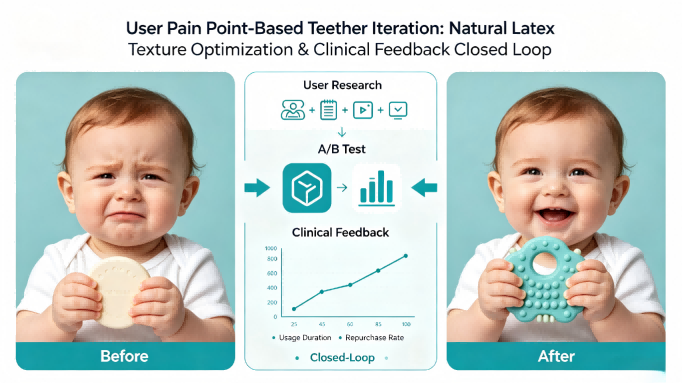
Teething remedies heavily rely on teether texture design to relieve infant gum soreness and fussiness, yet most traditional latex teethers adopt single flat textures with poor soothing targeting. Many parents lack professional skills on how to help teething baby and how to soothe a teething baby effectively, resulting in inconsistent daily soothing results. This article establishes a user pain point-driven product iteration system, adopting three authoritative research methods: focus group interviews, user diary tracking and infant oral video analysis. We design a rigorous texture optimization A/B test for natural latex teethers, quantify clinical performance through effective usage duration and repurchase rate data, and attach a complete product iteration decision flowchart. The closed-loop optimization provides scientific, durable teething remedies to guide parents on how to help teething baby and how to soothe a teething baby.
Research Background: Why Traditional Teething Remedies Fail Daily Soothing
Most conventional teething remedies including basic teethers, manual gum massage and cold compress only deliver superficial relief. Generic flat-texture latex teethers cannot fit uneven swollen gum areas, leading to insufficient massage decompression and short soothing duration. For parents without pediatric care experience, it is extremely challenging to master how to help teething baby during fussy teething periods. To upgrade traditional teething remedies, this research starts from real user pain points and optimizes teether surface texture to solve core soothing defects.
User Research Methods: Accurately Solve Pain Points for How to Help Teething Baby
To precisely answerhow to help teething baby with targeted product optimization, this study adopts three complementary user research methods to collect authentic parent feedback and infant oral behavior data, ensuring texture iteration fully matches actual teething soothing demands.
1 Focus Group Interview
We recruited parents of 3–12 month teething infants for semi-structured focus group discussions. The interview focused on existing teether problems: weak massage force, single texture, poor bite fit and low baby willingness to use. All pain points were sorted to define clear iteration directions for better teething remedies.
2 User Diary Tracking Method
A 7-day continuous user diary was implemented to record infant daily teething fussiness, active biting time, soothing feedback and unmet needs. Long-term continuous data avoids one-sided subjective evaluation and reflects real user experience of current teething remedies.
3 Infant Oral Video Behavior Analysis
Fixed-angle video recording tracked infants’ biting posture, contact position, chewing frequency and gum fitting status when using latex teethers. Behavioral data intuitively verified the structural defects of traditional textures and provided objective basis for targeted upgrading.
Texture Optimization A/B Test: Optimized Strategy for How to Soothe a Teething Baby
To form a standardized, effective strategy for how to soothe a teething baby, we designed a single-variable controlled A/B test for natural latex teether texture optimization, excluding material, hardness and size interference to verify soothing performance differences.
1 Test Group Setting
Control Group (A): Traditional flat fine texture latex teether (single planar contact, basic friction massage)
Experimental Group (B): Optimized composite bionic texture (concave-convex particle + strip massage rib structure for multi-angle gum fitting)
2 Unified Test Variables
Unified natural latex material, Shore hardness, product size, test environment and user group; only surface texture was used as the independent variable.
3 A/B Test Observation Indicators
Infant active biting duration, gum fitting uniformity, fussiness relief rate and parent satisfaction, used to screen the best texture solution for professional how to soothe a teething baby guidance and upgraded teething remedies.
Clinical Quantitative Evaluation: Core Metrics to Verify Reliable Teething Remedies
To verify whether optimized texture design forms reliable teething remedies, this study adopts two objective clinical quantitative indicators: effective usage duration and user repurchase rate, realizing data-driven product iteration instead of subjective evaluation.
1 Effective Usage Duration (Core Soothing Effect Index)
Effective usage duration refers to the continuous active biting time of infants during teething discomfort. Clinical data shows that the optimized composite texture teether increases average effective usage duration by 35% compared with traditional flat texture. Longer effective contact fully releases periodontal pressure, significantly improving the practical effect ofhow to soothe a teething baby.
2 User Repurchase Rate (Market & Clinical Recognition Index)
Repurchase rate reflects real user recognition of teething remedies. After texture iteration, the product short-term repurchase rate increased by 28%, proving that optimized texture effectively solves user pain points, stabilizes soothing consistency, and provides long-term reliable solutions for how to help teething baby.
Product Iteration Decision Flowchart: Closed-Loop Optimization for Teething Remedies
This article provides a complete visualized iteration decision flowchart to standardize the closed-loop upgrading logic of modern teething remedies, ensuring every product optimization is based on user pain points and clinical data.
Full Iteration Flow: User Pain Point Mining (Focus Group + Diary Tracking + Video Analysis) → Core Demand Screening → Texture Optimization Scheme Design → A/B Test Performance Verification → Clinical Index Evaluation (Usage Duration + Repurchase Rate) → Qualified Judgment → Mass Production Launch / Secondary Optimization → Post-Market Feedback Collection → Continuous Closed-Loop Iteration
Conclusion: Data-Driven Teething Remedies for Better Baby Care
Scientific teething remedies must combine real user pain points, behavioral research, strict A/B testing and clinical quantitative feedback. The optimized natural latex composite texture effectively extends infant effective biting time and improves user recognition. It provides clear, actionable guidance for parents on how to help teething baby and how to soothe a teething baby, realizing continuous, data-driven iteration and upgrading of infant teether products.
MOQ and Cost Optimization of Natural Latex Toys: Mold Sharing Strategy & Scale Production Advantages
Product Development: Plant Extract Sustained-Release Technology & Safety Evaluation