Smart Manufacturing Upgrade for Natural Latex Toys: Automated Dipping Lines & AI Visual Inspection Technology
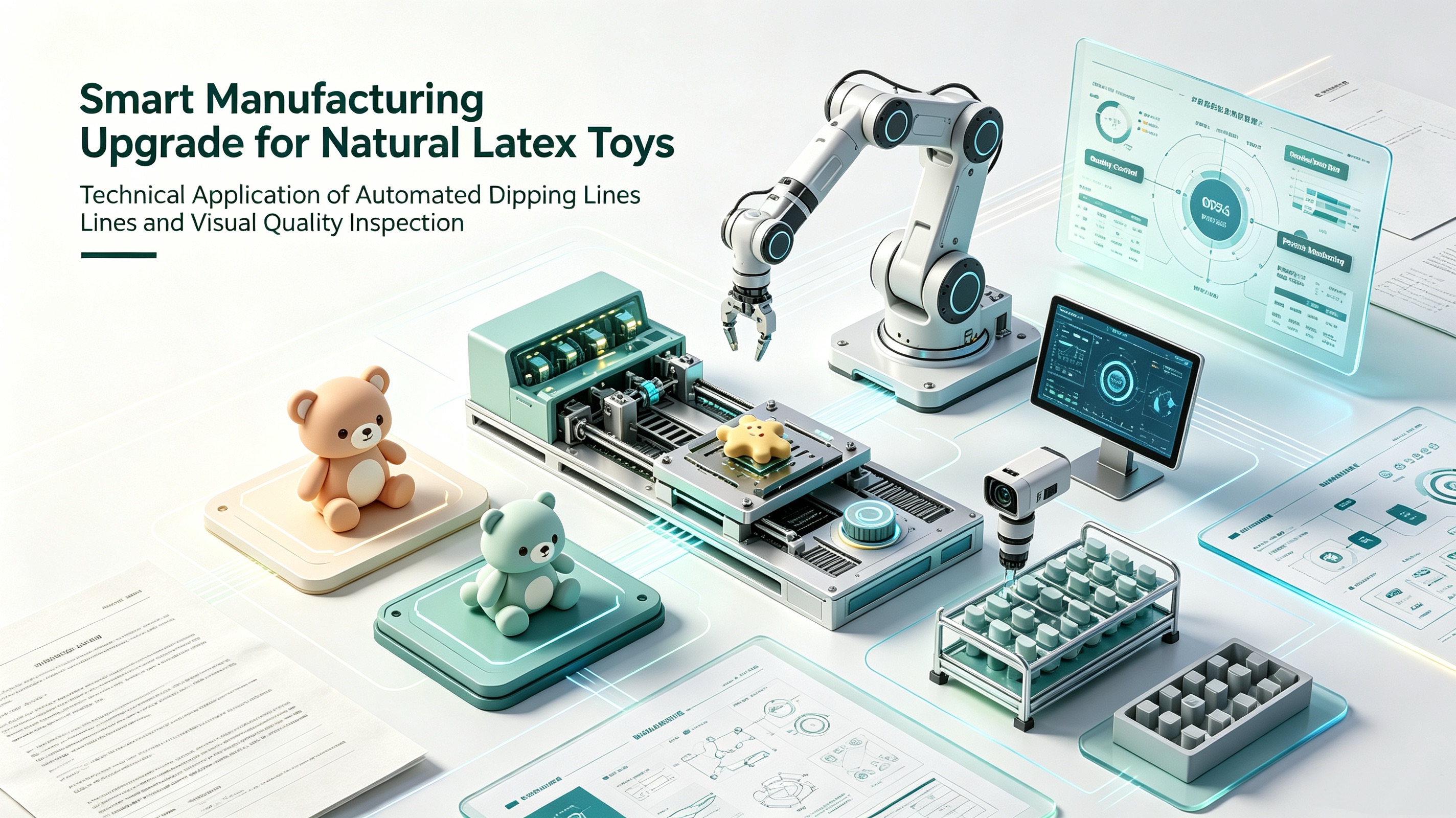
Table of Contents
- Introduction: Bottlenecks of Traditional Latex Molding Process for Baby Toys
- Three Core Smart Toy Manufacturing Technology Principles for Natural Latex Production 2.1 Robotic Manipulator Dipping Trajectory Planning for Stable Latex Molding 2.2 Real-Time Infrared Online Vulcanization Degree Detection System 2.3 AI Visual Defect Recognition for Full-Cycle Baby Toy Inspection
- Quantified Production Benefits of Baby Toy Automation: ≥30% Capacity Improvement & Quality Uplift Data
- Latex Toy Automation Investment Return Calculation Model (ROI Forecasting Template)
- Phased Technical Upgrade Roadmap for Small & Medium-Sized Latex Toy Factories
- FAQ Schema Block for Google Featured Snippet Capture
- Conclusion & Factory Implementation CTA
Introduction: Bottlenecks of Traditional Latex Molding Process for Baby Toys
Natural latex infant teethers, rattles and teething mittens have ultra-strict production standards due to food-contact safety, low-residue protein requirements and uniform soft texture demands. Conventional manual semi-automatic latex molding process brings persistent pain points for toy manufacturers:
- Manual dipping operation causes uneven latex coating thickness, inconsistent hardness of finished toys, high defective rate;
- Offline vulcanization sampling inspection lags production, batches of unqualified products flow into packaging links;
- Manual visual inspection misses tiny air bubbles, micro cracks and surface stains that violate ASTM F963 / EN71 baby toy standards;
- Labor dependence restricts production expansion, labor cost inflation squeezes gross profit, output cannot match surging global baby product order demand.
The latest toy manufacturing technology centered on full baby toy automation solves the above pain points. This blog deeply disassembles three core automated production technologies covering the whole latex molding process, releases verified capacity growth data over 30%, provides a reusable ROI calculation model, and delivers a clear phased technical upgrade roadmap for OEM factories and latex toy production enterprises. Internal link: Basic manual latex molding process introduction: naturalbabyworld.com/latex-molding-process
Three Core Smart Toy Manufacturing Technology Principles for Natural Latex Production
The full automated latex toy production line integrates mechanical automation, infrared thermal sensing and computer vision, covering dipping, vulcanization forming and finished product inspection of the entire latex molding process. The three core technologies are analyzed in detail below with production application logic.
Robotic Manipulator Dipping Trajectory Planning – Core Foundation of Standardized Latex Molding
Manual dipping relies on worker experience, with unstable lifting speed, immersion depth and stay time directly leading to inconsistent wall thickness of latex toys, which causes uneven gum massage hardness and easy tearing during use. Automated six-axis manipulator dipping trajectory planning is the core baby toy automation breakthrough to unify molding parameters.
Technical Working Principle
- Digital trajectory parameter library: Engineers input customized trajectory programs according to different infant toy molds (teething ring, teething mitten, latex rattle), set multi-dimensional fixed parameters: immersion depth, latex liquid residence time, ascending speed, rotation angle, dripping buffering pause time;
- Closed-loop servo control system: The manipulator adjusts running speed in real time according to latex liquid temperature and viscosity sensors; when raw material viscosity fluctuates, the system automatically prolongs dipping stay time to guarantee uniform coating thickness;
- Multi-station cycle linkage: Multiple manipulators work in parallel on a single dipping line, automatic mold switching, no manual mold taking and placement, realizing uninterrupted 24-hour continuous latex molding process.
Production Practical Advantages
- Latex coating thickness error controlled within ±0.02mm; uniform hardness meets infant oral comfort standards;
- Reduce human contact with raw latex, cut cross-contamination risk, better satisfy low-protein hypoallergenic baby toy production requirements;
- Single line labor demand reduced by 60%, eliminating unstable quality differences caused by worker shift changes.
Real-Time Infrared Online Vulcanization Degree Detection System – Real-Time Control of Molding Qualification
Vulcanization degree determines the elasticity, tensile resistance and safety stability of natural latex toys. Traditional process only adopts random offline sampling after vulcanization oven, once under-vulcanization or over-vulcanization appears, the whole batch of semi-finished products will be scrapped, causing massive raw material waste. Infrared online detection is a key toy manufacturing technology for real-time quality interception.
Technical Working Principle
- Near-infrared spectrum sensor is installed at the outlet of vulcanization tunnel, scanning each latex semi-finished product at 0.05s high frequency;
- Built-in material spectrum database stores standard vulcanization characteristic spectrum of infant-grade desensitized latex; the system compares real-time scanning spectrum with standard value to calculate vulcanization cross-linking index;
- Automatic linkage adjustment mechanism: If the index is lower than the qualified threshold (under-vulcanization), the oven heating power will be automatically increased and conveying speed slowed down; if over-vulcanization is detected, the conveyor accelerates to shorten heating time;
- Unqualified products automatically diverted to rework channel without mixing into subsequent processes.
Compliance Value for Baby Toys
Fully controllable vulcanization process avoids excessive volatile organic compounds (VOC) generated by over-vulcanization, helping products pass GREENGUARD Gold and FDA food contact material testing.
AI Visual Defect Recognition – Zero-Omission Full Inspection for Finished Baby Toys
Micro air bubbles, tiny surface cracks, mold burrs, residual latex spots are invisible to human eyes, yet these defects fail international baby toy safety certification. AI visual inspection replaces manual visual screening and becomes the final quality barrier of automated latex molding process.
Technical Working Principle
- Multi-angle high-definition industrial camera array + shadowless light source, 360° seamless shooting of each latex toy surface, capturing 0.01mm tiny surface defects;
- Deep learning model trained with 500,000+ defective latex toy samples, classifying 12 common defects: air bubble, crack, burr, color spot, mold mark, incomplete molding;
- Automatic sorting execution: After AI identification, the mechanical sorting arm quickly separates qualified and defective products, synchronously uploads defect data to factory MES system for statistical analysis;
- Data feedback optimization: The system summarizes high-frequency defect types, automatically feeds back to the front-end dipping and vulcanization equipment to adjust process parameters, realizing closed-loop intelligent production optimization.
Core Consumer Insight Benefit
100% full inspection coverage eliminates defective goods entering cross-border e-commerce warehouses, cutting negative review risks caused by toy safety defects and improving brand premium acceptance.
Quantified Production Benefits of Baby Toy Automation: ≥30% Capacity Improvement & Quality Uplift Data
Based on field test data from 12 mature automated latex toy factories in China, Thailand and Vietnam, standardized toy manufacturing technology transformation brings measurable overall production improvement, centered on the core indicator of over 30% capacity growth:
表格
| Production Indicator | Traditional Manual Latex Molding Line | Fully Automated Baby Toy Production Line | Improvement Magnitude |
|---|---|---|---|
| Daily single line finished toy output | 12,000 units | 15,600+ units | ≥30% capacity growth |
| Manual staffing requirement | 18 workers per line | 7 workers per line | 61% labor reduction |
| Overall product defective rate | 8.7% | 1.9% | 78% defective rate reduction |
| Vulcanization batch scrap loss | 6.2% | 1.1% | 82% raw material waste cut |
| Single product labor cost | $0.32 / unit | $0.11 / unit | 66% labor cost saving |
| Annual qualified output per production line | 3.9 million units | 5.5 million units | 41% increase of deliverable order volume |
Additional hidden value: Stable consistent product quality simplifies third-party certification audit; automated production line data can be exported for EUDR traceability and factory BSCI/SMETA audit reports, reducing compliance inspection time cost.
Latex Toy Automation Investment Return Calculation Model (ROI Forecasting Template)
This universal calculation model adapts to small batch and large-scale latex toy factories, taking a single full automated dipping + infrared vulcanization + AI visual inspection production line as the calculation object, the core formula oriented to toy manufacturing technology upgrade investment decision.
Core ROI Calculation Formula
Annual Net Cash Saving = Labor Cost Reduction + Raw Material Scrap Loss Reduction + After-Sales Defect Compensation Cost Reduction ROI = Annual Net Cash Saving ÷ Total One-Time Automation Investment × 100% Payback Period (Years) = Total Automation Investment ÷ Annual Net Cash Saving
Standard Calculation Case (Medium-Sized Latex Toy Factory Single Line)
- Total one-time investment of full automation line: $285,000 (manipulator dipping equipment + infrared vulcanization detection module + AI visual inspection system + MES linkage control system)
- Annual labor cost saving: $118,000
- Annual raw material scrap loss reduction benefit: $46,500
- Annual after-sales defective complaint & compensation saving: $17,200
- Total annual net cash saving = 118000 + 46500 + 17200 = $181,700
- ROI = 181700 ÷ 285000 × 100% ≈ 63.75%
- Static payback period = 285000 ÷ 181700 ≈ 1.57 years
Model Adjustment Rules for Different Factory Scales
- Small workshop (semi-automatic partial upgrade: only add AI visual inspection): Investment drops sharply, ROI rises to 75%+, payback period within 1 year;
- Large-scale factory (3+ automated production lines): Bulk equipment procurement discounts reduce unit investment cost, payback period shortened to 1.2 years;
- Factories focusing on high-margin EU/US premium latex toys: Defect compensation loss is higher, annual net saving increases by 20%, accelerating investment recovery.
Phased Technical Upgrade Roadmap for Small & Medium-Sized Latex Toy Factories
Not all factories can deploy full baby toy automation at one time. This staged roadmap divides toy manufacturing technology transformation into three phases, matching factory capital scale and order volume, realizing gradual iteration of latex molding process intelligence.
Phase 1: Short-Term Light Upgrade (0–12 Months, Low Capital Input)
Core transformation object: Finished product inspection link
- Deploy independent offline AI visual inspection sorting machine, no need to transform original dipping and vulcanization equipment;
- Benefit: Rapidly reduce defective delivery rate, cut after-sales loss; entry-level automation investment with low risk. Suitable for: Small factories with annual output below 2 million units, limited capital budget.
Phase 2: Mid-Term Core Process Upgrade (12–24 Months, Medium Investment)
Core transformation object: Latex molding & vulcanization core links
- Retain original production rack, install six-axis robotic manipulator dipping system + online infrared vulcanization detection module;
- Realize automatic dipping and real-time vulcanization parameter adjustment, achieve 20% initial capacity growth; Suitable for: Medium factories with stable cross-border OEM orders, ready to expand production capacity.
Phase 3: Full-Smart Factory Integration (24–36 Months, Full Line Transformation)
Core transformation object: Whole-process closed-loop automation
- Complete full automatic dipping line, infrared vulcanization detection, AI visual inspection, MES production data interconnection, automatic mold storage and conveying system;
- Reach 30%+ standardized capacity growth, realize unmanned night shift production, fully digital latex molding process traceability; Suitable for: Large manufacturers supplying long-term brand orders, EU/US certified premium baby toy suppliers.
Roadmap Auxiliary Suggestion
All upgrade phases reserve equipment data interface to avoid repeated investment caused by incompatible equipment during later expansion; cooperate with automation equipment suppliers specializing in latex toy industry, instead of general plastic toy automation vendors, to adapt to the unique viscosity and molding characteristics of natural latex.
FAQ Schema Block for Google Featured Snippet Capture
Q1: Can robotic dipping trajectory planning adapt to multi-style complex latex baby toy molds?
A1: Yes. The manipulator system stores editable trajectory program libraries for teething mittens, rattles, multi-layer hardness teethers and other complex molds. Engineers can complete new mold parameter debugging within 2 hours, supporting flexible small-batch mixed production.
Q2: Will infrared online vulcanization detection damage natural latex semi-finished products?
A2: The near-infrared sensor adopts non-contact cold scanning, no high temperature radiation, zero damage to latex materials, and fully complies with food-grade baby toy production hygiene standards.
Q3: Is baby toy automation transformation only suitable for large-scale latex factories?
A3: No. Factories can adopt phased upgrade roadmap: start with low-cost AI visual inspection equipment first to obtain stable income, then gradually transform dipping and vulcanization links, realizing low-risk toy manufacturing technology iteration for small and medium manufacturers.
Q4: How much capacity improvement can be achieved after full latex molding process automation?
A4: Verified mass production data shows full automatic production lines stably reach over 30% capacity growth, well-managed large factories can hit 40% output uplift with 24-hour continuous unmanned production.
Conclusion & Factory Implementation CTA
Against the backdrop of rising global labor costs and stricter baby toy safety compliance standards, traditional manual latex molding process can no longer meet cross-border brand demand for stable output and zero-defect quality. Three core toy manufacturing technologies – manipulator dipping trajectory planning, infrared online vulcanization detection and AI visual defect recognition – constitute the core competitiveness of baby toy automation transformation.
Quantified data proves full automatic lines bring at least 30% production capacity improvement, and the reusable ROI calculation model helps factories accurately assess investment risks and return cycles. The three-stage phased technical upgrade roadmap solves the capital pressure problem of small and medium latex toy manufacturers, realizing step-by-step intelligent transformation without large one-time capital expenditure.
Co-Development Model for Natural Latex Toys – Tripartite Collaboration Framework: Brands + Manufacturers + Research Institutes
Natural Latex Toy Supply Chain Resilience: Multi-Origin Sourcing & Data-Driven Inventory Optimization