Ring Teether Structure Optimization: Natural Latex Hollow Water-Filled Design & Freezing Safety Verification
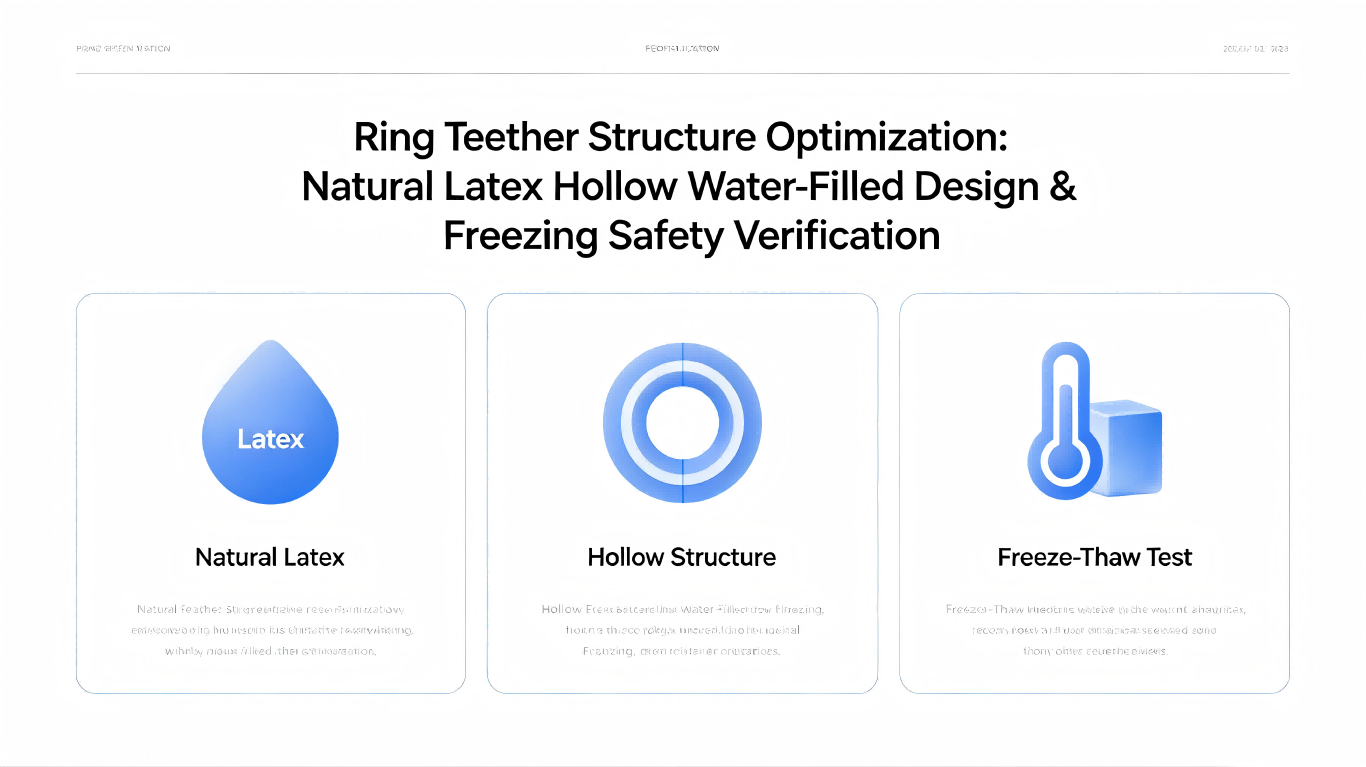
Ring Teether Structure Optimization: Natural Latex Hollow Water-Filled Design & Freezing Safety Verification
Introduction
Table of Contents
- Core Structural Optimization:Cavity Water Injection to Prevent Freeze Cracking for Cooling Teething Ring
- Freeze-Thaw Cycle Test Method for Durable Frozen Teething Rings
- Burst Pressure Test Standard for Teething Ring Structural Safety
- Standard Safety Warning Specifications for Water-Filled Teething Rings
- Conclusion
Core Structural Optimization:Cavity Water Injection to Prevent Freeze Cracking for Cooling Teething Ring

The most persistent challenge facing traditional cooling teething rings is structural rupture caused by the volumetric expansion of water during low‑temperature freezing. Water expands by approximately 9% when fully frozen, and if the cavity is overfilled, the internal pressure easily exceeds the elastic limit of the natural latex shell – leading to irreversible cracking, bulging, and eventual leakage of the gel fluid. Such damage not only ruins the teething ring but also poses safety risks, as leaking contents or sharp edges can irritate a baby’s sensitive gums.
To eliminate this hazard, the industry has established a unified safety standard for all frozen teething rings: the water injection volume must not exceed 70% of the total cavity capacity. The deliberately reserved 30% hollow air buffer space acts as a pressure absorber, evenly distributing the expansion stress generated during freezing. This design prevents localised stress concentration, shell deformation, and micro‑cracking, ensuring that the latex enclosure remains fully intact.
This standardised fill control is the critical structural optimisation for reusable teething rings – it guarantees that the natural latex shell preserves its inherent toughness, airtightness, and dimensional stability even after hundreds of freeze‑thaw cycles. As a result, parents can confidently rely on these cooling teething rings for long‑term soothing, knowing that each frozen teething ring delivers consistent, leak‑free performance without compromising safety or durability. In short, proper water volume is not a mere suggestion – it is the engineering backbone that distinguishes a truly reliable teething ring from one prone to premature failure.
Freeze-Thaw Cycle Test Method for Durable Frozen Teething Rings

To ensure the long‑term reliability and safety of cooling teething rings in everyday household use, all finished hollow teething rings must pass a standardized freeze‑thaw cycle aging test. This rigorous protocol simulates months of repeated freezing and thawing – exactly what parents do when rotating frozen teething rings in and out of the freezer for their baby’s sore gums.
Standard test procedure:
Each teething ring is filled with water strictly to the 70% cavity volume limit, then placed in a constant low‑temperature chamber at ‑18°C for 4 hours of complete solid freezing. Afterwards, it is removed and left to thaw naturally at room temperature (25°C) for 2 hours. This sequence constitutes one full freeze‑thaw cycle. To pass, every cooling teething ring must endure no fewer than 50 consecutive cycles without failure – a threshold that far exceeds typical home usage, where most parents freeze and reuse their teething rings only a few times per week.
Qualified acceptance criteria:
After completing 50 cycles, the frozen teething rings must show zero cracking, zero water leakage, no shell hardening, and no permanent deformation. They must also retain their original soft, chewy texture and maintain airtight sealing performance – because even microscopic damage can compromise hygiene and comfort. Passing this test verifies the product’s outstanding low‑temperature fatigue resistance and confirms that each teething ring delivers consistent soothing relief cycle after cycle. In short, this benchmark transforms a simple cooling teething ring into a dependable companion for teething babies, giving parents peace of mind that durability and safety are built right into the design.
Burst Pressure Test Standard for Teething Ring Structural Safety

Burst pressure resistance stands as the core mandatory safety benchmark for every water‑filled cooling teething ring. During daily use, teething rings face multiple sudden pressure spikes – from an infant’s emerging teeth clamping down with instinctive force, to a caregiver’s accidental squeeze, and most critically, the volumetric expansion of water during freezing. Any of these events can generate instantaneous impact loads on the natural latex shell, and without adequate strength, the result could be a sudden rupture, leaking fluid, or sharp edges – all unacceptable risks for a baby’s mouth.
To eliminate this hazard, the industry has unified around a strict minimum burst pressure of 0.3 MPa for all frozen teething rings and general cooling teething ring products. This threshold is not arbitrary; it is derived from extensive biomechanical tests that simulate the strongest infant bite forces, the highest manual compression, and the maximum freezing pressure produced at −18°C – ensuring that the safe limit comfortably exceeds all real‑world extremes.
Test specification: Each finished teething ring is filled with water and subjected to a controlled hydraulic pressure ramp, then held at 0.3 MPa for a full 60 seconds. During this hold period, qualified frozen teething rings must exhibit zero shell rupture, no micro‑cracks, and absolutely no water seepage – even under magnified inspection. Passing this test confirms that the cooling teething ring can endure repeated freeze‑thaw cycles, vigorous chewing, and accidental squeezing without compromising its structural integrity. In essence, this single standard gives parents the confidence that every teething ring they hand to their little one is engineered to stay intact, safe, and soothing – no matter how much pressure teething brings.
Standard Safety Warning Specifications for Water-Filled Teething Rings
Conclusion
Teething Glove Mass Production Process: Natural Latex Dipping Molding & Embossed Texture Quality Control
Pacifier Teether Composite Product Development: Flow Rate Design & Teething Adaptation of Natural Latex Pacifiers