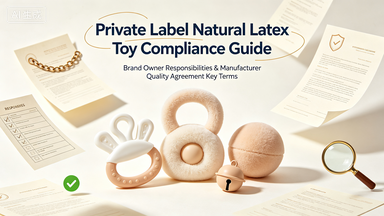
Private Label Natural Latex Toy Compliance Guide: Brand Owner Responsibilities & Manufacturer Quality Agreement Key Terms
author: Yvonne
2026-07-02
Sellingprivate label baby toys, white label teether, and custom branded infant products made from natural latex is one of the most profitable niches in the global baby goods market. Parents prioritize non-toxic, soft, and durable natural latex materials for teething, sensory, and soothing toys, making these private label lines highly competitive for DTC brands, retailers, and gift companies. However, behind every successful white label infant product launch lies strict manufacturing compliance, clear liability division, and airtight quality control protocols.
Unlike generic plastic toys, natural latex baby products face stricter global safety regulations due to direct oral and skin contact with infants aged 0–3. For brand owners who outsource production to third-party manufacturers, vague quality agreements and neglected liability insurance coverage are the top two causes of product returns, market recalls, regulatory fines, and brand reputation damage.
This comprehensive compliance guide breaks down core brand owner obligations, mandatory product liability insurance requirements, non-negotiable quality agreement clauses (including acceptance standards, defect rate caps, and recall liability), real international brand cooperation cases, and a actionable agreement review checklist for private label natural latex toy partnerships.
Why Natural Latex Private Label Infant Products Need Strict Compliance Rules
Natural latex is favored for baby teethers, chew toys, and sensory infant products for its hypoallergenic properties, flexibility, and biodegradability. Yet the material’s organic nature also brings unique quality risks: residual latex protein allergies, mold growth from improper curing, inconsistent softness hardness, and unqualified surface cleanliness during mass production.
For private label baby toys and white label teether products sold in North America, Europe, and Australia, compliance is not optional—it’s a market entry threshold. Key regulatory standards include EU EN 71, US ASTM F977, FDA food-grade contact requirements, and CE marking mandates. Most importantly, regulatory bodies and consumer courts hold brand owners primarily responsible for non-compliant products, even if manufacturing faults stem from the factory.
Many emerging brand operators mistakenly believe that outsourcing production transfers quality and safety risks. In practice, manufacturers bear production liability, while brand owners undertake market sales, consumer-facing, and regulatory compliance liability. This core division makes standardized quality agreements and full-coverage product insurance indispensable for long-term private label operations.
Brand Owner Core Responsibilities & Mandatory Product Liability Insurance Requirements
Brand owners are the final market-facing entity of branded infant products. Beyond product positioning, packaging design, and sales operation, you bear three irreplaceable compliance responsibilities, with product liability insurance serving as your critical risk firewall.
1. Full Compliance & Labeling Responsibility
Brand owners must verify that all white label latex toys meet target market safety standards before launch. This includes reviewing manufacturer test reports, ensuring batch-wise safety certification, and standardizing product labeling. Qualified labels must display batch numbers, production dates, material compositions, age grading, warning statements, and brand responsibility information. Unqualified labeling will lead to customs detention, shelf removal, or forced recalls, regardless of product quality.
2. Product Liability Insurance (PL Insurance) Mandatory Rules
Unlike general commodity insurance, infant toy product liability insurance focuses on consumer injury compensation, regulatory fine coverage, and recall cost reimbursement. For private label latex teethers and baby chew toys, insurers universally require the following coverage terms for policy approval:
-
Minimum coverage limit: $2 million per occurrence for the US and EU markets, covering personal injury, allergic reaction damages, and property loss caused by product defects
-
Strict coverage scope: Must cover latent manufacturing defects, material residual risks, and batch quality inconsistencies, not just explicit production errors
-
Recall cost inclusion: Insurance must cover logistics, disposal, consumer compensation, and public announcement fees for voluntary or mandatory recalls
-
Third-party claim coverage: Protect brand owners from lawsuits filed by consumers, regulatory agencies, and retail platform partners
A common compliance mistake for new private label brands is purchasing low-cost general commodity insurance that excludes infant oral-contact products. Such policies will refuse compensation once quality disputes or safety incidents occur, leaving brands to bear all losses independently.
3. Post-Market Supervision & Recall Cooperation Responsibility
Brand owners are obligated to collect consumer feedback, track product batch sales data, and cooperate with manufacturers for defect screening. Once potential safety hazards are found, brands must initiate risk assessment immediately and coordinate recall actions per regulatory requirements.
Key Quality Agreement Clauses for Private Label Latex Toy OEM/ODM Cooperation
A loose quality agreement is the biggest hidden risk for private label baby toys and white label teether cooperation. Most factory disputes, batch rejections, and after-sales losses stem from ambiguous contract terms. Below are the three core mandatory clauses that every branded infant product cooperation agreement must clarify, with enforceable and quantifiable standards.
1. Precise Product Acceptance & Testing Standards
All quality inspection standards must be written into the agreement with quantifiable indicators, rather than vague descriptions like “meet industry standards”. For natural latex infant toys, the acceptance criteria cover material, appearance, performance, and safety testing:
-
Material standard: 100% pure natural latex without recycled latex; latex protein residue meets EU EN 71-10 allergy safety standards; no harmful additives, phthalates, or heavy metals (lead, cadmium) exceeding ASTM F977 limits
-
Appearance & dimension standard: No burrs, cracks, bubbles, or color unevenness; dimensional tolerance controlled within ±0.5mm; smooth edges to avoid scratching infant skin
-
Performance standard: Tensile and bite resistance meets infant chewing intensity; no deformation or breakage after 500+ simulated biting tests; high-temperature resistant (up to 100°C) for daily disinfection
-
Batch testing requirement: Each production batch must provide third-party test reports, including material safety, mechanical performance, and microbial detection reports
2. Clear Defect Rate Upper Limit & Dispute Resolution Rules
Mass production inevitably produces defective products, but the agreement must define clear defect rate ceilings and handling mechanisms to avoid brand economic losses. We recommend the following industry-leading quantifiable terms for branded infant products:
-
Major defect rate cap: 0.3%. Major defects include material non-compliance, surface cracks, sharp edges, and unqualified safety indicators—these products are prohibited from market sales. Manufacturers must replace all major defective products free of charge and bear all logistics costs.
-
Minor defect rate cap: 1.0%. Minor defects refer to slight color difference or tiny surface scratches that do not affect safety and use. Excess minor defective products shall be deducted proportionally from the settlement payment or replaced for free.
-
Inspection right reservation: Brand owners have the right to conduct random sampling inspection before shipment, factory in-process inspection, and full batch rejection right if the defect rate exceeds the upper limit
3. Full-Cycle Recall Liability Division
Product recall is the highest-cost risk in the latex baby toy industry. The agreement must clearly divide liability for different recall scenarios to prevent mutual shirking between brands and factories:
-
Manufacturer full liability: If recalls are caused by unqualified raw materials, non-standard production processes, batch quality inconsistency, or falsified test reports, the manufacturer shall bear all costs including product replacement, consumer compensation, recall logistics, regulatory fines, and brand reputation loss compensation
-
Brand owner liability: If recalls result from brand’s incorrect labeling, improper packaging design, or unreasonable usage instructions, the brand shall bear relevant costs
-
Joint liability & proportional allocation: For mixed causes, the two parties shall divide responsibilities based on third-party accident assessment reports
-
Recall cooperation obligation: The manufacturer must provide full batch production data, material sourcing records, and technical support within 24 hours once a recall is initiated
International Brand Cooperation Case: Mature Private Label Latex Toy Compliance Practice
A US cross-border baby goods brand specializing in white label teether and natural latex sensory toys has maintained zero recall records in 8 years of overseas sales, relying entirely on standardized quality agreement mechanisms and strict risk control. Their cooperation model is highly referential for all private label infant product brands.
The brand adopts a dual-inspection cooperation mechanism with its Southeast Asian latex toy manufacturer. First, the factory conducts full-process self-inspection during production and provides batch test reports before shipment. Second, the brand entrusts a SGS-certified third-party institution to conduct random sampling of each batch of goods, focusing on latex protein residue and heavy metal detection.
In their quality agreement, they strictly implement the 0.3% major defect rate cap and clarify that the manufacturer shall bear a 20% penalty of the total batch value for any batch exceeding the standard, in addition to full replacement costs. For recall risks, the agreement stipulates that the manufacturer must provide a dedicated recall reserve fund to ensure rapid response to safety incidents.
Meanwhile, the brand purchases $5 million high-limit product liability insurance covering EU and US markets. This compliant operation system helps the brand successfully enter Amazon, Walmart, and European offline mother-and-baby chain channels, forming a stable high-margin private label business model.
This case fully proves that standardized quality agreements and complete insurance coverage are the core competitiveness of long-term operation ofprivate label baby toys, not just low production costs.
Private Label Latex Toy Quality Agreement Review Checklist (Must-Check Before Signing)
To help brand owners avoid contract loopholes and standardize OEM/ODM cooperation, we have sorted out a practical full-item review checklist, covering all core compliance points:
-
Standard Term Verification: Confirm that the agreement explicitly binds EN 71, ASTM F977, and FDA food-grade safety standards, with no vague “industry standard” alternative descriptions
-
Defect Rate Confirmation: Verify written major/minor defect rate upper limits and corresponding penalty and replacement clauses
-
Inspection Right Clause: Ensure reserved brand owner’s in-process factory inspection, pre-shipment sampling, and batch rejection rights
-
Test Report Obligation: Clarify that the manufacturer must provide complete third-party batch test reports and material certification documents
-
Recall Liability Division: Confirm clear liability division, cost bearing, and cooperation process for all recall scenarios
-
Liability Indemnity Clause: Add manufacturer indemnity terms for brand losses caused by production quality problems
-
Batch Traceability Provision: Require manufacturers to retain production batch records, raw material sourcing data for more than 3 years
-
Insurance Cooperation Term: Confirm that the manufacturer has factory quality insurance and cooperates with brand product liability insurance claims
Final Thoughts
The core competition of private label baby toys, white label teether, and customized branded infant products is not only product design and market sales, but also underlying compliance and quality control capabilities. Natural latex baby toys belong to high-risk infant contact products, and any trivial quality loophole may trigger batch returns, platform delisting, consumer lawsuits, and brand crisis.
For brand owners, standardized quality cooperation agreements are the most effective risk isolation tool, and complete product liability insurance is the ultimate safety net for overseas market operations. By clarifying bilateral responsibilities, quantifying quality standards, and improving pre-signing review mechanisms, brands can build stable, safe, and profitable long-term private label manufacturing cooperation systems and stand out in the fierce global baby product market competition.
Natural Latex Baby Toy Certification Matrix: Entry Requirements for Europe, America, Asia
MOQ and Cost Optimization of Natural Latex Toys: Mold Sharing Strategy & Scale Production Advantages