Natural Rubber Sensory Toys for Babies: Benefits & Product Ideas
Every parent has watched a baby pick up an object, turn it over, squeeze it, and put it straight into their mouth. That moment is not random curiosity — it is the brain building itself. During the first year, more than one million neural connections form every second, and sensory input is the raw material that wires those connections. This is why the right toys matter far beyond entertainment. They are the tools a baby uses to understand the world.
Natural rubber sensory toys have emerged as a preferred category for parents who want safe, tactile, developmentally supportive playthings without the chemical concerns of plastic or cheap silicone. Derived from the sap of the Hevea brasiliensis tree, natural rubber offers a warm, soft, resilient texture that responds to a baby's grip in a way no hard plastic can match. This guide explores what sensory play is, how tactile stimulation shapes early development, and the key categories of natural rubber sensory toys — from textured pieces and grasping toys to sensory balls and teethers — along with product design ideas for brands expanding beyond the teether.
What Is Sensory Play?
Sensory play is any activity that stimulates a baby's senses — touch, sight, sound, smell, and taste — through exploration and manipulation. For infants, this is not a structured lesson. It is the unscripted process of squeezing a soft ball, running fingers across a ridged surface, shaking a rattle, or mouthing a flexible toy. Each action sends signals to the brain, which responds by strengthening the pathways that process those signals.
Developmental neuroscience calls this experience-dependent plasticity. The sensory and motor cortices are among the most plastic regions of the developing brain, and they develop through use. Neural pathways strengthen when they fire repeatedly, and sensory play provides exactly that repetition in a form that feels intrinsically motivating. A baby does not need to be taught to squeeze a rubber toy — the feedback of the material giving and bouncing back is rewarding enough to encourage repetition, and that repetition is what builds skill.
Sensory play also serves a regulatory function. Research in developmental psychology and occupational therapy consistently shows that rich tactile input can reduce cortisol levels, calm the nervous system, and improve a baby's capacity for attention and self-regulation. This is why a fussy baby often settles when given something interesting to hold and chew. The sensory input is not just distracting — it is regulating.
Sensory play evolves in predictable stages. Newborns experience the world primarily through touch and taste. By three to four months, intentional reaching begins. By six months, transferring objects between hands and mouthing everything becomes dominant. By nine to twelve months, the pincer grasp emerges, and babies begin to poke and point. The best natural rubber sensory toys meet babies where they are at each stage, offering the right level of stimulation without overwhelming them.
Tactile Stimulation
Touch is the first sense to develop in the womb and the most continuously active after birth. A baby's skin is their largest sensory organ, and the hands and mouth contain an especially high density of mechanoreceptors — nerve endings that detect pressure, texture, vibration, and temperature. When a baby grips a natural rubber toy, those receptors fire in complex patterns, sending detailed information to the somatosensory cortex about the object's hardness, texture, temperature, and shape.
The quality of the material matters enormously. Natural rubber is warm to the touch, unlike plastic or silicone which feel cool and inert. It has a slight surface drag that makes it easy for small, uncoordinated hands to hold. It yields under pressure and then recovers, giving the baby clear haptic feedback. This feedback loop is essential for building motor control — a baby learns to adjust grip strength by feeling how the material responds, and that learning transfers to every other physical skill they will develop.
Tactile stimulation also supports cognitive development. When a baby feels a bumpy surface, a smooth surface, and a ridged surface in sequence, they are learning to categorize and compare. These early sensory discriminations are the foundation of later mathematical and scientific thinking. A baby who has experienced a wide range of textures has a richer internal library of sensory memories to draw on when they begin to sort and classify objects in toddlerhood.
The implication for parents and designers is clear: a sensory toy should not be uniformly smooth. It should offer varied tactile zones — smooth areas, raised bumps, ridged edges, soft depressions — that invite the baby's fingers and tongue to explore. Natural rubber is particularly well suited because it can be molded with fine surface detail that holds up under repeated chewing and washing, and its elasticity means textured surfaces do not wear down quickly.
Textured Toys
Textured natural rubber sensory toys are designed to maximize tactile exploration. They feature surface patterns — bumps, ridges, waves, dots, geometric reliefs — that give a baby's fingers and gums a rich, varied sensory landscape. Unlike a smooth teether offering only one tactile experience, a well-designed textured toy provides multiple zones of stimulation, encouraging the baby to turn and reposition the toy to discover new surfaces.
The developmental value lies in refining tactile discrimination. As a baby runs fingers over a ridged section and then across a smooth section, the brain processes the difference. This contrast-based learning is how the sensory cortex builds precision. Over time, babies who regularly play with textured toys develop more refined fine motor control and greater sensitivity to subtle differences in pressure and texture — skills that later support self-feeding, dressing, and writing.
Textured toys also serve an important oral sensory function. When a baby is teething, swollen, tender gums respond well to firm but yielding pressure. A textured surface the baby can press and rub against their gums offers more targeted comfort than a smooth toy, with raised elements creating localized pressure points that feel especially soothing. This is why many parents find that a spiky natural rubber sensory puzzle ball becomes a favorite during fussy teething periods — the multi-pointed texture gives the baby something to chew on from any angle.
From a design perspective, textured toys should balance stimulation with safety. Raised elements should be rounded, not sharp, and firmly integrated so they cannot be bitten off. The texture should be varied but not so dense that cleaning becomes difficult. Natural rubber's non-porous surface is an advantage here — it wipes clean easily and does not harbor bacteria the way porous materials can.
Grasping Toys
Grasping is one of the most important motor milestones of the first year. A baby's grasp evolves through a clear sequence: reflexive palmar grasp at birth, intentional whole-hand reach at three to four months, palmar grasp with thumb opposition at five to six months, raking grasp at seven to eight months, and finally the pincer grasp — thumb and index finger working together — at nine to twelve months. Each stage requires different kinds of toys.
Natural rubber grasping toys are designed to be easy for small hands to hold at every stage. The material's natural surface friction means even a newborn with weak grip can hold a lightweight rubber ring without it slipping. The softness means that if the baby accidentally hits themselves in the face — common in early months — it does not cause injury. And the flexibility means the toy can be squeezed and bent, providing haptic feedback that reinforces the grasping action.
For three to six months, the ideal grasping toy is lightweight, with a narrow profile fitting across the palm and some textural interest. A simple natural rubber ring or bar gives the baby something to grip, shake, and mouth. As control develops, toys with multiple grasping points — a figure-eight shape or protruding handles — encourage switching hands and exploring different grip positions.
For six to nine months, when hand-to-hand transfer becomes key, symmetrical shapes work well because they feel the same regardless of which hand holds them. Toys that make a gentle sound when shaken add an auditory reward that encourages repeated grasping, further strengthening arm and hand muscles. By nine to twelve months, as the pincer grasp emerges, babies benefit from toys with small protrusions or indentations that invite poking with the index finger. Across all stages, the toy should be slightly challenging but not frustrating — rewarding effort with success.
Sensory Balls
Sensory balls are among the most versatile natural rubber sensory toys. A single ball can support tactile exploration, grasping practice, hand-eye coordination, cause-and-effect learning, and early gross motor development as the baby crawls and chases a rolling ball. The spherical shape is inherently engaging — it moves unpredictably, fits easily in the hands, and offers a continuous curved surface always presenting a new angle.
The simplest sensory ball is a smooth, soft ball the baby can squeeze, roll, and chase. The give of rubber under pressure teaches elasticity and cause-and-effect — squeeze and it deforms, release and it returns. This is a fundamental physics lesson absorbed through play long before the baby has words for it.
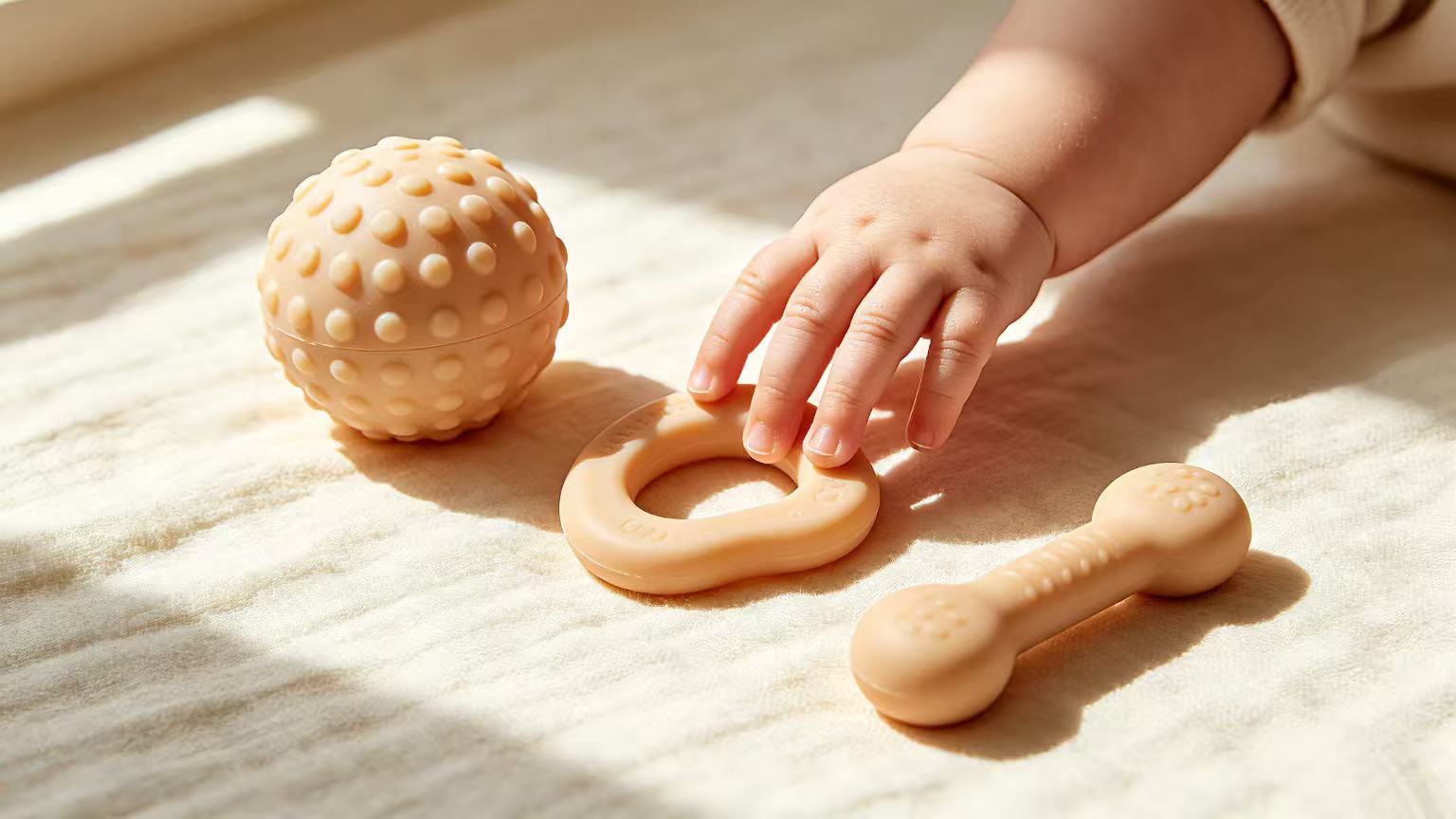
Textured sensory balls add another layer. A ball with raised bumps, ridges, or spiky protrusions offers tactile stimulation on every surface, and uneven texture makes the ball roll in unpredictable patterns that encourage crawling and reaching. The textured natural latex sensory ball for babies exemplifies this — its varied surface invites finger exploration, its softness makes it safe for indoor play, and its size is calibrated for infant hands. Some textured balls produce a gentle squeak or rattle when squeezed, adding auditory feedback that makes cause-and-effect even more explicit.
Sensory balls support development across domains: physically building grasp strength and bilateral coordination, cognitively teaching object permanence and spatial awareness, and socially enabling the first back-and-forth exchanges with a caregiver — roll the ball to baby, baby rolls it back — laying the foundation for turn-taking. For designers, natural rubber's ability to be molded in a single piece, with no seams or glued-on parts, makes it ideal for ball construction, eliminating choking hazards common in multi-part plastic balls.
Teethers
Teethers are the most familiar category of natural rubber baby toy. Teething typically begins around four to six months and can continue through the second year. The pressure of an emerging tooth pushing through the gum causes swelling and discomfort, and babies instinctively seek something firm to bite on. A natural rubber teether provides the ideal combination of softness and resistance — yielding enough to be comfortable but firm enough to deliver meaningful counter-pressure.
What sets natural rubber apart from silicone or plastic is its warmth and flexibility. It warms quickly to body temperature, never feeling shockingly cold against sensitive gums. Its elasticity allows compression and stretching during vigorous chewing without losing shape, and its natural surface texture provides subtle tactile feedback that ultra-smooth silicone cannot match.
Safety is paramount. High-quality natural rubber teethers are made from 100% pure Hevea latex, free from BPA, phthalates, PVC, and artificial softeners. They should meet ASTM F963 (U.S. toy safety standard, 16 CFR Part 1250), EN71 (European toy safety standard), and FDA 21 CFR 177 for indirect food contact. Responsible manufacturers use a deproteinization process to reduce latex protein — the allergy-triggering component — to below 50 micrograms per gram, making the toy safe for most babies. Families with known latex allergy should consult a pediatrician.
The teether category is where sensory design can be most impactful. A smooth, flat teether serves only gum relief, but one with varied textures, multiple biting surfaces, and an easy-to-grasp shape doubles as a sensory toy. The organic natural latex teethers collection demonstrates this, with shapes featuring textured chewing zones, smooth gum-massage areas, and easy-grip handles. This dual-function design means the toy remains useful beyond acute teething, transitioning into a general sensory and grasping toy as the baby grows.
Early Development
The first twelve months are the most rapid period of brain development in human life, and sensory input quality has lasting effects. Harvard's Center on the Developing Child describes brain architecture as built through "serve and return" — a baby serves up a gesture or exploration, and a responsive caregiver or engaging toy returns a meaningful response. Each exchange strengthens neural connections. Natural rubber sensory toys are excellent "return" partners because they respond immediately and predictably: squeeze and the toy gives, shake and it might rattle, roll and it moves. This reliable feedback loop is exactly what the developing brain needs to understand cause and effect.
Benefits extend across every domain. Motor: grasping, squeezing, and manipulating build fine motor skills underpinning self-feeding, dressing, and writing. Cognitive: exploring textures and shapes builds foundations for categorization, problem-solving, and spatial reasoning. Language: sensory play creates natural opportunities for caregivers to narrate — "you're squeezing the ball," "that feels bumpy" — building vocabulary. Social-emotional: tactile input's self-regulating effect helps babies manage stress, laying groundwork for emotional regulation.
Research on tactile deprivation underscores this necessity. Studies of infants in institutional settings with limited physical contact show impaired growth, cognition, and immune function, with evidence pointing to lack of mechanosensory stimulation rather than maternal deprivation. While no loving home approaches that level, the research makes clear that rich, varied tactile input is not a luxury — it is a developmental necessity. The natural baby toys that support early growth article explores how the right toys can grow with a child from infancy through toddlerhood.
For parents, a well-chosen collection — a textured ball, a grasping ring, a multi-surface teether — provides months of developmentally supportive play. These toys need no batteries or screens. They need to be safe, tactile, and responsive, and natural rubber delivers on all three.
Product Design Ideas
For brands expanding from teethers into the broader sensory toy market, the opportunity is significant. The global baby sensory toy market is growing, driven by parental awareness of developmental science and a shift from plastic to natural, sustainable materials. Natural rubber's biodegradability, renewable sourcing, and superior tactile properties position it well. The following ideas illustrate how to extend beyond the basic teether.
Multi-Texture Grasping Bars. A 12cm cylindrical bar with three texture zones — smooth, ridged, bumpy — separated by raised rings. Under 50 grams, flexible, with slightly flared ends to prevent over-insertion. Targets three to eight months, encouraging the baby to shift the bar to discover different surfaces and building bilateral coordination.
Sensory Stacking Rings. Three to five graduated natural rubber rings, each with a different texture and muted color, stackable on a central rubber post or playable individually. Soft enough to be safe if the baby falls on them, and chew-safe. Teaches size discrimination and early problem-solving while providing ongoing tactile interest. Appeals to six to eighteen months.
Rolling Sensory Cylinder. A hollow 10cm rubber cylinder with textured exterior and internal rattle. Pushing it produces rolling motion and gentle sound, encouraging crawling and chasing. More predictable than a ball, ideal for early crawlers. The hollow center invites finger exploration. Targets six to twelve months.
Modular Sensory Set. Interchangeable natural rubber pieces — ball, cube, ring, figure-eight — each with different textures and weights, connectable via soft rubber links into a chain. Parents customize to the baby's skill level; individual pieces serve as teethers, graspers, and sensory explorers. Strong gift potential. The best natural baby toys for early development guide provides context on how grow-with-me designs extend product lifespan.
Bath-Time Sensory Toys. Natural rubber is water-resistant and buoyant — ideal for bath toys. Floating, squirting shapes with varied textures turn bath time into sensory-rich play, and warm water softens the rubber slightly, changing its tactile properties. Single-piece construction means no seams for mold to grow, unlike plastic bath toys. Extends the line into a new use case.
Across all designs, core principles apply: single molded piece with no glued parts or detachable elements; rounded, varied textures; soft muted colors from food-safe mineral pigments; certification to ASTM F963, EN71, and FDA 21 CFR 177; and plastic-free, environmentally responsible packaging aligned with the sustainable values that draw parents to natural rubber.
Final Thoughts
Natural rubber sensory toys represent a convergence of safety, sustainability, and developmental science. Simple in concept — a piece of shaped rubber a baby can hold, squeeze, and chew — but profound in impact. Every squeeze builds motor control. Every texture explored builds neural connections. Every moment of regulated, engaged play lays the foundation for lifelong learning. For parents, natural rubber means a material safe for the baby and gentle on the planet. For brands, the sensory toy category offers a logical expansion beyond the teether into a growing, underserved market. The babies who play with these toys today are building the brains of tomorrow — one squeeze, one texture, one discovery at a time.
Eco-Friendly Baby Toys: What Brands Need to Know in 2026
Non-Toxic Baby Toys: What International Buyers Need to Know