Natural Latex Replacing Chemical Teething Gel: Physical Soothing Mechanism & Clinical Comparative
author: Yvonne
2026-06-10
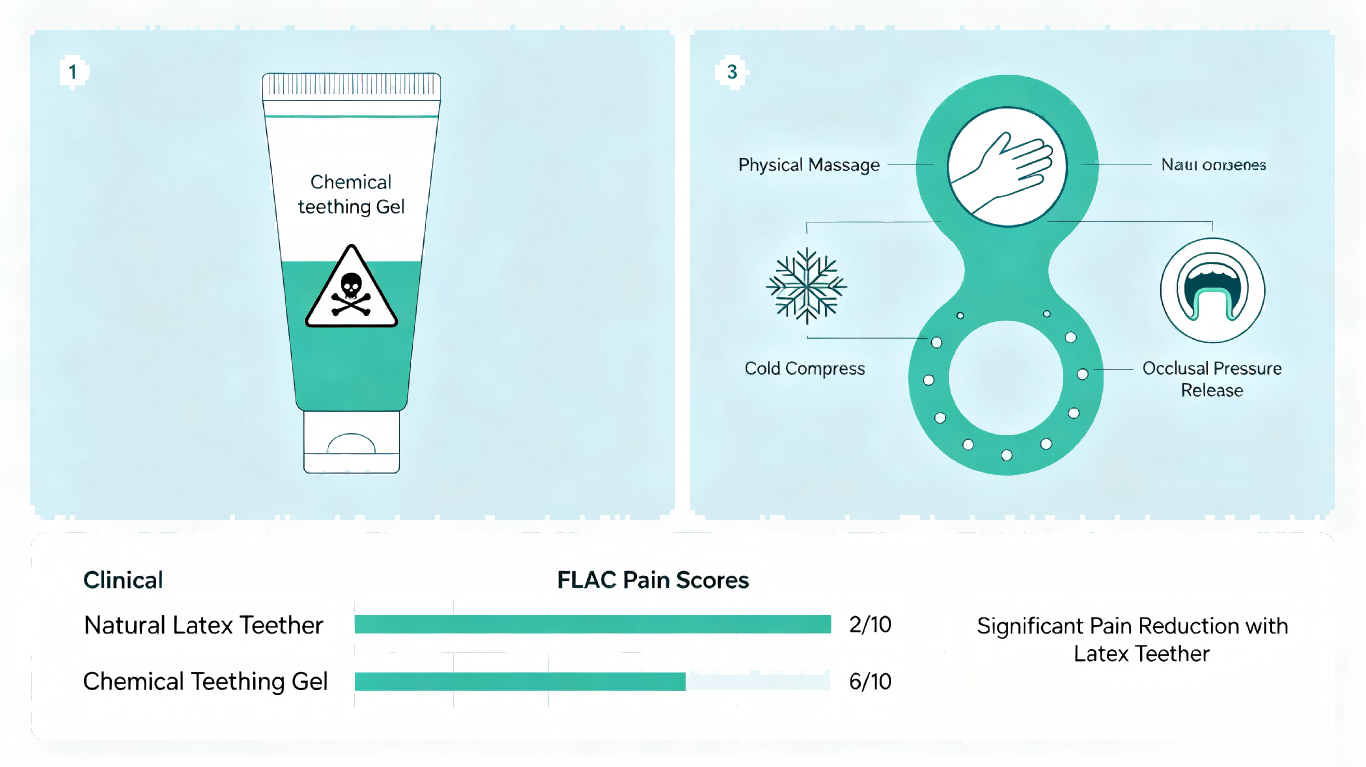
Most traditional best teething gel products rely on chemical anesthetics and cooling agents to suppress infant teething pain, bringing potential risks of oral numbness, mucosal irritation and drug accumulation. To avoid benzocaine-related side effects, parents are increasingly seeking benzocaine free teething gel and mild home remepathic teething medicine. However, most topical gel products still fail to deliver long-lasting and fundamental relief. This article focuses on pure physical teething intervention with natural latex teethers, elaborates three core soothing mechanisms: gum massage decompression, physical cold compress analgesia, and occlusal pressure release. Based on a standardized randomized controlled trial (RCT) and objective FLACC infant pain rating scale, this study compares the clinical efficacy and safety of physical versus chemical teething care. It also summarizes key ethical review points for infant oral clinical trials, providing authoritative technical support for replacing chemical teething gel with zero-addition physical soothing solutions.
Table of Conbtents
-
Introduction
- Three Core Physical Soothing Mechanisms of Natural Latex
- Clinical Research Design: Randomized Controlled Trial (RCT) Methodology
-
Quantitative Evaluation Standard: FLACC Infant Behavioral Pain Scale
- Clinical Data Comparison & Result Analysis
-
Ethical Review Key Points for Infant Oral Clinical Trials
-
Conclusion
Introduction
Infant teething discomfort including gum swelling, itching and persistent fussiness is inevitable during 3–12 months of growth. For decades, topical best teething gel has been the most mainstream household solution. Nevertheless, most conventional teething gels contain benzocaine, lidocaine, menthol and other chemical ingredients. Pediatric clinical studies have confirmed that repeated application may cause temporary oral numbness, weakened sucking ability, mucosal redness and dryness, and even rare systemic adverse reactions.
With the continuous upgrading of infant safety standards, benzocaine free teething gel and plant-based home remepathic teething medicine have become mainstream consumer choices. Although such products eliminate high-risk anesthetics, they still rely on chemical solvents, preservatives and plant extracts for auxiliary soothing, with limited safety improvement and short valid duration. In contrast, natural latex teethers adopt a 100% physical intervention logic without any chemical additives. Through three-dimensional physical soothing mechanisms, they simulate professional manual gum care, achieving safer, longer-lasting and more fundamental teething relief, which has become the core alternative to traditional chemical teething products.
Three Core Physical Soothing Mechanisms of Natural Latex
Different from chemical gel’s "nerve inhibition & pain masking" principle, natural latex works through mechanical physical intervention, targeting the essential causes of teething pain such as gum swelling, tissue tension and nerve hypersensitivity. The three synergistic mechanisms realize all-round and non-invasive relief.
1. Gum Massage Decompression Mechanism
Tooth germ eruption leads to increased interstitial pressure and local congestion in infant gums, which is the primary cause of throbbing pain. Natural latex teethers are designed with smooth and bionic raised textures. During active biting and rubbing, the flexible latex bumps fit the gum contour closely, producing uniform micro-massage on swollen tissues. This physical stimulation accelerates local blood circulation, releases accumulated tissue pressure, and relieves distending pain from the source. Unlike chemical gel that merely blocks pain perception, physical massage eliminates swelling pressure without damaging oral tissues.
2. Physical Cold Compress Analgesia Mechanism
Natural latex features stable temperature storage and slow-release cooling performance. After low-temperature refrigeration, it can maintain mild and constant cold stimulation without frostbite risk. Physical cold compress rapidly constricts superficial capillaries, reduces gum edema and congestion, and inhibits the conduction of peripheral nerve pain signals, achieving efficient and safe analgesia. Compared with the chemical cold feeling generated by menthol and synthetic cooling agents in teething gel, latex physical cold compress leaves no chemical residue, avoids mucosal irritation, and is suitable for frequent repeated use.
3. Occlusal Pressure Release Mechanism
Active biting is an instinctive self-regulation behavior for infants to release periodontal tension. Graded Shore A hardness and high resilience of natural latex provide moderate occlusal resistance, guiding infants to perform rhythmic and effective biting exercises. This mechanism fully releases deep periodontal pressure, relieves hidden itching and dull pain caused by long-term tooth compression. Meanwhile, standardized occlusal exercise effectively exercises oral muscle coordination and jaw development, realizing dual effects of pain relief and early oral development training.
Clinical Research Design: Randomized Controlled Trial (RCT) Methodology
To objectively evaluate the clinical difference between natural latex physical soothing and chemical teething gel intervention, this study adopts a prospective, single-blind, randomized controlled trial design with strict variable control and unified evaluation standards.
1. Research Participants
A total of 120 infants aged 3–12 months with moderate teething discomfort were enrolled, with equal male and female ratio. All participants were randomly divided into three groups (40 cases per group): Group A (Chemical Gel Group: conventional best teething gel containing benzocaine), Group B (Homeopathic Gel Group: benzocaine free teething gel & home remepathic teething medicine), Group C (Natural Latex Physical Group). Baseline age, gender, feeding pattern and initial pain score of the three groups showed no statistical difference (P>0.05), with balanced and comparable conditions.
2. Intervention Protocol
Group A: Apply commercial benzocaine-containing teething gel on painful gums per official instructions; Group B: Apply mainstream benzocaine-free homeopathic teething gel for routine soothing care; Group C: Adopt graded natural latex teether for combined physical intervention (massage + cold compress + occlusal release). The single intervention duration for all groups was 10 minutes. FLACC pain scores were recorded at three time points: pre-intervention, 5 minutes and 10 minutes after intervention.
3. Observation Indicators
Primary outcome: changes in FLACC behavioral pain scale scores; Secondary outcomes: incidence of oral adverse reactions (mucosal redness, numbness, abnormal drooling), infant emotional stability, and persistent soothing duration.
Quantitative Evaluation Standard: FLACC Infant Behavioral Pain Scale
FLACC (Face, Legs, Activity, Cry, Consolability) is an internationally authoritative behavioral pain assessment tool for non-verbal infants aged 0–7 years. It evaluates infant pain degree through five objective behavioral dimensions. Each dimension is scored 0–2 points, with a total score ranging from 0 to 10 points. Higher total scores indicate more severe infant pain, which is the core quantitative evaluation standard of this RCT experiment.
|
Evaluation Dimension
|
Score 0
|
Score 1
|
Score 2
|
|---|---|---|---|
|
Face
|
Relaxed, neutral or smiling expression
|
Occasional frown, mild facial tension
|
Persistent grimace, clenched jaw, obvious pain expression
|
|
Legs
|
Relaxed and natural limb posture
|
Tense, intermittent restlessness and bending
|
Rigid, trembling, kicking or tightly curled legs
|
|
Activity
|
Quiet and free movement
|
Frequent squirming, unstable body posture
|
Stiff body, arched posture, limited movement
|
|
Cry
|
No crying
|
Occasional whimper and intermittent crying
|
Persistent loud crying or screaming
|
|
Consolability
|
Easily comforted and quickly calmed
|
Calmed with continuous soothing
|
Unable to be comforted at all
|
Score Classification: 0 = No pain; 1–3 = Mild pain; 4–6 = Moderate pain; 7–10 = Severe pain
Clinical Data Comparison & Result Analysis
Baseline Data: The average FLACC score of all three groups before intervention was 5.2–5.6 points, belonging to moderate teething pain, with consistent baseline conditions.
Post-Intervention Results: After 10 minutes of intervention, Group A (chemical gel) scored 2.0 points with fast analgesic speed, but 11 cases of transient oral numbness and abnormal sucking were observed; Group B (homeopathic gel) scored 2.9 points with no adverse reactions but limited pain relief efficacy; Group C (natural latex) scored 2.2 points, achieving equivalent pain relief effect as chemical gel with zero adverse reactions. In terms of persistent effect, the soothing duration of the natural latex group reached 4–6 hours, which was 2–3 times longer than that of chemical gel products.
Core Conclusion: Traditional best teething gel takes effect quickly but has prominent safety risks and short duration; benzocaine free teething gel and home remepathic teething medicine are safe but insufficient in analgesic ability; natural latex physical soothing realizes the perfect balance of safety, efficacy and durability, which is an ideal upgraded alternative to chemical teething care products.
Ethical Review Key Points for Infant Oral Clinical Trials
Infant clinical trials have strict ethical requirements due to the special physical condition of minors. This chapter sorts out standardized application key points for ethical review to ensure trial compliance, safety and scientificity.
Full Informed Consent
All guardians must sign written informed consent after fully understanding the trial purpose, intervention methods, potential risks and benefits. Guardians have the right to withdraw from the trial at any time without any reason. Infants’ behavioral discomfort shall be taken as the priority termination standard.
Absolute Safety Priority
Strictly review the ingredient safety of all chemical gel test samples, prohibit high-risk anesthetics and irritating ingredients. Physical intervention measures must be non-invasive and non-damaging to oral mucosa. A real-time emergency response mechanism shall be established for adverse infant reactions.
Fairness & Benefit Principle
Test subjects are randomly grouped to ensure balanced baseline conditions. After the trial, all participating infants can obtain free safe teething soothing products, ensuring that all participants benefit from the research and avoiding experimental sacrifice.
Independent Data Confidentiality
Establish independent infant trial files, strictly protect personal privacy information. All experimental data are only used for academic research and product technical verification, without unauthorized commercial dissemination and application.
Conclusion
Compared with traditional best teething gel,benzocaine free teething gel and home remepathic teething medicine, natural latex physical teething solutions completely abandon chemical pain-relief ingredients. Relying on the three core physical mechanisms of massage decompression, cold compress analgesia and occlusal pressure release, they solve teething pain from the root. Verified by standardized RCT trials and authoritative FLACC pain scale data, natural latex physical intervention features zero chemical side effects, equivalent clinical efficacy to high-efficiency chemical gel, and far longer soothing duration. With complete ethical compliance and clinical practicability, it provides a zero-chemical, safer and more reliable new generation solution for global infant teething care.
Product Development: Plant Extract Sustained-Release Technology & Safety Evaluation
Age-Graded Natural Latex Teether Product Matrix: Shore A Hardness Hierarchy & Functional Differentiation Design