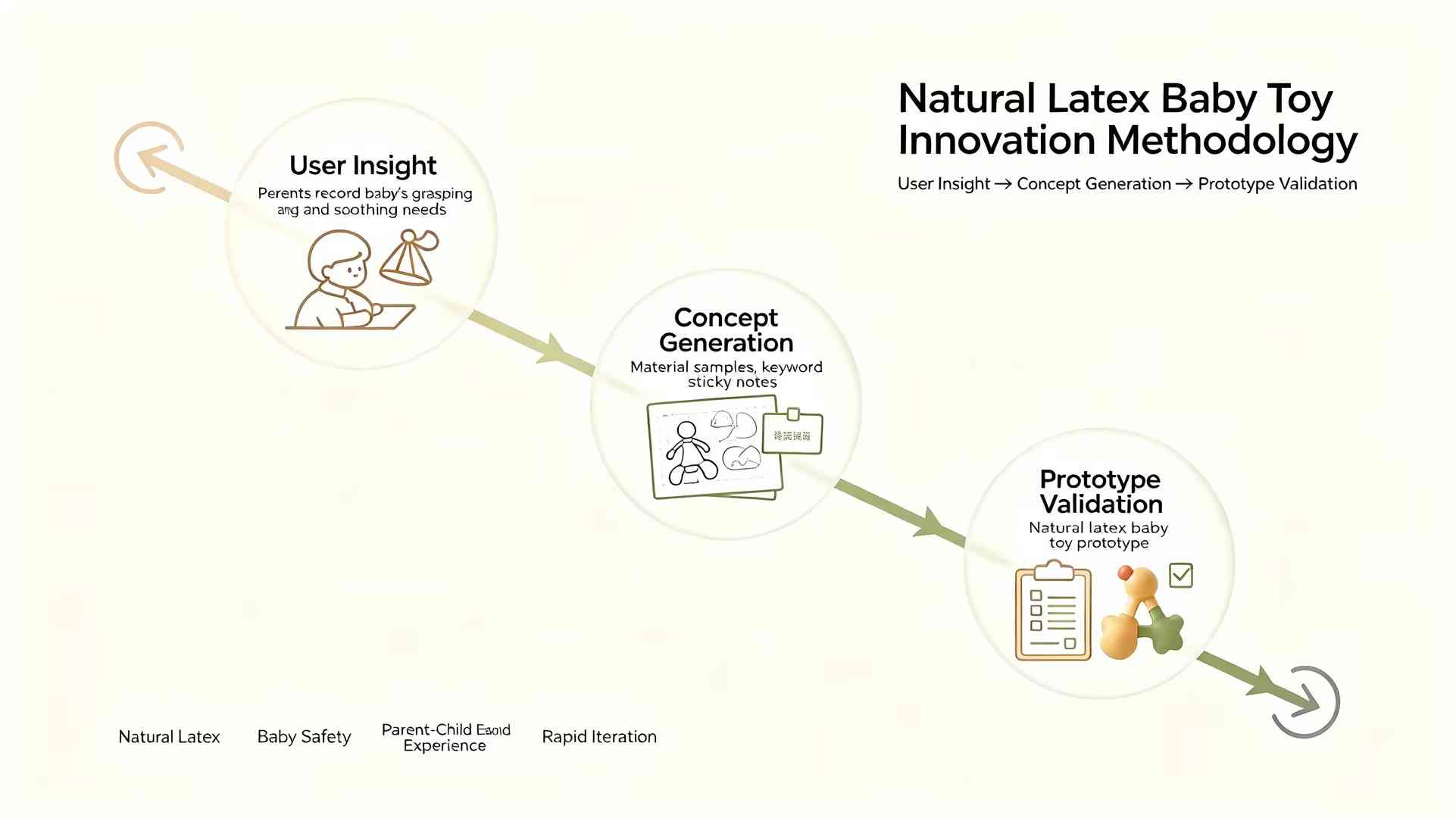
Natural Latex Infant Toy Innovation Methodology: Agile Workflow from User Insight to Concept Generation and Prototype Validation
author: Yvonne
2026-08-03
In the competitive maternal and infant market, infant toy innovation has become the core driver of product differentiation and brand growth. Parents today no longer merely focus on toy appearance or basic playability — they prioritize material safety, developmental adaptability, and refined user experience. For natural latex infant toys, which are widely used for teething, tactile training, and early education, traditional empirical development methods often lead to homogeneous design, insufficient safety verification, and long iteration cycles. Therefore, adopting a standardized, user-centered agile workflow has become the key to professional toy product development and high-quality baby product design.
This article systematically explains how to apply the five stages of design thinking — Empathize, Define, Ideate, Prototype, and Test — to natural latex infant toy R&D. It delivers a complete industrial development pipeline: user insight mining → concept generation → rapid prototyping → user testing → iterative optimization. In addition, it shares practical rapid prototyping solutions including 3D printing and silicone hand prototype fabrication, provides a reusable user feedback collection template, and attaches real cycle optimization cases for innovation toy development teams.
Why Modern Infant Toy Innovation Needs Design Thinking & Agile Development
Traditional infant toy innovation and development relies heavily on designer experience and market trend imitation. This model creates obvious drawbacks for latex baby products and restricts professional baby product design upgrades. First, product functions often deviate from real infant developmental needs. Second, safety details and tactile experience cannot be fully verified before mass production in conventional toy product development. Third, the entire development cycle is lengthy and difficult to adapt to fast-updating consumer demands, limiting the output of high-quality innovation toy products.
By integrating design thinking into toy product development, brands can shift from “designer-driven creation” to “user-driven innovation”. The agile process minimizes trial-and-error costs, shortens time-to-market, and ensures every innovation toy is developed around real infant behaviors and parental pain points, which is essential for professional infant toy innovation and premium baby product design.
Design Thinking 5-Stage Application in Natural Latex Toy Development
Design thinking consists of five closed-loop stages: Empathize, Define, Ideate, Prototype, and Test. Each stage corresponds to a clear operational node in latex infant toy development, forming a complete and scalable agile development system that standardizes modern infant toy innovation and professional toy product development for premium baby product design and reliable innovation toy iteration.
Stage 1: Empathize — Deep User Insight for Real Demand Mining
Empathy is the foundation of reliable baby product design. Different from ordinary toy design, infant latex products must consider two core user groups: growing infants and purchasing parents.
For infants aged 0–3, product experience focuses on physiological adaptation, which is the core starting point of human-centric baby product design. Babies in the oral stage need safe, biteable, soft latex structures; growing toddlers require textured surfaces for tactile stimulation and ergonomic shapes for grasping training. For parents, core demands include material safety, high-temperature washability, easy cleaning, anti-mold performance, and multi-scenario usability, guiding targetedinfant toy innovation in every toy product development link to create practical innovation toy solutions.
In practical infant toy innovation, teams collect authentic data through community interviews, user scenario observation, competitor negative review analysis, and parent questionnaires, ensuring all subsequent development decisions are based on real user pain points rather than subjective imagination.
Stage 2: Define — Refine Pain Points and Position Innovation Directions
After collecting user insights, the Define stage sorts and summarizes overlapping and high-frequency pain points to form clear product positioning. In latex toy development, typical definable problems include hard biting feeling, single functional design, water accumulation after cleaning, insufficient tear resistance, and poor grip adaptability for small hands.
This stage outputs standardized product requirement documents, clarifying applicable age groups, core functions, material standards, structural constraints, and innovation highlights. Precise definition effectively avoids redundant design and becomes the core guideline for efficient toy product development.
Stage 3: Ideate — Multi-Dimensional Concept Generation for Differentiated Innovation
The Ideate stage expands innovative solutions around defined pain points, covering shape optimization, structural improvement, functional integration, and process upgrading. For natural latex infant innovation toy design, feasible innovations include bionic streamline modeling, non-slip tactile texture design, one-piece seamless molding, hollow anti-waterlogging structure, and multi-functional integration of teething, grasping and sensory training.
Teams usually generate multiple concept solutions and select 1–2 optimal directions through internal evaluation of safety, manufacturability, user friendliness, and cost control, laying a solid foundation for subsequent prototype production and standardized toy product development while ensuring every creative innovation toy idea lands as practical, marketable infant toy innovation under mature baby product design specifications.
Stage 4: Prototype — Fast Prototyping Solutions for Low-Cost Verification
Rapid prototyping is the core advantage of agile toy product development. It helps teams verify appearance, structure, size, tactility and rationality before formal mold opening, greatly reducing mass production risks. Two mainstream solutions are widely used in infant toy innovation projects.
3D Printing Prototype (Structural & Appearance Verification)
3D printing rapidly outputs high-precision resin samples within 1–2 days. It is mainly used to verify overall proportion, hollow structure rationality, edge radian, and assembly logic. It supports fast iteration of multiple design versions and is the most cost-effective solution for early concept screening in baby product design.
Silicone Hand Prototype (Experience & Safety Simulation)
Silicone hand prototypes adopt food-grade materials with softness, elasticity and biting feedback highly consistent with natural latex finished products. The 3–5 day production cycle supports real scenario tests including infant gripping, oral biting, high-temperature disinfection, and cleaning simulation. It is the most reliable verification method before formal production of latex innovation toy products.
Stage 5: Test — Standardized User Verification & Closed-Loop Iteration
The Test stage realizes continuous optimization through real user feedback. To unify evaluation standards and collect effective data in toy product development, a reusable user test feedback template is essential for infant toy innovation projects.
Reusable User Test Feedback Template for Baby Toy Design
|
Testing Dimension
|
Key Evaluation Indicators
|
|---|---|
|
Safety Performance
|
No sharp edges, no odor, no shedding, high temperature resistance
|
|
Usage Adaptability
|
Age suitability, grip comfort, biting experience
|
|
Practical Performance
|
Cleaning convenience, waterproof & anti-mold, durability
|
|
Interactive Experience
|
Tactile richness, visual friendliness, early education value
|
|
Overall Satisfaction
|
Comfort experience, repurchase intention
|
Through multi-group real-user testing and laboratory safety inspection, teams can accurately locate structural defects, experience deficiencies and functional imperfections, and complete closed-loop iteration to ensure that the final innovation toy product meets strict market and safety standards. This data-driven optimization method greatly improves the professionalism of infant toy innovation and refines the whole set of toy product development and baby product design processes.
2025 Natural Latex Infant Toy Trend Report – Three Core Directions: Safety Upgrade, Diversified Senses, Sustainability
Organic Latex Comfort Doll|Natural Rubber Snuggle Toy for Toddler Anxiety Relief