Natural Latex Baby Toy Innovation Methodology: Agile Development from User Insight to Prototype Verificatio
author: Yvonne
2026-07-13
Introduction
The global infant toy market is trapped in severe homogenization competition right now. Walk through any wholesale exhibition, cross-border e-commerce store or offline baby boutique, and you’ll find dozens of nearly identical latex teething rings, rubber bath ducks and simple sensory latex toys with barely distinguishable shapes and functions. Today’s parents no longer just buy basic bite-safe latex toys; their purchasing standards keep rising across three core dimensions: raw material safety, multi-stage functional design and interactive play experience for growing babies.
Many traditional latex toy manufacturers still stick to outdated, slow product development workflows. They rely on copying hot-selling market styles instead of digging into real user demands, leading to long R&D cycles, rigid product designs that fail to match market trends, and large batches of unsold inventory once consumer preferences shift. Brands that follow this old development mode lose market share quickly to competitors with differentiated, user-centric latex toy lines like our bumpy yellow chick teether browse our innovative toy lineup here.
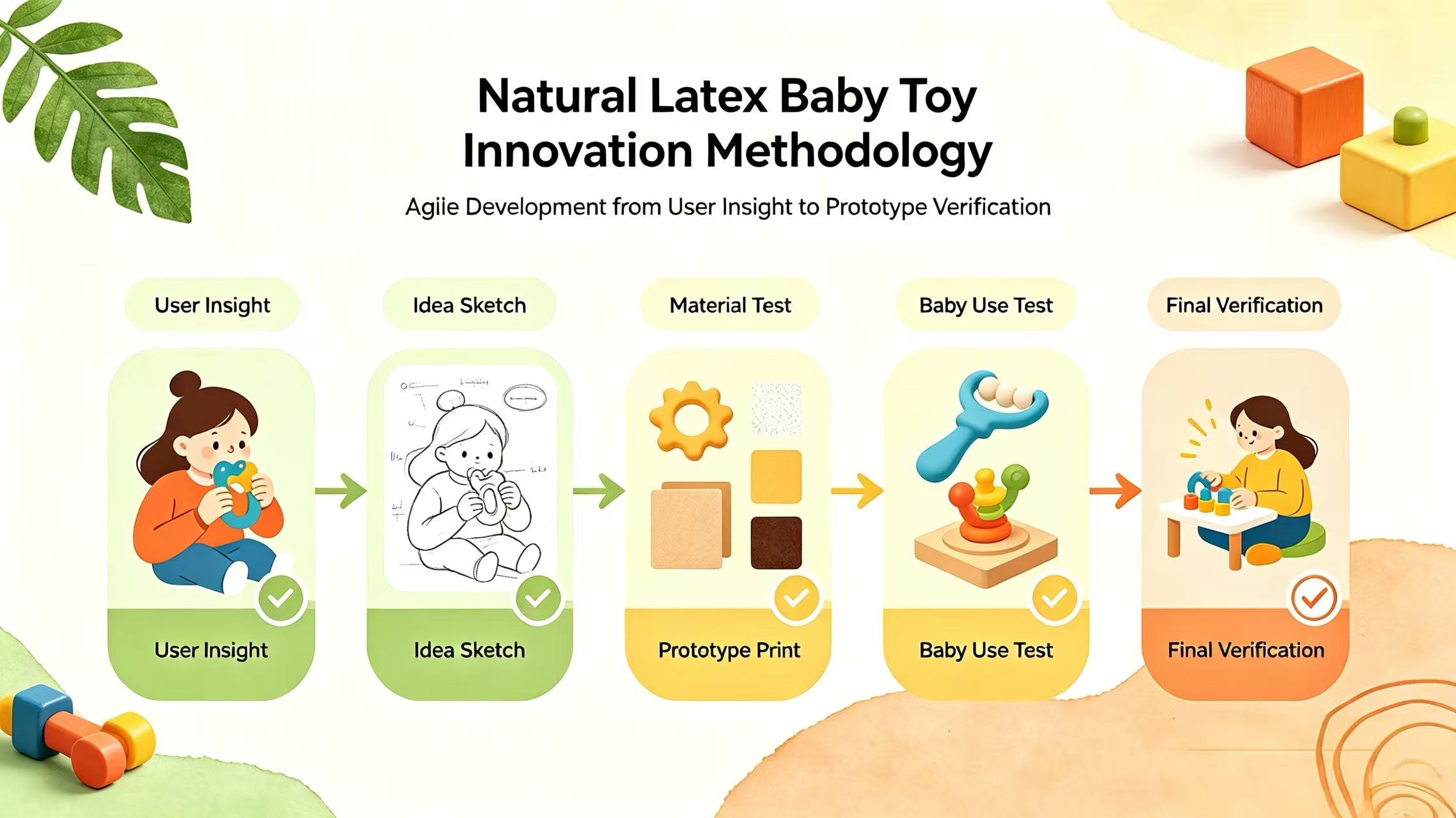
This complete guide builds a tailor-made agile innovation development process for natural latex infant toys, built entirely around design thinking methodology. We break down five sequential, loopable core phases: empathy-driven user research, precise demand definition, divergent creative conception, rapid prototype manufacturing, and real-world market test verification. We walk through practical ways to dig out unspoken pain points of caregivers and stage-specific growth demands of babies, then translate scattered consumer expectations into manufacturable, marketable latex toy design solutions.
We also detail two low-cost, fast-track rapid prototype production methods—high-precision 3D printed prototypes and handcrafted silica gel physical samples—that drastically cut down overall toy product development timelines and slash repeated mold trial costs. Attached is a standardized user test feedback collection template, which helps R&D and marketing teams systematically sort, classify and quantify trial user experience data without messy scattered notes. Paired with real iteration optimization cases of best-selling natural latex baby toys, this guide summarizes high-impact adjustment points across every development stage, enabling baby product design teams to achieve fast product iteration, stand out from homogeneous competition with differentiated infant toy innovation, and accurately launch hit latex toy SKUs favored by global parents and retailers.
The Urgency of Agile Infant Toy Innovation in a Homogenized Market
For natural latex baby toy brands and OEM manufacturers, sticking to conventional passive R&D brings three irreversible operational risks:
- Slow iteration speed can’t keep up with evolving parental demands Modern parents care far more than just non-toxic latex material. They seek multi-functional toys that soothe teething discomfort, boost baby tactile development, fit bath time play and portable outdoor use. Traditional development cycles take 30–45 days just to finish a single prototype and mold trial, by which time popular design trends on Amazon, Etsy and offline supermarkets have already shifted. Agile development shortens the whole loop to 7–14 days for preliminary verification, letting brands launch updated styles ahead of competitors.
- Blind copycat design leads to low product differentiation and thin profit margins When factories simply replicate existing latex teether or bath toy shapes without user research, their products can only compete on low prices. Retailers will prioritize brands with unique interactive functions, ergonomic textures and humanized details. Reliable baby product design built on real user pain points creates exclusive selling points that support premium pricing and stable wholesale orders.
- Unverified mass production triggers high inventory loss Skipping user testing and directly opening mass production molds is a costly gamble. Many latex toy factories invest heavily in mold development only to find parents complain about hard-to-grip shapes, insufficient massage bumps or poor buoyancy for bath play. Agile development validates all design flaws at the low-cost prototype stage, avoiding thousands of dollars in wasted mold and production expenses.
Brands that adopt user-led agile development continuously launch updated, market-fit latex toys year-round and build stable long-term cooperation with global distributors. Explore our full range of iteratively optimized natural latex teethers and bath toys refined via complete user insight and prototype testing at //www.naturalbabyworld.com/.
Five Core Agile Development Steps for Natural Latex Baby Toys (Design Thinking Framework)
The entire agile workflow forms a closed-loop iterative system rather than a one-time linear process. After market test verification, teams can circle back to user research to optimize design details repeatedly, perfectly matching the flexible production characteristics of natural latex toy manufacturing.
Step 1: Empathy User Research – Dig Out Real, Hidden User Pain Points
The foundation of all valuable infant toy innovation lies in authentic user empathy, not subjective guesses by design teams. This phase targets two core user groups: parents (purchasers) and infants (actual product users).
Multi-channel User Insight Collection Methods
- Offline parent in-depth interviews Communicate with buyers in baby retail stores, maternity and child centers, and parenting activity venues; record real complaints about existing latex toys: slippery surfaces that babies can’t grasp, single massage bumps only for front gums, bath ducks that trap dirty water inside, overly hard latex texture unsuitable for newborns.
- Cross-border e-commerce comment data sorting Analyze negative reviews of mainstream latex teether and bath toy SKUs on Amazon, Shopify and AliExpress, extract high-frequency pain points such as difficult cleaning, deformed shape after boiling, too-large size for tiny infant palms.
- Baby growth behavior observation Track how babies of different months interact with latex toys: newborns need lightweight, easy-to-clench ring teethers; 6–12 month teething toddlers demand dense multi-angle massage bumps; 1–3 year old kids prefer floating interactive bath toys with sound effects.
- Merchant and retailer feedback collection Collect frontline sales feedback from supermarket and boutique operators, who share which toy styles have higher return rates and what functional improvements parents ask for most frequently.
Research Output
A complete user pain point list classified by baby age group, plus demand priority ranking, to avoid developing functions that parents don’t actually need.
Step 2: Demand Definition – Convert User Pain Points into Clear Design Objectives
Raw user feedback is scattered and vague; this step screens and categorizes all collected demands to form quantifiable, actionable design standards exclusive to natural latex toys.
Standard Demand Classification Dimensions
- Safety demand (non-negotiable baseline) Requirements covering natural latex purity, no plasticizer, heavy metal-free pigment, boil-resistant high-temperature vulcanization, no small detachable parts that pose choking hazards, fully rounded edges.
- Functional demand (core differentiation point) Tactile massage distribution, grip size matching baby palm size, bath water drainage structure, portable lightweight design, dual-use for teething and sensory training.
- Interactive experience demand (sales boost highlight) Multi-texture bump layout, floating balance design for bath play, cartoon animal shapes that attract baby visual attention, easy-to-clean integrated molding structure.
- Commercial demand (factory & retail adaptability) Suitable for custom OEM logo printing, compatible with retail hang card packaging, low mold production cost, stable mass production yield rate.
Deliverable: Clear Demand Brief
Lock core design priorities, mark non-negotiable safety standards and optional innovative functions, providing a clear roadmap for the creative conception stage to avoid design deviation.
Step 3: Creative Conception – Generate Differentiated Latex Toy Design Schemes
Based on the finalized demand brief, the design team launches divergent creative brainstorming, combining ergonomics for infants and latex material molding process limitations to draft multiple preliminary design drafts.
Key Latex Toy Design Innovation Directions
- Ergonomic shape optimization: Curved ring bodies matching infant grasping force, split limb structures for multi-angle gum massage, lightweight hollow design to reduce arm fatigue for babies.
- Multi-layer texture innovation: Mixed dense small massage bumps + large soothing protrusions, segmented softness control via vulcanization adjustment for different oral comfort zones.
- Interactive structure upgrade: Self-draining bath duck cavity design to prevent mold growth, detachable portable teether pendant, stackable latex animal sets for sensory play.
- Appearance differentiation: Soft matte cartoon animal silhouettes (chick, duck, bear) that stand out on retail shelves, low-saturation neutral color palettes favored by modern minimalist parents.
After brainstorming, the team screens 2–3 most feasible creative drafts, balancing innovation, production feasibility and cost control, and outputs 2D engineering drawings with detailed dimensional parameters.
Step 4: Prototype Production – Two Rapid Prototyping Solutions to Shorten Trial Cycles
Traditional development relies on formal mold opening for sample making, which costs thousands of dollars and takes over two weeks. The agile process adopts two fast prototype methods to complete appearance, structure and hand-feel verification within 1–3 working days, cutting trial-and-error costs by over 70%.
Solution 1: 3D Printing Precision Prototype
- Process: Use light-cured resin 3D printing to output 1:1 full-size toy models according to 2D drawings, precision up to ±0.05mm, fully restoring contour, bump layout and dimensional proportions.
- Core advantages: One piece minimum order, ultra-fast delivery within 24 hours, convenient to adjust model parameters digitally for repeated iteration; mainly used for verifying overall shape, grip size and retail packaging matching effect.
- Applicable scenarios: Early-stage appearance screening, shelf display simulation, client preliminary design confirmation.
Solution 2: Silica Gel Hand-Made Prototype
- Process: Carve master molds by hand, inject food-grade silica gel material to simulate the soft touch of natural latex, complete with vulcanization simulation to restore real product softness and surface texture.
- Core advantages: Realistic bite and touch experience identical to mass-produced latex toys, can test boiling resistance, elasticity and massage bump comfort directly; supports minor structural modification by trimming hand molds.
- Applicable scenarios: User experience testing, softness and functional verification, final design confirmation before formal mold opening.
Combined usage workflow: 3D printing for quick shape iteration → silica gel hand prototype for real touch user testing, which eliminates most design defects before expensive steel mold development. Reference the chick teether physical prototype view finished prototype mass production styles to see how prototype design translates to retail-ready finished goods.
Step 5: Market Test Verification – Collect User Feedback to Lock Final Design
Prototypes are distributed to trial user groups (parents and babies of matching age ranges) for real home usage testing, then standardized feedback forms are used to collect systematic evaluation data, which guides targeted design optimization.
Standard User Test Feedback Collection Template (Core Modules)
- Basic information: Baby age, daily teething performance, family usage scenarios (home / bath / outdoor travel)
- Safety evaluation indicators: Texture softness, edge smoothness, odor after boiling, cleaning convenience
- Functional experience scoring (1–5 points): Grip ease, gum massage comfort, bath play practicality, portability
- Interactive experience feedback: Baby’s willingness to take initiative to bite/play, visual attractiveness of shape and color
- Defect & improvement suggestions: Specific details to adjust (bump density, ring size, cavity drainage structure)
- Purchase intention & premium acceptance: Whether willing to buy, acceptable price range compared with similar products
After sorting all test data, the team quantifies low-scoring weak links, returns to the creative conception stage to adjust prototype structures, and carries out secondary testing until the comprehensive satisfaction score reaches the qualified threshold before formal mold opening and mass production launch.
Real-World Latex Toy Iteration Case & Key Development Optimization Points
Case: Multi-Massage Chick Teether Iteration
The initial prototype adopted uniformly distributed small bumps with a single circular ring body. After user testing, parents fed back that newborns couldn’t grip the smooth ring, and single-size bumps failed to soothe back molars for older babies. Agile optimization adjustments:
- Add protruding wing and foot handles on both sides to increase friction points for tiny palms;
- Mix large soothing bumps and small dense massage protrusions in segmented zones to fit babies of 0–12 months;
- Adjust latex vulcanization parameters to make the ring body slightly softer while keeping the massage bumps firm enough for effective gum relief. The optimized version became a top-selling SKU, with retail sales 3 times higher than the original homogeneous circular teether design.
Universal Key Optimization Points Across All Latex Toy Development
- Prioritize ergonomic grip testing at the prototype stage; avoid overly smooth or oversized ring structures unsuitable for infants under 6 months.
- Reserve integrated drainage holes for all bath latex toys to solve the core pain point of residual water and mold growth inside hollow bodies.
- Control latex softness in layers: massage protrusions maintain moderate hardness for teething relief, while main body stays soft to prevent gum bruising.
- Unify all outer contour full rounding; eliminate tiny sharp edges that trigger parental safety concerns during user testing.
- Match prototype dimensions with mainstream retail custom toy packaging specifications in advance, avoiding secondary size revision after design finalization.
Long-Term Value of Agile Infant Toy Innovation for Brands & Manufacturers
Adopting this design thinking-based agile toy product development system delivers lasting competitive edges for natural latex toy suppliers and brand owners beyond faster R&D speed:
- Build differentiated product barriers against homogeneous market competition User-centric baby product design creates exclusive functional and experiential selling points that copycat factories cannot replicate quickly, supporting stable premium pricing and higher retail shelf priority.
- Cut overall R&D and inventory capital waste Rapid prototype verification avoids invalid mold investment; market testing reduces the risk of launching unpopular styles and accumulating unsold inventory, greatly improving capital turnover efficiency.
- Rapidly respond to shifting global parental consumption trends The closed-loop iterative workflow allows teams to adjust design details within weeks when new safety demands or play preferences emerge from overseas markets (EU, North America, Southeast Asia cross-border consumers).
- Boost long-term cooperation with global retail and e-commerce buyers Brands with mature agile innovation capabilities can provide regular new product iteration plans for distributors, becoming preferred long-term suppliers instead of one-time order manufacturers.
If you’re an infant brand or OEM factory looking to launch differentiated natural latex baby toys built via complete user insight and prototype verification agile workflows, explore our full catalog of iteratively optimized teethers, bath ducks and sensory play items at //www.naturalbabyworld.com/. Every core SKU in our lineup passed multi-round user testing and prototype iteration before mass production.
Final Wrap-Up
The increasingly saturated infant toy market leaves no room for passive, copycat product development. Rising consumer standards for safety, functionality and interactivity force natural latex toy manufacturers to shift from traditional slow R&D to agile, user-driven infant toy innovation.
The five-step design thinking agile development process—user empathy research, demand definition, creative conception, rapid prototype manufacturing and market test verification—builds a complete closed-loop innovation system. Paired with low-cost 3D printing and silica gel hand prototype solutions, plus standardized user feedback sorting templates, R&D teams can accurately translate parental and infant growth demands into manufacturable, market-popular latex toy designs.
By learning from real latex toy iteration cases and optimizing key design details at every development stage, brands can realize fast product iteration, break through homogenization competition, and continuously launch hit natural latex infant toys that resonate with global consumers. For OEM manufacturers and baby product brands, standardized agile toy product development methodology is the core engine to sustain long-term growth in the fiercely competitive global natural rubber baby toy industry.
Best Natural Rubber Teether for 3 Month Old Babies|Safe Chewing Toy Guide 2026
Retail-Ready Packaging Design for Natural Latex Baby Toys: Integrated Hang Card, Color Box & Display Stand Solution