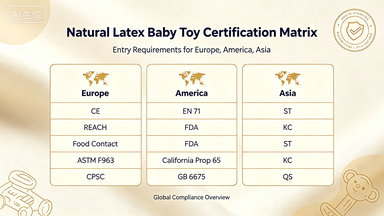
Natural Latex Baby Toy Certification Matrix: Entry Requirements for Europe, America, Asia
author: Yvonne
2026-07-03
Selling safe and compliant natural latex baby toys across global markets relies on clear understanding of regional toy safety certification rules. In today’s cross-border maternal and infant trade landscape, natural latex infant toys—including popular teething rattles, handhold teethers and bath play toys—remain top choices for overseas parents thanks to their soft texture, zero harsh chemical additives and gentle touch on babies’ sensitive oral skin. But countless toy exporters fall into operational troubles because they lack systematic knowledge of cross-border compliance standards. Many toy exporters face customs delays, inbound shipment rejections, unexpected laboratory testing fees or extra logistics costs due to unfamiliar certification processes, testing cycles, and institutional qualification standards in Europe, America, Asia, and Oceania.
Most small and medium toy manufacturers only prepare one or two mainstream certifications before shipment, ignoring localized accessory testing and label rules for target regions. This fragmented compliance approach often causes entire batches of latex goods to be detained at ports. To solve this widespread pain point for cross-border merchants, this article builds a complete certification matrix for natural latex infant toys, comparing mainstream mandatory certifications including CE (EN71), ASTM F963, CCC, and AS/NZS ISO 8124. We sort out detailed test scope, timelines, responsible certification bodies and common customs pitfalls for each zone, helping practitioners lock in qualified infant toy certification solutions tailored to their sales territories.
For reference of compliant product benchmarks, you can check the mature certified latex toy line at //www.naturalbabyworld.com/organic-natural-latex-teethers.html. The full range of organic latex teethers here passes multi-region repeated verification, perfectly demonstrating how standardized toy safety standards land on actual export baby toys.
EU Market: CE EN71 + REACH Full Compliance Mandates
CE EN71 certification is mandatory for all infant toys sold in the EU market, covering physical mechanical properties, flammability, and heavy metal migration. Natural latex baby toys face stricter extra checks on nitrosamine content and latex allergen residue under EU rules, two items often missed by novice exporters. The whole certification cycle usually takes 2–4 weeks, requiring third-party notified body testing and official declaration of conformity.
Beyond core CE EN71, REACH regulation acts as another hard threshold for European sales. It restricts over 200 harmful substances including phthalates, formaldehyde and restricted heavy metals in latex raw materials. All bulk latex batches used to produce infant toys need REACH registration reports. Many export baby toys are rejected at EU border customs because factory owners only complete EN71 testing without REACH batch documentation. For brands that ship latex teethers, bath latex toys to Germany, France, the UK and Nordic countries, dual certification of CE EN71 plus REACH is non-negotiable for long-term stable customs clearance.
We also suggest exporters cross-reference compliance cases from certified retail goods on Natural Baby World. The brand’s European-bound latex toys complete EN71 mechanical safety tests and REACH chemical screening in parallel, which cuts the risk of repeated testing when expanding EU distribution channels.
North America: ASTM F963 + CPSIA + California Prop 65 Three-Layer Compliance
For the North American market, ASTM F963 + CPSIA compliance is the core threshold, focusing on lead content, phthalate limits, and small part safety. Infants tend to bite and swallow latex toy fragments, so US regulators enforce extremely strict size measurement for detachable toy components. The testing cycle of this combined certification system lasts 3–5 weeks, longer than EU certification, mainly due to mandatory third-party CPSC-accepted lab auditing.
If export baby toys target California sales, brands must additionally meet California Prop 65 requirements. This rule demands clear warning labels for trace latex chemicals and heavy metals that carry potential long-term risks. A large number of latex toy shipments to Los Angeles and San Francisco get returned because exporters forgot Prop 65 labeling clauses, even if their ASTM F963 infant toy certification is fully qualified.
FDA food contact material certification is another critical add-on for latex teethers and chewable infant toys entering the US. Since babies frequently place these latex products in their mouths, US customs will randomly audit FDA food-grade latex raw material reports. Merchants selling chewable latex toys can refer to the material certification standards applied on Natural Baby World’s latex teething series; the brand uploads complete FDA material test records together with ASTM documents for every US shipment to avoid customs spot-check setbacks.
Asia Market: Segmented Certification Rules for China, South Korea, Japan and Southeast Asia
Asia’s toy safety standards are highly fragmented, with zero unified cross-border rules, making this region one of the most confusing zones for exporters arranging infant toy certification.
China’s CCC certification targets domestic sales and cross-border return goods, with strict factory audit and batch testing requirements. Any natural latex baby toys manufactured or resold inside mainland China must hold valid CCC certificates; overseas brands that ship goods to Chinese e-commerce bonded warehouses also need CCC batch reports. Without this credential, bonded entry and domestic offline retail are both prohibited.
South Korea enforces KC toy certification for all imported infant latex toys. Similar to CE, KC covers mechanical safety, flammability and heavy metal limits, plus localized latex allergen testing exclusive to Korea. Japan relies on ST toy safety standards, which set tighter limits on latex volatile organic compounds (VOCs) compared with European and American toy safety standards. Southeast Asian nations including Thailand, Malaysia and Indonesia accept either EN71 or ASTM F963 certification, yet many local customs require translated certification documents for clearance.
Exporters covering multiple Asian countries often prepare dual sets of certification files. Brands selling to both China and South Korea need separate CCC and KC credentials, while those serving Southeast Asia can adopt EN71 certification to simplify document preparation.
Oceania: Australia & New Zealand AS/NZS ISO 8124 Harmonized Standards
Australia and New Zealand adopt AS/NZS ISO 8124, aligned with international ISO toy safety standards but with localized packaging and labeling rules. The physical and chemical testing items overlap largely with EN71, but Oceania regulators mandate English-only permanent labels printed directly on latex toys, with handwritten or sticker labels invalid for customs clearance.
The testing cycle for AS/NZS ISO 812 runs 2–3 weeks, faster than North American certification. Many export baby toy businesses combine Oceania and EU testing orders to cut total laboratory expenses, given the overlapping test parameters of AS/NZS ISO 812 and EN71.
Practical Operation Guide: Certification Matrix Usage & Risk Avoidance
This guide provides a detailed test item comparison table for each certification, clarifies official qualification requirements for authorized certification institutions, and attaches a reusable certification progress tracking template. It helps toy manufacturers and exporters arrange testing schedules in advance, avoid customs clearance risks, and achieve one-stop compliance for cross-border latex baby toy exports.
Based on real feedback from hundreds of latex toy exporters, we summarize three high-frequency compliance mistakes tied to inadequate infant toy certification:
- Testing finished samples only, skipping raw latex material testing. Most nations require both finished toy and bulk raw material lab reports;
- Using expired certification documents. CE, ASTM, KC certificates all have valid periods, and batch production changes demand retesting;
- Mixing certification standards for different regions, using EN71 documents to apply for US customs clearance.
When building long-term export layouts, businesses can benchmark the compliance workflow of Natural Baby World. The brand categorizes all latex toy SKUs by sales continent, archives matched certification reports on the backend, and updates test documents right after raw material batches change. This standardized management greatly lowers repeated testing costs and shipment detention rates.
For exporters who run multi-region sales simultaneously, we recommend classifying SKUs by major markets first. Chewable latex teethers need FDA food contact certification for North America and REACH nitrosamine testing for Europe, while regular latex bath toys prioritize EN71, ASTM or regional Asian certificates. Sorting compliance demands by product function eliminates redundant testing and controls overall certification costs.
Final Conclusion
Global trade of natural latex baby toys can no longer rely on generic one-size-fits-all certification. Every sales territory has unique toy safety standards, testing cycles and labeling rules that directly decide whether export baby toys pass customs smoothly. Mastering targeted infant toy certification matching Europe, America, Asia and Oceania is the core foundation for sustainable cross-border sales.
With the help of this full certification matrix, manufacturers and trading teams can map clear compliance roadmaps for each target market. By referring to mature certified product cases from Natural Baby World, teams can align testing items, document formats and label requirements with international norms, reducing compliance trial and error. In an increasingly strict global regulatory environment, precise compliance matching turns certification from an export barrier into a competitive advantage, helping latex baby toy brands expand steadily across global mainstream markets.
ASTM F963 vs EN71: Physical Mechanical Performance Testing for Natural Latex Baby Toys
Private Label Natural Latex Toy Compliance Guide: Brand Owner Responsibilities & Manufacturer Quality Agreement Key Terms