MOQ and Cost Optimization of Natural Latex Toys: Mold Sharing Strategy & Scale Production Advantages
author: Yvonne
2026-07-01
Introduction
The natural latex baby toy market has witnessed booming growth in recent years, as modern parents increasingly prioritize safe, non-toxic, eco-friendly, and skin-friendly toy options for infants and toddlers. Natural latex, with its soft texture, hypoallergenic properties, and biodegradable features, has become a mainstream material for baby rattles, sensory toys, and wholesale infant toy products. However, for emerging brands and new market entrants, MOQ (Minimum Order Quantity) remains one of the most daunting and unavoidable barriers to market entry. Many startup brands struggle with excessive upfront costs, high inventory pressure, and inflexible customization rules, largely due to rigid MOQ requirements and unoptimized production models. This blog elaborates on the core logic behind MOQ-related cost challenges, analyzes the correlation between mold investment, production volume, unit cost and customization demands, and explores how partnering with experienced manufacturers and adopting mold sharing and scaled production strategies can effectively solve these pain points for natural latex baby toy brands.
Why MOQ Is a Top Challenge for New Natural Latex Baby Toy Brands
Unlike plastic or silicone toys with mature standardized production lines, natural latex baby toys rely on customized vulcanization molds, strict material formulas, and specialized production processes, which leads to inherent MOQ thresholds in the industry. For new brands aiming to test market trends, launch new product lines, or build niche baby toy collections, high MOQ requirements create multiple operational dilemmas.
First, high minimum order quantities force brands to overstock inventory. Infant toy market demands are trend-sensitive and seasonal; overstocking not only occupies substantial capital but also raises risks of unsold products and inventory depreciation. Second, rigid MOQ rules often conflict with small-batch customization needs. Many emerging brands focus on personalized designs, unique shapes, and exclusive pattern printing to differentiate their products, but most ordinary factories only support mass production with fixed molds, forcing small-order brands to either abandon customization or accept excessive production quantities. Third, high MOQ is always accompanied by high upfront investment, which greatly raises the market entry threshold and limits the product iteration speed of new brands. In short, MOQ barriers have long restricted the development of small and medium-sized baby toy brands in the natural latex track.
The Core Correlation: Mold Investment, Production Volume, Unit Cost and Customization
To break the MOQ and cost dilemma, it is essential to understand the internal connection between mold investment, production volume, unit cost, and customization requirements—these four factors determine the final pricing and order flexibility of natural latex baby toys.
Mold investment is the largest fixed cost in natural latex toy production. Each customized latex toy shape requires an independent vulcanization mold, with high manufacturing costs and long development cycles. For every new mold developed, factories need to recover mold costs through subsequent order production. If brands place small-batch orders, the mold depreciation allocated to each product will surge directly.
Production volume directly affects cost amortization. The larger the production volume, the more evenly the fixed costs (mold cost, equipment debugging cost, setup labor cost) are distributed among individual products, resulting in a lower unit production cost. On the contrary, small-batch orders lead to extremely high unit costs, making products lose market competitiveness.
Unit cost is the core factor affecting brand profit margins and retail pricing. In addition to fixed mold costs, small-order production also leads to higher variable costs, including repeated equipment debugging, low production efficiency, and scattered material scheduling. Experienced manufacturers can effectively balance unit cost and order volume, while ordinary factories often fail to support cost control for small and medium orders.
Customization requirements further amplify MOQ and cost pressure. Customized products with exclusive shapes, logos, colors, and sizes require independent mold opening and targeted process adjustment, which means higher upfront investment and higher MOQ thresholds. Standard products with universal molds have lower costs and more flexible order quantities, which forms a clear contrast with customized products.
How Experienced Custom Baby Toy Manufacturers Reduce Brand Upfront Investment
Working with professional and experienced custom baby toy manufacturers is the most efficient way for new brands to lower entry barriers and cut upfront investment costs. Mature manufacturers with years of experience in natural latex toy production have accumulated complete production systems, rich mold resources, and standardized process management capabilities that emerging factories cannot match.
First, experienced manufacturers have massive ready-made mold libraries. Unlike new factories that require full mold opening for every new product, professional manufacturers own hundreds of mature molds for baby rattles, sensory toys, and daily infant toys, covering most mainstream shapes and styles in the market. Brands can directly select existing molds for production, completely saving high custom mold opening fees and shortening product development cycles.
Second, they have mature production scheduling and cost control systems. Veteran manufacturers are proficient in latex material ratio, vulcanization process, and quality inspection standards, which can effectively reduce product defect rates and material waste. At the same time, their flexible production line scheduling can adapt to mixed-batch production of multiple products, greatly reducing the extra labor and equipment costs caused by small orders.
Third, professional manufacturers provide flexible customization solutions. On the basis of existing standard molds, they support secondary customization such as logo printing, color matching, and surface polishing, meeting brands’ personalized needs without high mold opening costs and high MOQ restrictions. This allows new brands to launch differentiated products with low upfront investment and quickly verify market feedback.
Mold Sharing & Scale Production: The Ultimate Cost Optimization Strategies
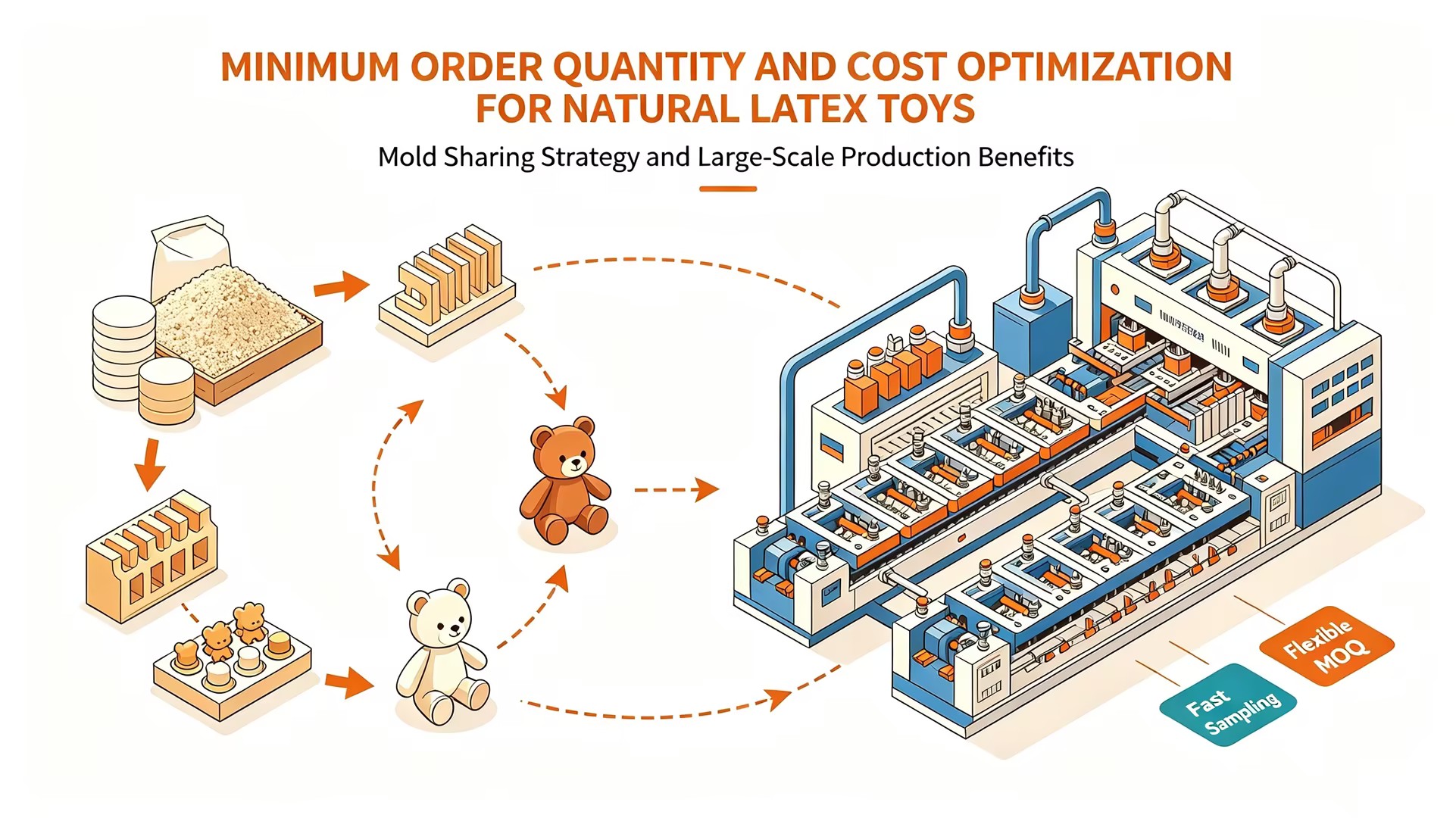
For natural latex baby toy brands focusing on wholesale and customized infant toy business, mold sharing and scale production are two core, proven strategies to optimize MOQ and reduce unit costs. These two solutions perfectly solve the pain points of high upfront investment, inflexible orders, and high unit prices, and are widely applicable to natural latex baby rattles, wholesale infant toys, and baby sensory toys.
Mold Sharing Strategy is the optimal choice for small and medium-batch customized orders. The core logic of mold sharing is to allow multiple brands to share mature existing toy molds from manufacturers, eliminating the need for independent mold development for single orders. This strategy completely saves mold opening costs, shortens product lead time, and significantly lowers the minimum order quantity. For brands that need personalized products, manufacturers can realize low-cost differentiation through post-processing customization (printing, coloring, packaging) on shared molds. It is especially suitable for brands testing new products, developing niche markets, or launching small-batch customized sensory toys and baby rattles.
Scale Production Advantages focus on optimizing long-term unit costs and profit margins. When brands accumulate stable order volume and adopt centralized large-scale production, manufacturers can fully amortize fixed costs such as mold depreciation, equipment debugging, and production line setup. Large-scale continuous production also improves production efficiency, reduces material loss and manual error rates, and further compresses unit production costs. For wholesale infant toy businesses with stable sales demand, scaled production can form a virtuous cycle of “large order volume – low unit cost – high profit margin – stronger market competitiveness”.
Conclusion
MOQ restrictions and high production costs are the core challenges for brands entering the natural latex baby toy market, rooted in the high investment characteristics of mold opening and the unbalanced relationship between production volume and unit cost. By cooperating with experienced custom baby toy manufacturers, brands can effectively reduce upfront investment through mature mold resources and flexible production modes. Meanwhile, adopting mold sharing strategies for small-batch customized products and scale production for wholesale orders is the most practical and efficient cost optimization solution. Whether for natural latex baby rattles, bulk wholesale infant toys, or customized baby sensory toys, these two strategies can help brands balance order flexibility, customization diversity, and cost advantages, quickly occupy the niche baby toy market, and achieve sustainable profit growth
Private Label Natural Latex Toy Compliance Guide: Brand Owner Responsibilities & Manufacturer Quality Agreement Key Terms
User Pain Point-Based Teether Iteration: Natural Latex Texture Optimization & Clinical Feedback Closed Loop