Age-Graded Natural Latex Teether Product Matrix: Shore A Hardness Hierarchy & Functional Differentiation Design
author: Yvonne
2026-06-09
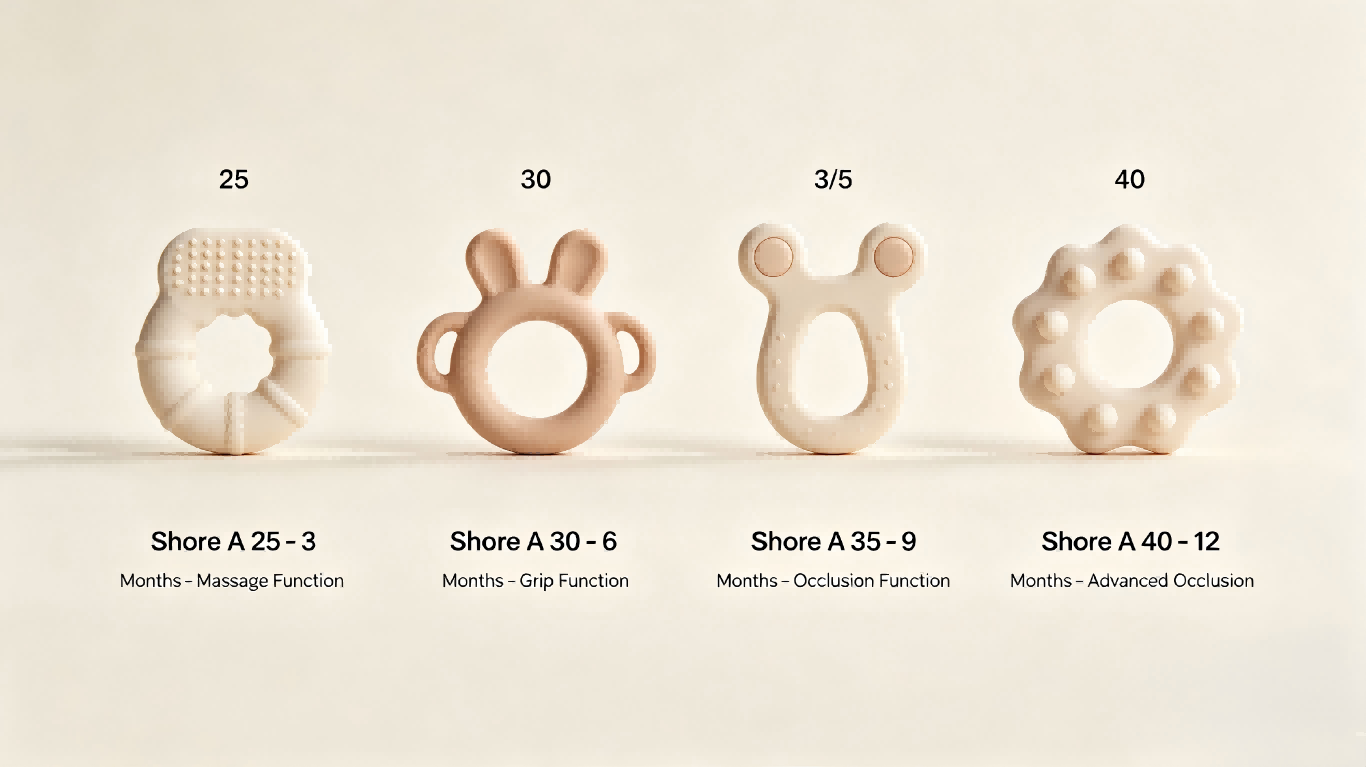
Selecting the best teether for infants and the best teether for 3 month old, 6/9/12-month babies requires precise matching with infant gum development physiology and teething discomfort characteristics. Unlike universal teething toys, age-graded natural latex teethers adopt a scientific Shore A hardness gradient (25/30/35/40) and targeted functional differentiation design (gum massage, grip training, intensive occlusion) for 3/6/9/12-month-old infants. This article combines professional pediatric gum development data, quotes pediatric dentist consultation records, and systematically elaborates on the product development logic of age-segmented teethers, providing a complete product line planning template for maternal and infant product R&D. It also offers authoritative selection guidance for parents looking for the best teether for baby at different growth stages.
Table of Contents
-
Introduction
-
Gum Development Characteristics of 3/6/9/12-Month-Old Infants
-
Scientific Hardness Gradient Design: 25/30/35/40 Shore A Matching Age Stages
-
Functional Differentiation Strategy: Targeted Design of Massage / Grip / Occlusion
- Pediatric Expert Consultation Record & Professional Verification
-
Complete Age-Graded Teether Product Line Planning Template
-
Conclusion
Introduction: Why Age-Graded Teethers Replace Universal Teething Toys
Infant oral development and teething discomfort show obvious staged differences from 3 to 12 months old. A one-size-fits-all teether cannot adapt to changes in gum tenderness, teething intensity, and hand-mouth coordination ability at different stages. Too hard a teether will damage delicate immature gums, while too soft a teether cannot relieve the swelling and itching pain of tooth eruption, and fails to exercise infants’ oral muscle and grip ability.
Natural latex is the optimal material for infant teethers, featuring food-grade safety, skin-friendliness, bite resistance and good resilience. Based on the gum development rules of 3/6/9/12-month-old infants, we build a rigorous Shore A hardness gradient system and match differentiated core functions, realizing full-cycle precise care for infant teething periods, which is the core standard for screening thebest teether for baby in the industry.
Gum Development Characteristics of 3/6/9/12-Month-Old Infants
Combined with pediatric oral development clinical data and teething symptom tracking, we sort out the core gum physiological characteristics and teething pain demands of infants at four key stages, providing the fundamental basis for hardness gradient design
1.3-Month-Old Infants: Initial Oral Exploration Stage
Gum Development Data: Gums are fully tender, thin mucosal layer, low tissue density, no tooth germ eruption tension. Infants enter the oral sensitive period, with increased saliva secretion, frequent hand sucking behavior, and no obvious tooth swelling pain. The core demand is gentle gum comfort and oral exploration training.
Stage Pain Characteristics: Mainly oral itching and hypersensitivity, no strong occlusion demand; hard objects are likely to cause gum redness and slight damage.
2. 6-Month-Old Infants: Early Tooth Eruption Stage
Gum Development Data: Lower central incisor tooth germs begin to erupt, local gums bulge, redden and swell, mucosal tension increases significantly. Infants have obvious biting desire to relieve internal gum pressure, with frequent drooling and irritability symptoms.
Stage Pain Characteristics: Alternating swelling and itching pain, needing moderate resilient occlusion to decompress gums; overly soft teethers cannot achieve pain relief effect.
3. 9-Month-Old Infants: Peak Tooth Eruption Stage
Gum Development Data: Upper central incisors and partial lateral incisors erupt successively, multiple tooth germ eruption areas exist in the oral cavity, gum swelling range expands, and local tenderness is obvious. Infants’ hand-mouth coordination ability is mature, and they can actively grasp toys for fixed-point biting.
Stage Pain Characteristics: Intense continuous distending pain, requiring targeted gum point massage and high-resilience biting feedback; infants begin to exercise oral muscle biting strength.
4. 12-Month-Old Infants: Complete Primary Tooth Eruption Stage
Gum Development Data: Most primary incisors erupt completely, tooth roots are initially formed, gum tissue becomes dense and tough, oral muscle control ability is improved. Infants have strong active biting demand and need to exercise chewing coordination ability.
Stage Pain Characteristics: Local slight pain of residual tooth eruption, core demand shifts to chewing training, gum firming and oral muscle development.
Scientific Hardness Gradient Design: 25/30/35/40 Shore A Matching Age Stages
Based on the staged changes of infant gum tenderness and teething strength, we calibrate the natural latex hardness value one by one, forming a precise 4-level Shore A hardness gradient, which completely matches the oral development demands of 3/6/9/12-month-old infants, and solves the pain points of inappropriate hardness of the best teether for infants on the market.
1. 3 Months Old | 25 Shore A: Ultra-Soft Gentle Care
25 Shore A is the softest safe hardness of food-grade natural latex. It fits the delicate and fragile gum characteristics of 3-month-old infants completely. It has no hard extrusion pressure during oral exploration, can gently soothe oral itching, avoid gum damage, and is the exclusive hardness standard for the best teether for 3 month old. It focuses on adapting to infant oral sensitivity and cultivating initial oral cognition.
2. 6 Months Old | 30 Shore A: Moderate Resilient Decompression
30 Shore A balances softness and support. It adapts to the initial swelling and pain of 6-month-old infants’ tooth eruption. The moderate resilience can effectively decompress swollen gums, relieve teething itching and pain, will not hurt developing tooth germs, and meets the infant’s preliminary active biting demand.
3. 9 Months Old | 35 Shore A: Targeted Bite & Massage
35 Shore A is upgraded in hardness with strong resilience. For the peak teething pain of 9-month-old infants, it can form effective point-to-point extrusion and massage on swollen and bulging gums, quickly relieve continuous distending pain, and exercise infant oral muscle biting strength without damaging mature gum tissue.
4. 12 Months Old | 40 Shore A: High-Hardness Chewing Training
40 Shore A is the safe upper limit of natural latex teether hardness. It adapts to the dense and tough gum tissue of 12-month-old infants. The high support force can meet the infant’s intensive chewing and biting demands, exercise oral coordination and chewing muscle strength, assist in fixing tooth arrangement, and adapt to the advanced oral development needs of toddlers.
Functional Differentiation Strategy: Targeted Design of Massage / Grip / Occlusion
On the basis of the hardness gradient system, combined with the hand-mouth coordination ability and core teething demands of infants at different months, we realize functional differentiation of the product matrix through structural design, covering full-scene demands of gum soothing, ability training and pain relief.
1. 3-Month-Old Focus: Gentle Gum Massage (Ultra-Soft Soothing)
Aiming at the oral sensitivity and fragile gums of 3-month-old infants, the product adopts fine rounded convex point design. Combined with 25 Shore A ultra-soft latex, it simulates manual gentle massage. It has no sharp stimulation during contact with gums, can soothe oral itching and milk addiction discomfort, and calms infant emotions. The structure is simple and smooth, avoiding residue dirt, and adapting to the stage characteristics of passive oral exploration of young infants.
2. 6-Month-Old Focus: Auxiliary Grip Training (Initial Hand-Mouth Coordination)
6-month-old infants begin to develop independent grasping ability but have unstable grip force. The product is designed with anti-slip grooves and lightweight curved grip structure, matching the size of infant small hands. Combined with 30 Shore A moderate hardness, it is easy to grasp and not easy to drop. While soothing teething pain, it trains infants’ hand-mouth coordination, palm grip strength and initial limb control ability.
3. 9-Month-Old Focus: Fixed-Point Occlusion & Deep Massage (Peak Pain Relief)
For the peak teething pain of 9-month-old infants, the product adopts multi-angle three-dimensional bump and tooth groove simulation structure. Combined with 35 Shore A high-resilience hardness, it can perform deep fixed-point extrusion on multiple tooth eruption areas of gums, dredge gum pressure, and quickly relieve swelling and pain. The multi-area occlusal structure adapts to the simultaneous eruption of multiple teeth, realizing efficient pain relief and oral muscle exercise.
4.12-Month-Old Focus: Intensive Chewing & Occlusion Training (Oral Development Upgrade)
Combined with the mature chewing demand of 12-month-old infants, the product adopts thickened occlusal ribs and multi-layer texture structure. Matching 40 Shore A safe high hardness, it provides stable occlusal feedback, exercises infant tongue coordination, chewing muscle strength and jaw development, helps infants transition from milk chewing to complementary food chewing, and improves oral fine motor ability.
Pediatric Expert Consultation Record & Professional Verification
Consultation Core Records (Verbatim):
1. Many parents blindly choose super soft or super hard teethers, which is wrong. Infants’ gum tolerance and teething demands change dynamically with months. Fixed hardness cannot adapt to the whole teething cycle. Age-graded hardness gradient design is more in line with infant oral physiological development laws.
2. The 25/30/35/40 Shore A gradient set for 3-12 months is scientifically verified: 25 Shore A protects delicate gums of 3-month-old infants, 30 Shore A adapts to initial tooth eruption decompression, 35 Shore A targets peak teething pain relief, and 40 Shore A meets 12-month-old chewing training demands. All hardness values are within the safe range of infant oral contact.
3. Functional differentiation of massage, grip and occlusion is very necessary. Young infants focus on soothing and protection, while older infants focus on ability training. The staged functional matching design can effectively reduce infant teething irritability and avoid oral developmental lag caused by inappropriate teether selection.
4. Natural latex is safer than silica gel and other materials, with better resilience and simulation effect, which is more suitable for infant long-term oral biting use.
Complete Age-Graded Teether Product Line Planning Template
This template covers core R&D parameters, functional positioning, crowd matching and selling point design of segmented teethers, which can be directly used for product development, market promotion and commodity listing.
|
Applicable Age
|
Hardness (Shore A)
|
Core Function
|
Product Positioning
|
Core Selling Points & Keyword Matching
|
|---|---|---|---|---|
|
3 Months
|
25
|
Gentle Gum Massage, Emotional Soothing, Oral Sensitive Period Care
|
Ultra-Soft Protective Teether for Newborns
|
Best teether for 3 month old; ultra-soft latex, no gum damage, relieve oral itching, newborn oral exploration training
|
|
6 Months
|
30
|
Resilient Occlusion Decompression, Auxiliary Grip Training, Relieve Initial Teething Pain
|
Initial Teething Pain Relief & Grip Training Teether
|
Best teether for infants; moderate resilience, anti-slip grip, hand-mouth coordination enlightenment, early teething swelling relief
|
|
9 Months
|
35
|
Fixed-Point Deep Massage, Peak Teething Pain Relief, Oral Muscle Exercise
|
Peak Teething Professional Relief Teether
|
Best teether for baby; multi-point stereo massage, high resilience decompression, relieve severe teething pain, exercise oral muscle
|
|
12 Months
|
40
|
Intensive Chewing Training, Jaw Development, Complementary Food Adaptation
|
Toddler Oral Development Training Teether
|
Best teether for baby; safe high hardness, strengthen chewing power, assist jaw development, adapt to complementary food chewing
|
Conclusion
The age-graded natural latex teether product matrix breaks the homogenization dilemma of traditional universal teethers. Through the scientific 25/30/35/40 Shore A hardness gradient and three-dimensional functional differentiation of massage, grip and occlusion, it realizes one-to-one precise matching with the oral development and teething pain demands of 3/6/9/12-month-old infants. Supported by pediatric clinical data and expert professional verification, this design system is the authoritative standard for developing high-quality best teether for infants, best teether for 3 month old and best teether for baby products, and provides standardized, replicable R&D and market iteration solutions for maternal and infant teether track.
Natural Latex Replacing Chemical Teething Gel: Physical Soothing Mechanism & Clinical Comparative
Teething Glove Mass Production Process: Natural Latex Dipping Molding & Embossed Texture Quality Control