Co-Development Model for Natural Latex Toys – Tripartite Collaboration Framework: Brands + Manufacturers + Research Institutes
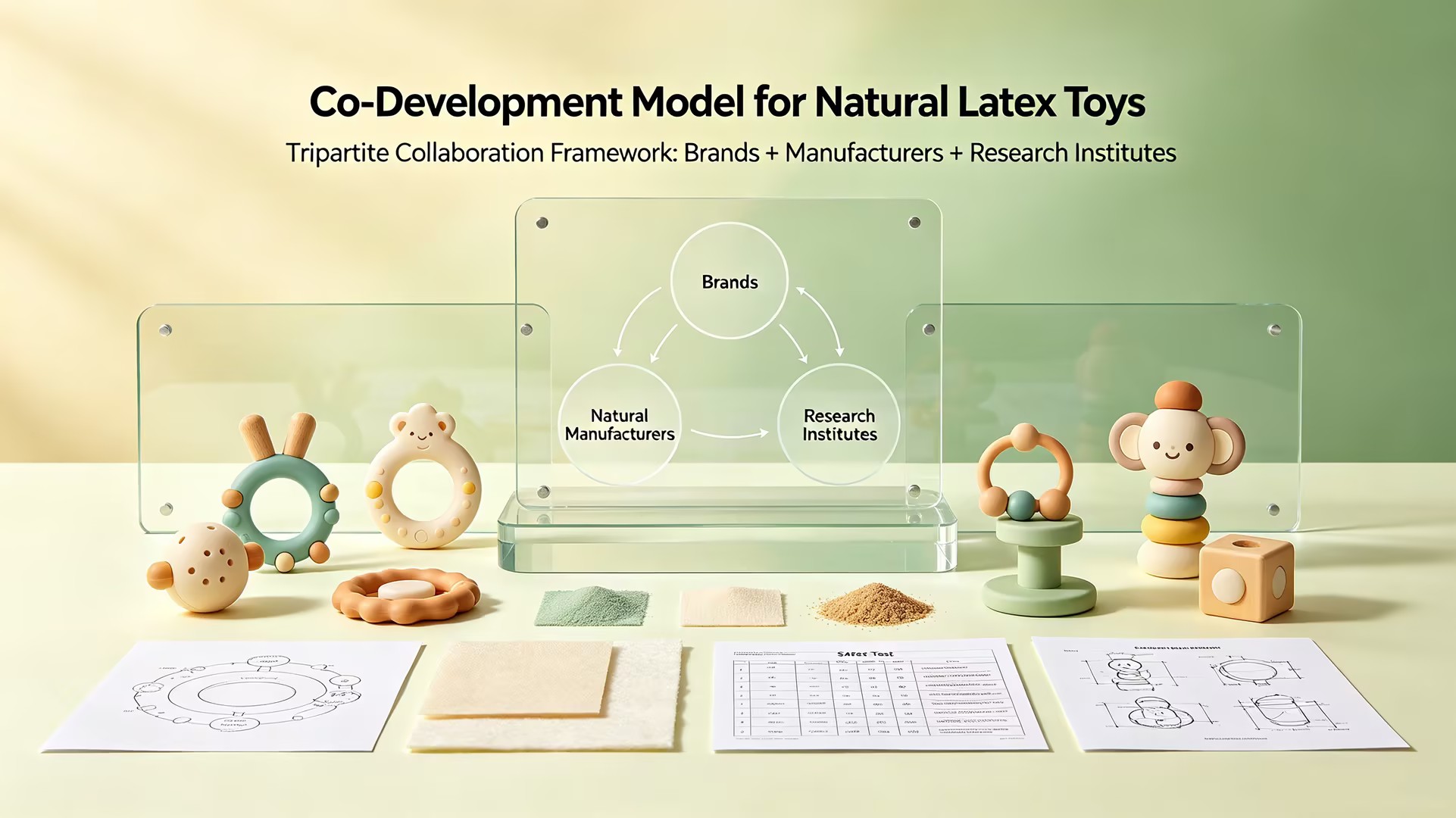
Table of Contents
- Introduction: Pain Points of Isolated R&D for Natural Latex Baby Toys
- Tripartite Role Division: Brand, Latex Manufacturer & Material Research Institute
- Three Core Cooperation Model Comparison: IP Ownership, Cost Sharing & Profit Distribution
- Complete Joint Laboratory Construction Plan for Natural Latex Toy R&D
- Verified Tripartite Innovation Collaboration Success Case (University Material Lab + Factory Process Conversion + Brand Global Launch)
- Full Key Checklist of Tripartite Baby Product Co-Development Agreement
- FAQ Schema Block for Google Featured Snippets
- Conclusion & Practical Cooperation Action Roadmap
Introduction: Pain Points of Isolated R&D for Natural Latex Baby Toys
Natural latex infant toy innovation faces obvious resource fragmentation when brands, factories and research labs operate independently:
- Consumer brands master market demand but lack material formulation & latex molding technical capacity, unable to realize differentiated low-protein, multi-sensory latex products;
- Latex toy manufacturers hold production lines yet lag advanced material research, limited capability to meet EU/US high-standard hypoallergenic and sustainable technical upgrades;
- Universities & material research institutes own laboratory formulas but lack mass-production process transformation channels and global baby product market landing resources.
A standardized tripartite toy R&D partnership framework integrates market insight, manufacturing technology and material basic research to form closed-loop innovation collaboration. This blog systematically contrasts three mainstream cooperation modes covering intellectual property ownership, R&D cost allocation and post-commercialization revenue distribution, delivers a replicable joint laboratory construction scheme, cites a complete industrialization success case, and sorts out a full legal checklist for baby product co-development contracts. Internal link: Browse our latex toy independent R&D cost analysis: naturalbabyworld.com/toy-rd-partnership
Tripartite Role Division: Brand, Latex Manufacturer & Material Research Institute
Clear role positioning is the precondition of stable innovation collaboration; each party bears exclusive core responsibilities to avoid resource overlap and responsibility ambiguity.
Infant Toy Brand Party (Market Terminal Side)
- Output global consumer insight, cross-border market demand trend, product positioning and compliance standard requirements (EN71, ASTM F963, EUDR);
- Undertake market verification, brand packaging, channel sales, cross-border marketing and after-sales operation of co-developed latex toys;
- Provide partial market-oriented R&D funding, define product commercialization milestones and sales revenue settlement rules.
Natural Latex Toy Manufacturer (Production Process Side)
- Offer latex molding automated production lines, dipping & vulcanization workshop, prototype mold manufacturing, pilot mass production capacity;
- Complete laboratory formula industrial transformation, optimize dipping trajectory, infrared vulcanization detection and AI visual inspection process parameters;
- Bear production raw material, equipment depreciation and production testing costs; provide factory compliance certification supporting documents for export.
Material Research Institute/University Lab (Basic R&D Side)
- Develop infant-grade desensitized latex formula, low-VOC composite latex material, biodegradable sustainable latex modification technology;
- Conduct material safety testing, protein residual control, oral contact toxicology research and patent layout for new materials;
- Provide professional R&D teams, precision testing instruments and patent application technical support; output standard material technical manuals for mass production.
Three Core Cooperation Model Comparison: IP Ownership, Cost Sharing & Profit Distribution
Three mature tripartite toy R&D partnership modes are widely adopted in natural latex baby product co development, differing in background/foreground IP split, capital bearing ratio and revenue allocation rules, applicable to different cooperation cycle and capital scale scenarios.
Model 1: Equal Joint Ownership Mode (Long-Term Strategic Innovation Collaboration)
Intellectual Property Ownership Rules
- Background IP (pre-existing patents, formulas, production equipment of each party) belongs to the original holder independently;
- All foreground IP (new latex material patents, molding process patents, product appearance designs generated by joint R&D) are co-owned by Brand + Manufacturer + Research Institute; all three parties have non-exclusive free use right within infant toy field; third-party licensing revenue split equally 1/3 for each side.
Cost Allocation Mechanism
Total R&D expenditure split equally 33% per party: lab material testing cost borne by institute, production pilot trial cost by factory, market validation & certification cost by brand. Extra large equipment investment for joint lab split in equal proportion.
Revenue Distribution Rule
Net profit after deducting production cost, marketing expense and operation cost divided equally into three parts; research institute’s profit share can be converted to annual fixed technical licensing fee upon negotiation.
Applicable Scenario
3–5 year long-term deep innovation collaboration, brands with stable cross-border orders, medium-large latex factories, professional university material labs; focus on original new material platform technology development.
Model 2: Brand-Led Exclusive Commercialization Mode (Brand Customized Exclusive SKU Co-Development)
Intellectual Property Ownership Rules
Foreground IP patent ownership belongs to the brand; manufacturer and research institute obtain permanent exclusive licensing right for production & technical research within the cooperation project scope; institute retains right to publish academic papers without involving commercial formula core parameters.
Cost Allocation Mechanism
Brand bears 60% of total R&D investment (market research, patent application, certification, marketing); manufacturer bears 25% (mold, pilot production, process adjustment); research institute bears 15% (lab reagent, testing labor). If R&D exceeds budget, brand covers over-limit cost.
Revenue Distribution Rule
After brand recovers all its R&D investment principal first, residual net profit split: Brand 60%, Manufacturer 30%, Research Institute 10%. Institute can choose one-time fixed R&D service fee instead of profit sharing at the initial stage.
Applicable Scenario
Cross-border premium latex toy exclusive line customized development; brand holds strong channel resources, short cooperation cycle (1–2 years), high requirement for exclusive product competitiveness.
Model 3: Manufacturer Production Transformation Leading Mode (Factory Technology Upgrade Cooperation)
Intellectual Property Ownership Rules
Process improvement patents obtained by industrial transformation belong to latex manufacturer; new material formula patents jointly owned by manufacturer and research institute; brand only holds exclusive sales authorization without IP ownership.
Cost Allocation Mechanism
Manufacturer undertakes 70% of R&D input (production line transformation, pilot mass production, mold cost); research institute bears 20% of material lab research cost; brand bears 10% of product market testing cost.
Revenue Distribution Rule
Manufacturer gets 65% of net sales profit; research institute gets 20% technical royalty; brand gets 15% channel operation profit via fixed wholesale price difference.
Applicable Scenario
Latex factory intelligent molding process upgrade, mass-market general latex toy iterative development; brands act as sales channel partners without large R&D capital investment.
Tripartite Model Comparative Summary Table
| Cooperation Dimension | Equal Joint Ownership Mode | Brand Exclusive Leading Mode | Manufacturer Transformation Mode |
|---|---|---|---|
| Foreground IP Owner | Three parties co-owned | Brand exclusive | Factory + Lab co-owned |
| Brand Cost Ratio | 33% | 60% | 10% |
| Factory Cost Ratio | 33% | 25% | 70% |
| Lab Cost Ratio | 33% | 15% | 20% |
| Brand Profit Share | 33% | 60% (after cost recovery) | 15% |
| Core Advantage | Balanced long-term innovation incentives | Brand exclusive differentiated products | Factory low-cost technical iteration |
| Suitable Cycle | 3–5 years strategic partnership | 1–2 years exclusive SKU development | Continuous mass product upgrade |
Complete Joint Laboratory Construction Plan for Natural Latex Toy R&D
The tripartite joint lab is the core physical carrier of innovation collaboration, integrating material research, process testing and safety compliance verification, with clear phased construction budget and functional zoning standards, matching infant latex toy low-protein, non-toxic testing demands.
Joint Lab Functional Zoning Design
- Raw Material Research Area (Led by Research Institute): Latex modification synthesis station, low-protein desensitization processing test bench, VOC & heavy metal spectrum detection equipment; target index: residual latex protein testing <50μg/g.
- Molding Process Pilot Area (Led by Manufacturer): Mini automated dipping manipulator, small vulcanization tunnel, AI micro-defect visual inspection test equipment, simulate full latex molding process.
- Baby Toy Safety Compliance Lab (Tripartite Co-Managed): EN71/ASTM F963 physical mechanical testing machine, oral migration simulation test bench, sustainable material biodegradation analysis station, realize one-stop export certification pre-test.
- Data & Patent Management Office: Centralized storage of R&D raw data, patent drafting & filing workstation, tripartite joint project progress digital management system.
Three-Stage Construction Investment & Operation Split Plan
Phase 1: Basic Lab Equipment Setup (0–6 months)
- Core equipment procurement cost allocated per selected cooperation model;
- Daily lab operation labor cost: research institute provides material researchers, factory assigns process engineers, brand sends compliance inspectors, human resource cost borne by each party itself.
Phase 2: Qualification Accreditation (6–12 months)
Jointly apply for CNAS testing laboratory qualification; certification application cost split by three parties; qualified lab test reports can be directly used for cross-border baby toy customs clearance.
Phase 3: Long-Term Iteration & Equipment Upgrade (Annual Cycle)
Annual equipment maintenance, reagent renewal and new testing instrument investment budget confirmed by tripartite steering committee; new investment cost follows the basic cost-sharing ratio of the cooperation model.
Joint Lab Governance Mechanism
Set up a tripartite joint steering committee with one representative from each side; major decisions (equipment procurement, patent application, R&D project termination) require unanimous consent; monthly joint progress meeting to synchronize formula test, process conversion and market sample feedback data.
Verified Tripartite Innovation Collaboration Success Case
Case Profile
Cooperation parties: EU premium baby brand TinyTots, China automated latex toy OEM manufacturer LatexSmart, University of Materials Science Natural Rubber Research Lab Cooperation objective: Develop zero-benzocaine low-protein multi-sensory teething mitten, complete material R&D → mass production conversion → global cross-border market launch.
Phased Implementation Process
- Research Institute Phase (0–8 months): Develop desensitized natural latex composite formula, control residual protein at 32μg/g, complete oral toxicology safety test, apply for 2 invention patents of modified latex materials.
- Manufacturer Conversion Phase (8–16 months): Adjust robotic dipping trajectory parameters, match low-viscosity modified latex raw material, deploy online infrared vulcanization detection, complete 5 batches of pilot production, reduce defective rate from 9.1% to 1.8%.
- Brand Market Landing Phase (16–24 months): Complete GREENGUARD Gold, FDA, EN71 full certification, launch on Amazon EU & independent stations; carry out parent consumer sensory experience testing, optimize product texture and size based on infant toy consumer insights.
Commercialization & Innovation Output Results
- Sales Performance: Within 12 months post-launch, global sales volume reached 480,000 units, category search growth rate +89%, premium acceptance rate 27% higher than ordinary latex teethers;
- IP Achievement: 3 co-owned invention patents, exclusive product appearance design right; annual technical licensing revenue from formula transfer to secondary factories reaches $46,000, split equally by three parties;
- Long-Term Value: Form stable 4-year equal joint ownership toy R&D partnership, continue iterative development of biodegradable sustainable latex toy series, jointly operate the shared natural latex baby toy joint laboratory.
Full Key Checklist of Tripartite Baby Product Co-Development Agreement
This checklist covers all core legal and commercial clauses required for toy r&d partnership, eliminating IP dispute, cost arrears and profit settlement risks during innovation collaboration.
Basic Cooperation Framework Clauses
- Clear definition of three parties’ legal subjects, cooperation project scope (limited to natural latex infant toys, exclude other toy categories);
- Cooperation term, project phased milestones and deliverable acceptance standards;
- Joint steering committee composition, voting rules and dispute escalation mechanism.
Intellectual Property Core Clauses (Most Critical)
- Clear distinction between Background IP (pre-existing assets of each party) and Foreground IP (new achievements from co-development);
- Foreground IP ownership, joint application procedure, patent maintenance cost allocation rules;
- Internal authorized use scope of each party, third-party licensing approval process and licensing revenue split ratio;
- Restrictions on independent transfer or mortgage of joint-owned IP; post-termination IP continued use rights.
Cost & Capital Settlement Clauses
- Detailed R&D cost classification: lab reagent, equipment, mold, pilot production, testing certification, marketing labor cost;
- Cost bearing ratio per party, quarterly cost reconciliation submission requirements;
- Over-budget investment approval process, advance payment and expense reimbursement rules.
Commercialization Revenue Distribution Clauses
- Calculation standard of net profit (deduction items: raw material, production, logistics, marketing, patent maintenance cost);
- Monthly/quarterly sales data disclosure mechanism, third-party audit right for sales revenue;
- Profit settlement cycle, tax-bearing rules, delayed payment liquidated damages standard.
Confidentiality & Non-Compete Clauses
- Definition of confidential information: latex formula, molding process parameters, consumer research data, unlaunched product drawings;
- Confidentiality obligation duration (minimum 5 years after cooperation termination); data destruction or return requirements when partnership ends;
- Non-compete restriction: within cooperation term + 2 years post-termination, no separate R&D of same low-protein latex toy products with third parties.
Termination & Liability Clauses
- Cooperation termination triggers: unilaterally breach cost payment obligation, fail to complete milestone deliverables, serious IP infringement;
- Post-termination inventory, semi-finished product, R&D data handover rules;
- Liability for breach of contract, liquidated damages amount, cross-border dispute resolution governing law and arbitration institution.
FAQ Schema Block for Google Featured Snippet Capture
Q1: Which tripartite co-development model is most suitable for cross-border premium natural latex toy brands?
A1: Brand-led exclusive commercialization mode is preferred. The brand holds exclusive foreground IP to avoid homogeneous product competition; after recovering self-funded R&D cost first, profit distribution ensures stable return on market investment, suitable for high-margin EU/US certified latex infant toy exclusive lines.
Q2: Can the research institute independently license jointly owned latex material patents to other toy factories?
A2: Under equal joint ownership mode, any third-party licensing requires written consent from brand and manufacturer; licensing revenue is split equally by three parties. In brand exclusive mode, only the brand has the right to authorize external licensing.
Q3: What core testing equipment must be equipped in the tripartite natural latex toy joint lab?
A3: Near-infrared vulcanization spectrum detector, latex residual protein quantitative analyzer, VOC migration tester, EN71 physical impact testing machine, AI micro-defect visual inspection prototype equipment, biodegradable material aging test chamber.
Q4: How to avoid tripartite disputes over delayed profit settlement during baby product co development?
A4: Sign clear monthly sales data disclosure clauses in the cooperation agreement, appoint an independent third-party accounting firm to audit sales data quarterly, and set clear late payment liquidated damages to restrict delayed settlement behavior.
Conclusion & Practical Cooperation Action CTA
Single-party independent R&D can no longer meet the high-standard, fast-iteration innovation demand of the global natural latex infant toy market. The tripartite framework of brand + latex manufacturer + material research institute builds closed-loop innovation collaboration covering market demand, industrial process and basic material research, which is the core competitive toy R&D partnership model for long-term brand iteration.
Three differentiated cooperation modes solve matching demands of different cooperation cycles and capital scales; the standardized joint laboratory construction plan provides physical carrier for stable baby product co development, and the industrialized success case verifies the commercial landing feasibility of innovation collaboration. The complete cooperation agreement key checklist helps all parties lock rights and interests in advance, eliminating IP, cost and revenue disputes.
Third-Party Testing Lab Selection Guide for Natural Latex Toys – Qualification, Testing Capacity & Lead Time Evaluation
Smart Manufacturing Upgrade for Natural Latex Toys: Automated Dipping Lines & AI Visual Inspection Technology