ASTM F963 vs EN71: Physical Mechanical Performance Testing for Natural Latex Baby Toys
author: Yvonne
2026-07-06
Introduction
Physical mechanical performance testing is the most fundamental and critical link in natural latex infant toy safety verification. Unlike rigid plastic, solid wooden or hard silicone toys, natural latex materials deliver ultra-high elasticity, soft chewable texture and flexible structure, which are the core selling points of teethers, bath toys and sensory play items for teething babies. However, this soft elastic property also creates unique compliance challenges that rigid toy materials do not face, forcing labs and manufacturers to adopt stricter testing standards for structural stability under repeated external force.
For cross-border suppliers focusing on US and EU markets, confusion between astm f963 baby toys and en71 infant toys mechanical rules often leads to costly shipment failures, customs holds, and rework on latex teether batches. Many OEM factories we’ve collaborated with only complete one set of mechanical testing before mass production, unaware that the abuse test thresholds, force parameters and failure judgment lines differ sharply between US and EU regulatory frameworks. Worse still, incomplete mechanical compliance will invalidate full cpsia certification for US retail sales, creating huge operational risks for export brands.
To resolve this common pain point for latex toy manufacturers, this article deeply interprets the core physical and mechanical test rules of ASTM F963 and EN71 standards, focusing on six mandatory testing items universal for all infant toys: small part test, sharp edge test, tension test, pressure test, drop test, and torque test. We break down region-specific test force values, sample handling rules, and real-world failure cases specific to stretchable natural latex products.
If you want to reference fully compliant latex toy designs that pass both standard sets, review the certified teething range at //www.naturalbabyworld.com/organic-natural-latex-teethers.html. Every chewable latex SKU here undergoes parallel ASTM F963 and EN71 mechanical pre-sample testing, serving as a benchmark for brands balancing dual-market compliance.
Why Natural Latex Toys Need Customized Mechanical Testing Protocols
Standard mechanical testing workflows built for hard plastic often produce misleading pass results on natural latex baby toys. Latex stretches, rebounds and deforms temporarily under force—behaviour that does not occur with wood or ABS plastic. For example, a latex duck teether’s protrusions may stretch under torque during testing but snap back to shape; yet if the internal bonding layer weakens under repeated pulling, small fragments can separate after long-term baby biting, triggering choking hazards.
Regulators in both the US and EU have added supplementary clauses for flexible chew toys within astm f963 baby toys and en71 infant toys standards, requiring extended abuse cycles to simulate months of infant gnawing, squeezing and dropping. Factories that skip extended latex-specific pre-testing frequently face batch rejection during third-party lab audits, as we will cover in our rectification case section later.
Deep Dive into 6 Mandatory Mechanical Test Items: ASTM F963 vs EN71 Breakdown
We elaborate on professional testing equipment parameters, standardized operation steps, and pass/fail judgment criteria for each core test item, highlighting key divergences between the two global toy safety standards.
1. Small Part Test (Anti-Choking Hazard for Under 36 Months Infants)
The small part test prevents fatal choking hazards for infants under 3 years old, the highest-priority mechanical check for all latex teethers and bath toys.
- ASTM F963 + CPSIA Rule: All detachable fragments after abuse testing must not fully fit inside the standard 31.75mm × 57.1mm small parts cylinder, per 16 CFR Part 1501. For latex chew toys targeted at babies 0–18 months, labs conduct the small part check after completing all tension, torque and drop abuse cycles, simulating worst-case bite damage. CPSIA compliance mandates third-party lab validation of this test before issuing CPC certificates for US market entry.
- EN71-1 EU Rule: Identical cylinder dimension criteria, but adds a secondary squeeze test for hollow latex toys. Testers apply 70N compression to hollow latex rings; if any inner liner breaks off into cylinder-sized fragments, the sample fails.
Common latex toy failure case: Thin latex nubs on teething rings tear during torque testing, producing tiny rubber chunks that fit the choking cylinder. The compliant molded texture design on Natural Baby World’s latex teethers avoids this flaw by thickening all raised massage bumps to withstand dual-standard abuse testing.
2. Sharp Edge & Sharp Point Test (Skin Injury Prevention)
Sharp edge and sharp point tests eliminate risks of scratching or puncturing babies’ delicate facial, gum and hand skin.
- ASTM F963: Rigid sharp point probes are used to pierce all toy protrusions; any tip penetrating deeper than 0.5mm counts as a failure. For soft latex, testers stretch the material to its maximum limit before probing, as stretched thin latex can form temporary sharp edges under baby pulling.
- EN71-1: Uses a different conical probe with gentler penetration thresholds, but requires testing latex toys at both room temperature and cold water temperature (simulating bath toy use). Cold latex stiffens and is far more likely to form sharp fractured edges after impact.
3. Tension Test (Simulate Baby Pulling & Biting)
Tension testing replicates infants tugging toy wings, feet and teething protrusions with hands or teeth—an extremely common daily use scenario for natural latex baby toys.
- ASTM F963 (CPSIA 16 CFR 1500.52): 44.5N (10lbs) tensile force applied evenly over 5 seconds, held steady for 10 seconds on every graspable or chewable projection. If any piece detaches, cracks or splits, the sample fails astm f963 baby toys mechanical requirementseCFR.
- EN71-1 EU Standard: Higher tension threshold of 70N for all infant toys under 36 months, with a 10-second hold period. This stricter force requirement forces latex manufacturers to reinforce mold joint lines to resist heavy pulling for European distribution.
4. Torque Test (Simulate Twisting & Gnawing)
Babies twist latex teethers in their jaws while teething, creating rotational stress that weakens molded seams over time.
- ASTM F963: 0.34 Nm torque applied clockwise and counterclockwise to all protrudable parts, no seam separation allowed post-test.
- EN71-1: Tighter torque requirement at 0.45 Nm full rotation, making it harder for thin latex molded joints to pass without structural reinforcement.
5. Pressure / Compression Test (Squeezing & Sitting Weight)
This test mimics babies squeezing latex toys in palms or accidentally sitting on soft bath teethers.
- ASTM F963: 111N compression force applied to the toy’s central body for 10 seconds; hollow latex rings must not collapse into sharp broken shards.
- EN71-1: Dual-cycle compression test: one vertical squeeze, one lateral side squeeze, to test all structural planes of curved latex products like duck-shaped teething rings.
6. Drop / Impact Abuse Test (Dropping, Throwing, Falling)
Drop testing simulates frequent accidental drops from high chairs, changing tables and bathtubs, a critical abuse scenario for lightweight natural latex toys.
- ASTM F963 (CPSIA 16 CFR 1500.51): All toys under 1.4kg drop 1.0m onto a hard steel surface 5 times in varying orientations. After impact, labs re-run small part and sharp point tests to check for fractured latex fragmentseCFR.
- EN71-1 EU: Drop height set at 0.8m onto concrete flooring, 4 drop cycles; the key difference is EU rules require testing cold-soaked latex bath toys to replicate cold water bath impact stress.
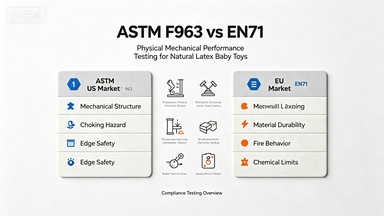
Key Differences Summary Between ASTM F963 & EN71 Mechanical Testing for Latex Toys
- Force Thresholds: EN71 sets higher tension and torque force values, making EU mechanical compliance more demanding for thin-walled latex teething products.
- Abuse Test Scope: ASTM F963 ties all mechanical results directly to cpsia compliance and CPC certification; US labs enforce post-abuse small part rechecks as a legal mandatory step.
- Environmental Simulation: EN71 adds cold-temperature bath toy testing, while ASTM F963 focuses solely on room-temperature dry-use abuse cycles.
- Regulatory Binding Power: ASTM F963 is enforced via federal CPSC law in the US; EN71 acts as the technical foundation for EU CE declaration of conformity for all infant toys.
How to Select Qualified Testing Labs for Latex Toy Mechanical Compliance
Many export baby toy brands waste budget and time by partnering with labs unqualified to test flexible natural latex materials. We summarize four core evaluation criteria for reliable third-party labs covering astm f963 baby toys, en71 infant toys and cpsia compliance:
- Official Accreditation: US market labs must hold CPSC-accepted lab credentials for issuing CPC certificates; EU testing bodies need notified body status to sign off EN71 test reports for CE marking. General plastic toy labs without latex test experience often misjudge elastic deformation as a passing result.
- Latex-Specific Test Equipment: Confirm the lab owns adjustable tension/torque fixtures for soft elastic materials and temperature-controlled water tanks for bath toy cold impact testing.
- Report Authenticity Traceability: Valid test reports include unique lab batch IDs, sample photos and full raw force data—customs and Amazon US will reject generic template reports without full test records.
- Industry Track Record: Prior experience testing natural rubber teethers and latex bath toys reduces retesting rates. Brands referencing Natural Baby World’s testing workflow work with dual-accredited labs that run ASTM and EN71 mechanical tests on the same sample batch to cut total testing turnaround time.
Complete Test Report Interpretation Guide & Typical Non-Conformity Rectification Cases
After mechanical testing completes, factories must fully interpret report failure items to adjust mold design, latex raw material hardness or wall thickness before mass production. Below are the three most frequent non-conformities we see in natural latex baby toy mechanical tests, paired with actionable fixes:
- Failure: Torque test causes teether bump detachment (Fails both ASTM F963 & EN71) Root cause: Thin latex wall thickness at molded massage nubs, weak fusion at mold seams. Rectification: Increase local wall thickness on all protrusions by 0.8–1.2mm during mold revision; reference the reinforced bump structure used on Natural Baby World’s latex teething collection.
- Failure: Drop test creates tiny latex fragments fitting the small parts cylinder (CPSIA compliance risk) Root cause: Low-hardness raw latex compound prone to brittle fracture under cold impact. Rectification: Adjust latex formula to boost shore hardness; add cross-linking agents to improve tear resistance for bath toy SKUs targeting EU sales.
- Failure: EN71 tension test splits hollow latex ring body (Passes ASTM F963 but fails EU standard) Root cause: EN71’s 70N tension force exceeds the 44.5N ASTM threshold, exposing thin hollow ring walls. Rectification: Add an internal supporting latex rib inside hollow teething rings to evenly distribute pulling force.
Pre-Production Testing Standardization to Avoid Batch Inspection Failure
This full mechanical testing framework helps latex toy factories standardize pre-production sample testing, eliminate unqualified bulk shipments, and fully meet CPSIA, EN71 and ASTM F963 market compliance requirements. We recommend manufacturers adopt this 3-step pre-mass-production workflow for cross-border latex toys:
- Submit first article samples to dual-accredited labs for parallel ASTM F963 and EN71 mechanical testing before mold finalization.
- Adjust mold thickness, latex formula and structural design based on lab failure feedback, and re-test revised prototypes.
- Archive complete mechanical test reports alongside chemical safety documents to satisfy Amazon, EU customs and US CPSC audit demands.
Running dual-standard mechanical testing early avoids costly post-production mold rework and shipment detention at international ports. Brands that skip pre-sample mechanical validation often face full batch returns, which erase profit margins for export baby toy lines.
Conclusion
For manufacturers selling natural latex infant toys to North America and Europe, mastering the divergences between astm f963 baby toys and en71 infant toys physical mechanical testing is non-negotiable, and full cpsia compliance relies entirely on passing ASTM F963’s strict abuse test suite. Natural latex’s unique elastic, soft material properties demand targeted mechanical testing workflows that rigid plastic toys do not require—ignoring region-specific force thresholds and abuse cycles creates avoidable safety compliance risks.
By implementing standardized pre-production mechanical testing, partnering with accredited latex-specialized labs, and benchmarking structural design against fully certified products like those at //www.naturalbabyworld.com/organic-natural-latex-teethers.html, factories can cut retesting costs, eliminate customs clearance delays, and build consistent cross-border compliance for their latex baby toy catalogs. In today’s tightening global toy safety regulatory landscape, precise alignment with ASTM F963 and EN71 mechanical performance rules turns compliance from a costly barrier into a core competitive selling point for global maternal and infant brands.
ISO 9001 Quality Control for Natural Latex Toy Factories: Full Process QC from IQC to OQC
Natural Latex Baby Toy Certification Matrix: Entry Requirements for Europe, America, Asia