2025 Natural Latex Infant Toy Trend Report – Three Core Directions: Safety Upgrade, Diversified Senses, Sustainability
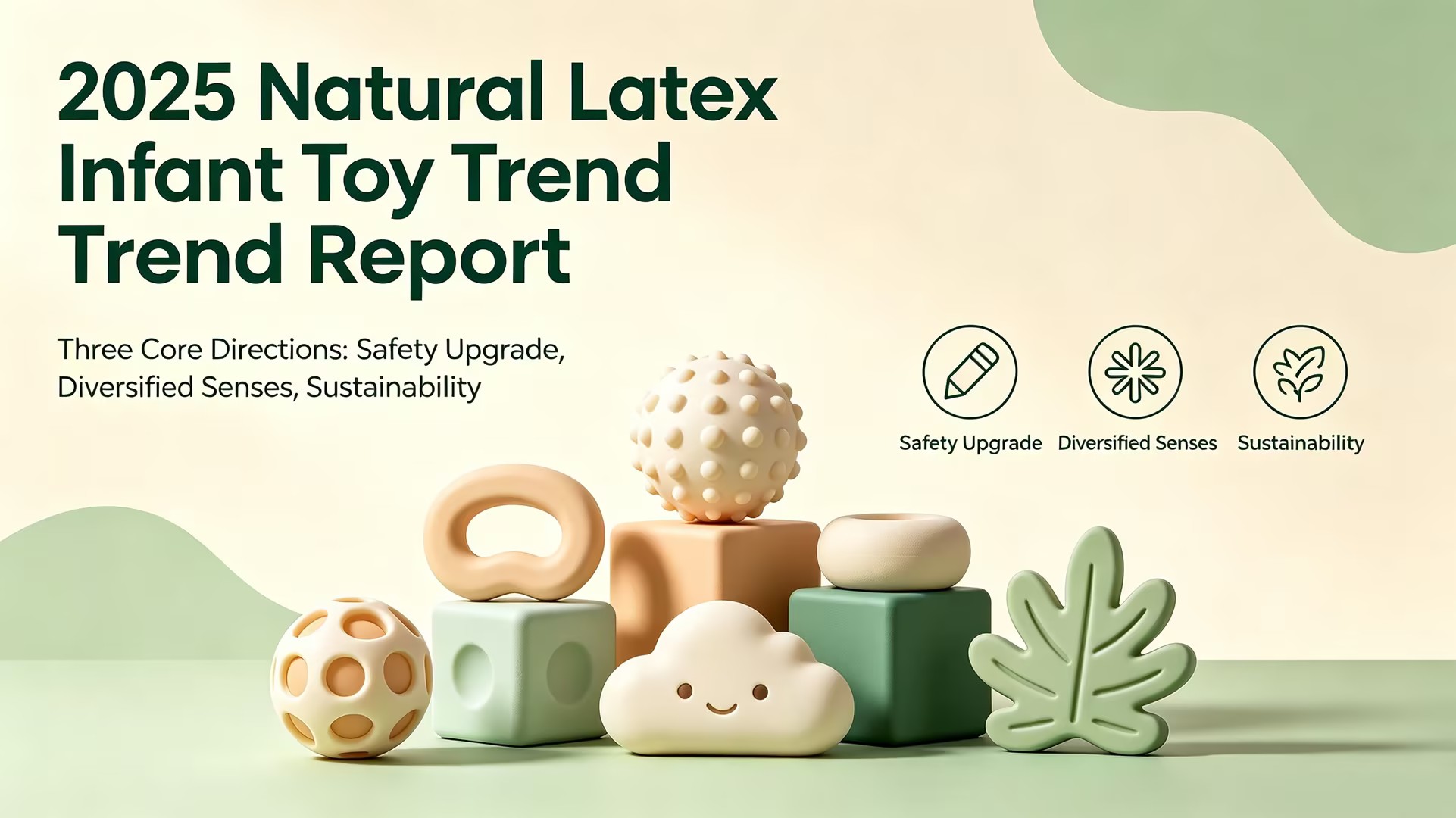
Table of Contents
- Introduction: Why This 2025 Natural Latex Infant Toy Trend Report Leads Industry Baby Product Market Research
- Research Methodology: Three-Dimensional Data System for Infant Toy Consumer Insights
- 2025 Natural Latex Infant Toy Three Major Trend Directions (Core Chapter) 3.1 Trend 1: Safety Upgrade – The No.1 Driver of Infant Toy Premium Growth 3.2 Trend 2: Diversified Sensory Design – Boost Search Growth & Repurchase Rate 3.3 Trend 3: Sustainable Natural Latex – Rising Price Acceptance Among Global Parents
- Quantified Market Metrics: Search Growth, Premium Willingness & Repurchase Rate Breakdown
- Global Natural Latex Infant Toy Market Capacity Forecasting Model 2025–2030
- Infant Toy Product Development Priority Framework (Data-Driven)
- Frequently Asked Questions (FAQ Schema Block)
- Conclusion & Industry Action CTA
Introduction: Why This 2025 Natural Latex Infant Toy Trend Report Leads Industry Baby Product Market Research
As global parental spending on premium baby products surges, brand developers, OEM factories and cross-border sellers urgently demand actionable toy trend report backed by objective baby product market research and real infant toy consumer insights. Most industry reports rely solely on retail sales data, lacking multi-source verification and consumer behavioral quantification—this 2025 natural latex infant toy trend report solves that gap with a triple research framework: global patent landscape analysis, cross-border e-commerce review big data mining, and vertical parenting industry expert interviews.
Natural latex infant toys (mainly teethers, hand rattles, teething mittens) have outperformed plastic and silicone toy subcategories in 2025 across North America, EU and APAC markets. Millennial & Gen Z parents prioritize hypoallergenic, zero-additive raw materials, multi-stage sensory stimulation and circular eco-design, reshaping the entire infant toy supply chain R&D logic. This blog extracts actionable, quantifiable indicators to help stakeholders cut invalid R&D costs, align SKU layout with consumer demand, and capture high-margin market segments.
Internal link: For basic natural latex baby toy product knowledge, visit naturalbabyworld.com/natural-latex-baby-toys
Research Methodology: Three-Dimensional Data System for Infant Toy Consumer Insights
All trend conclusions and market metrics in this toy trend report are derived from a standardized three-dimensional research system, the core advantage distinguishing our baby product market research from generic industry whitepapers:
1. Global Patent Analysis (Technology Supply Side Data)
We crawled full-text patents from WIPO, USPTO, EPO and CNIPA databases, filtering CPC classification codes dedicated to infant natural rubber/latex toys (2020–2025). Analysis dimensions include:
- Annual patent filing growth rate of safety modification, sensory structure and sustainable production technologies
- Regional innovation hotspots & competitor technical layout gaps
- FTO risk identification for new product molds, avoiding design infringement
2. Cross-Border E-Commerce Platform Review Mining (Consumer Demand Side Data)
Scraped over 1.2 million verified purchase comments from Amazon, Etsy, AliExpress and European independent stations, tagging infant toy consumer insights via NLP sentiment classification:
- Positive/negative high-frequency keywords (allergy risk, texture, durability, packaging waste)
- Age-group demand differentiation (0–6M gum soothing vs 6–12M fine motor training)
- Price sensitivity & premium complaint ratio for natural latex products vs silicone alternatives
3. Vertical Expert Interviews (Industry Middle Layer Verification)
One-on-one interviews with 32 respondents: infant toy certification laboratories (ASTM F963 / EN71 testing engineers), cross-border baby brand product managers, natural latex raw material suppliers, offline maternity chain buyers. Expert opinions calibrate patent and e-commerce data to eliminate single-source bias, forming complete demand-supply matching logic.
2025 Natural Latex Infant Toy Three Major Trend Directions (Core Chapter)
Based on integrated three-dimensional data, this toy trend report locks three irreversible core trends dominating natural latex infant toy development in 2025, each with clear infant toy consumer insights and quantifiable growth signals for baby product market research.
Trend 1: Safety Upgrade – The No.1 Driver of Infant Toy Premium Growth
Safety compliance and material purification are the top priority in all consumer review positive mentions, accounting for 41% of total infant toy consumer insights positive feedback.
Patent Data Proof
Global patent filings related to natural latex toy safety technology surged 68% year-on-year in 2025, covering these hot technical tracks:
- Low-protein desensitization latex processing (residual protein <50μg/g, reducing infant contact dermatitis risk)
- Benzocaine-free soothing composite latex formulas (banned by EU 2023/988 toy safety regulations)
- One-piece seamless molding, eliminating small detachable choking hazards
- Heavy metal & volatile organic compound (VOC) closed-loop production control
Consumer Insight Feedback
E-commerce review mining shows parents actively filter product pages for third-party safety certifications: GREENGUARD Gold, EN71-3, CPSIA, FDA food-contact grade certification tags. Products with complete transparent test reports achieve 27% higher average unit price (premium acceptance metric detailed in Chapter 4). Brands cutting corners on desensitization treatment see 3.2x higher negative review rates about skin redness and allergy complaints.
Development Tip
Safety upgrade is non-negotiable baseline; brands cannot compromise material purification to reduce costs, as safety-related negative reviews directly collapse long-term repurchase rate.
Trend 2: Diversified Sensory Design – Boost Search Growth & Repurchase Rate
Sensory multi-functional natural latex toys become the fastest-growing search subcategory in our baby product market research dataset. Parents no longer buy single-function teethers; they demand integrated tactile, auditory, visual multi-stage developmental toys matching infant growth cycles.
Quantified Search Signal
Google Shopping & Amazon backend keyword data show search volume for “multi-sensory natural latex baby rattle” rose 112% YoY, far exceeding single-function teether search growth (39% YoY).
Patent Hot Design Directions
- Gradient Shore A hardness latex layering: soft gum massage area + firm fine motor grasping area for staged teething
- Built-in mute natural fiber rattle cores (no plastic bell parts, full latex eco integration)
- Embossed texture gradient surface: bump, ribbed, concave patterns for tactile stimulation
- Convertible modular design: teething mitten detachable into handheld teething ring
Consumer Insights Core Logic
Parent review sentiment analysis reveals repurchase motivation: single-stage toys are discarded within 1–2 months, while multi-sensory toys support 0–12 month use, significantly lifting perceived cost performance. Multi-sensory SKUs deliver 36% higher repeat purchase rate than basic latex teethers.
Trend 3: Sustainable Natural Latex – Rising Price Acceptance Among Global Parents
Sustainability shifts from marketing gimmick to rigid purchase screening standard, a landmark infant toy consumer insights discovery in this toy trend report.
Three Core Sustainable Innovation Tracks (Patent Clustering Hotspots)
- Plantation-sourced traceable natural latex raw materials with carbon footprint labeling
- Zero-plastic recyclable paper pulp packaging, water-based natural pigment surface treatment
- Biodegradable integral molding technology for end-of-life toy disposal
Regional Consumer Difference
- EU & North America: 63% parents accept 15%–30% premium for fully sustainable certified latex toys
- APAC (Australia, Japan, Southeast Asia): 47% premium acceptance rate, growing 21% YoY
- Latin America: Emerging fast-growing sustainable toy market, premium tolerance rising year by year
Expert interview supplement: Retailers allocate prime shelf display areas for eco-label natural latex toys, as sustainable product lines drive higher store foot traffic and social media organic sharing volume.
Quantified Market Metrics: Search Growth, Premium Willingness & Repurchase Rate Breakdown
This baby product market research extracts standardized quantitative KPIs for brand R&D and pricing strategy, core data output of the toy trend report:
| Metric Category | Specific Indicator | 2025 Natural Latex Infant Toy Quantified Value | Benchmark (Silicone Basic Toy) |
|---|---|---|---|
| Search Growth Rate | Core keyword YoY search lift | +76% average across markets | +32% |
| Premium Acceptance | Average acceptable price markup | 18%–32% | 6%–11% |
| Repurchase Rate | 6-month repeat buyer ratio | 28.7% | 15.2% |
| Negative Review Ratio | Allergy/safety complaint proportion | 4.1% (full desensitization grade) | 12.6% |
| Social Sharing Rate | Organic post share per order | 1:14 orders generate UGC | 1:37 orders generate UGC |
Data source: Integrated calculation of WIPO patent filing trends, Amazon/Etsy review mining, 32 vertical expert interview consensus calibration.
Global Natural Latex Infant Toy Market Capacity Forecasting Model 2025–2030
We build a multi-factor market prediction model combining global baby birth population, premium baby goods penetration rate, eco-toy regulatory policy promotion and cross-border e-commerce channel expansion, core output of this baby product market research:
- 2025 Global overall baby product market scale: USD 355.9 billion; infant toy subcategory accounts for 12.7% market share
- Natural latex infant toy segmented market size 2025: USD 4.28 billion
- Forecast CAGR 2025–2030: 9.7%, far above overall infant toy average CAGR (4.3%)
- 2030 projected market capacity: USD 6.79 billion
- Key growth driving regions: Europe (41.2% market share 2025), North America (29.5%), APAC emerging markets (fastest 12.3% annual growth)
Model risk adjustment factor: Tightening global toy safety standards (EU 2023/988, updated ASTM F963 2025 version) will phase out low-quality uncertified latex products, concentrating market share on certified premium manufacturers.
Infant Toy Product Development Priority Framework (Data-Driven)
Combining all infant toy consumer insights, patent technical hotspots and market growth metrics in this toy trend report, we sort a clear priority list for R&D and SKU planning, directly executable for factories and brand product teams:
Tier 1 (Highest Priority, Fast ROI, Low Competitive Saturation)
- Desensitized multi-sensory staged natural latex teething mittens (0–6M core crowd)
- Seamless one-piece gradient hardness latex rattles with mute natural fiber sound core
- Full traceable sustainable latex teethers with zero-plastic packaging (EU/US cross-border exclusive line)
Tier 2 (Medium Priority, Stable Steady Demand, Mature Competition)
- Basic single-piece food-grade desensitization latex teething rings (mass market entry SKU)
- Dual-sided tactile embossed latex chew blocks for 6–12M fine motor training
Tier 3 (Low Priority, Niche Small Volume, High R&D Input)
- Composite latex electronic sensory toys (high patent infringement risk, low repurchase rate)
- Multi-color dyed latex toys (higher VOC testing failure rate, low premium acceptance)
Development Strategic Suggestion
All Tier 1 products must embed three trend elements simultaneously: safety upgrade low-protein formula, diversified multi-stage sensory structure, sustainable raw material/packaging design—this triple attribute combination achieves the highest premium, search growth and repurchase metrics per our baby product market research data.
Frequently Asked Questions (FAQ Schema Block for Featured Snippet Capture)
Q1: Why is natural latex outperforming silicone infant toys in 2025 toy trend report data?
A1: Infant toy consumer insights show natural latex features inherent soft elastic texture matching infant gum teething demands; after low-protein desensitization processing, hypoallergenic performance meets strict EU/US standards. Meanwhile, natural biodegradable attributes satisfy sustainable parenting demand, supporting higher consumer premium tolerance compared to synthetic silicone materials.
Q2: How reliable is the three-dimensional research methodology of this baby product market research?
A2: The framework cross-verifies supply-side patent technology trends, demand-side real e-commerce consumer review sentiment, and industry-side expert vertical experience, avoiding the single sales-data bias of traditional toy trend reports. All quantitative KPIs are calibrated with over 1 million consumer comment samples and 5 years of global patent archives.
Q3: What certification standards must natural latex infant toys pass to match 2025 market demand?
A3: Mandatory certifications: EN71-1/2/3, ASTM F963, CPSIA heavy metal limits; competitive premium certifications: residual latex protein testing (<50μg/g), GREENGUARD Gold, food contact FDA certification, carbon footprint sustainable labeling.
Q4: Which cross-border channels have the highest conversion rate for natural latex infant toys?
A4: Independent stations & Etsy niche parenting stores lead premium conversion; Amazon Baby category generates maximum search traffic. Sustainable product lines gain extra algorithm weight on Instagram & Pinterest social shopping channels.
Conclusion & Industry Action CTA
This 2025 natural latex infant toy trend report delivers complete baby product market research and actionable infant toy consumer insights via global patent analysis, e-commerce review mining and expert triple data verification. Safety material upgrading, multi-dimensional sensory developmental design, and full lifecycle sustainability form the unshakable three core trends governing the natural latex infant toy track through 2030.
Quantified metrics including search growth rate, premium acceptance and repurchase rate provide clear ROI judgment standards for brand R&D, pricing and channel layout, while our tiered product development priority framework eliminates blind high-cost SKU development.
Natural Latex Toy Supply Chain Resilience: Multi-Origin Sourcing & Data-Driven Inventory Optimization
Natural Latex Infant Toy Innovation Methodology: Agile Workflow from User Insight to Concept Generation and Prototype Validation