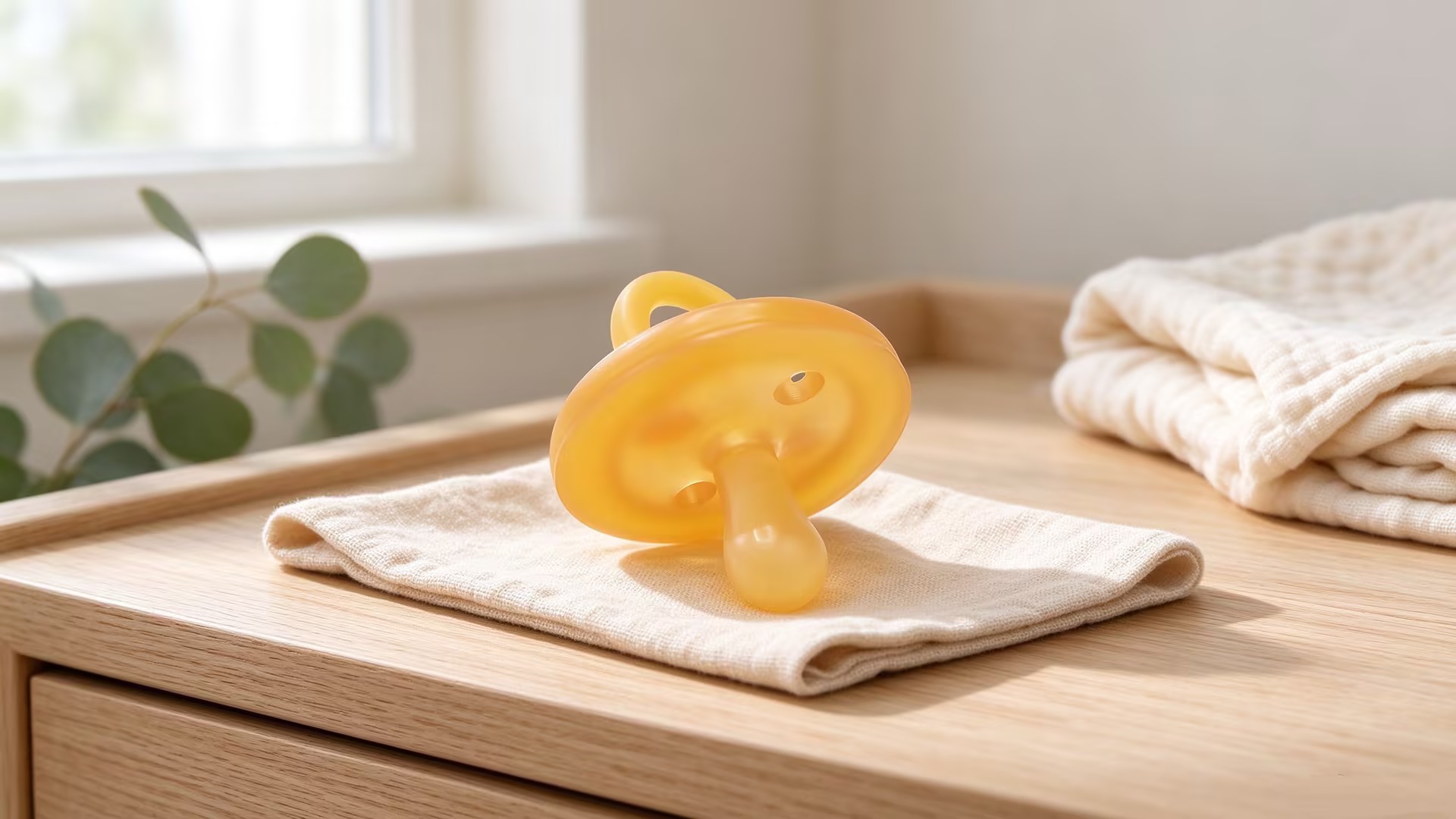
How to Clean a Natural Rubber Teether and When to Replace It
The short version
Warm water and a drop of mild, fragrance-free detergent. Rinse until the surface stops feeling slippery.
Check and replace interval for a baby with erupted teeth who chews hard and often.
Boiling, steam sterilisers, UV cabinets, microwaves and dishwashers all age natural latex fast.
Natural rubber has a lifespan — cleaning and replacing are part of safety
Buying a well-made natural latex teether is the beginning of its safety story, not the end. Natural rubber is a plant polymer: soft, elastic, warm to the touch, and — unlike silicone — a material that responds to heat, sunlight and time. That responsiveness is exactly why it soothes a baby's gums so well, and exactly why it needs a care routine that respects what it is.
Two habits decide whether a teether stays safe: how it is cleaned and when it is retired. Get the cleaning wrong and you accelerate the aging of the material you paid a premium for. Get the replacement timing wrong and your baby ends up mouthing a degraded surface with micro-cracks, sticky residue and texture grooves that no brush can reach. Neither failure is dramatic. Both are avoidable in about two minutes a day.
This guide sets out the daily routine, the sterilising methods that should never touch natural rubber, the 4–6 week replacement rule and the wear signs that override any calendar, plus storage rules that keep latex from aging early. It is written for parents and for buyers who need to brief their retail partners on after-sales care.
Daily cleaning: warm water, mild soap, and nothing harsh
The routine our own care guidance for organic natural latex teethers specifies — and the one that matches the widest range of natural-rubber brands — is deliberately unglamorous.
What you need: lukewarm water, a mild fragrance-free baby detergent (or a pH-neutral dish soap in a pinch), your fingers or a soft cloth, and a clean drying rack. No brushes with stiff bristles, no scouring pads, no alcohol, no bleach, no essential oils.
- Rinse first. Hold the teether under lukewarm running water to remove saliva, milk and food residue before anything else touches it.
- Use a drop, not a bowl. Put a small drop of mild soap on your fingers or a soft cloth and work it over the surface — including the textured areas, the ring interior and the joins between features, which is where residue actually hides.
- Keep it brief. Wash for 20–30 seconds. Do not soak the teether in soapy water for minutes; prolonged soaking lets water and detergent sit against the rubber and is explicitly discouraged by several natural-rubber manufacturers.
- Rinse thoroughly. Soap residue is its own problem — it leaves a film that tastes wrong and can irritate. Rinse until the surface no longer feels slippery, including inside holes and grooves.
- Air dry completely. Shake off excess water, pat once with a clean cloth if needed, then leave it on a drying rack in a cool, well-ventilated place. Never put it away damp, and never dry it on a radiator, in an oven or in direct sun.
Frequency: rinse after every use, and do the soap wash once a day for a teether in daily use. If the baby is ill, wash after each use and dry fully before the next one.
What not to use, ever: boiling water, steam sterilisers, microwave sterilisers, UV cabinets, dishwashers, chlorine-based sanitising solutions, alcohol wipes and essential-oil "natural" cleaners. The reasons are in the next section — they are not arbitrary rules, they are material science.
Sterilising methods compared: which are safe, which destroy the rubber
Parents reasonably assume that "sterilise" means "make safer." For natural rubber, the opposite is often true: the methods that sterilise hardest are the methods that age the material fastest, and a degraded surface is a worse hygiene problem than the one you were trying to solve.
| Method | Typical conditions | What it does to natural latex | Verdict |
|---|---|---|---|
| Warm water + mild soap | Lukewarm, 20–30 s | Removes residue without stressing the polymer. | Safe — default |
| Plain water rinse or damp cloth | Room temperature | Mechanical removal only; fine between soap washes. | Safe for daily use |
| Boiling | 100 °C, 5 min or more | Accelerates oxidation, softens the compound, can leave the surface tacky and promote cracking. | Not recommended |
| Steam steriliser | Around 100 °C saturated steam | Heat plus moisture penetrate the rubber; a leading natural-rubber brand explicitly prohibits steam sterilising. | Not recommended |
| UV or UV-C cabinet | UV radiation, often with mild heat | UV breaks polymer bonds and discolours latex; at least one 100% natural rubber brand prohibits UV sterilising. | Not recommended |
| Microwave steriliser | Localised high heat | Uneven heating, hot spots, deformation and structural damage. | Never |
| Dishwasher | 55–70 °C wash, alkaline detergent, mechanical action | Heat, chemistry and abrasion together; natural-rubber teether makers uniformly exclude dishwashing. | Never |
| Chlorine, alcohol or essential oils | Chemical wipe or soak | Corrodes or extracts the rubber and leaves residue on a mouth-contact product. | Never |
Verdicts describe ongoing care for uncoated natural latex. Always follow the care card supplied with your specific teether.
Two honest caveats
Brand instructions differ. HEVEA instructs a five-minute submerged boil before first use and warm-water washing only afterwards, while Sophie la girafe — also 100% natural rubber — rules out both steam and UV sterilisation, and Ingenuity's natural-rubber teether manual prohibits immersion, boiling, microwave and steam entirely. These differences come from compound formulation, wall thickness and surface finish, not from one brand being careless. The rule that survives all of them: follow the care card that came with your teether, and when in doubt, warm water and mild soap is the safe common denominator.
"Sterile" is not the goal. A teether is not a surgical instrument. The realistic hygiene target is "free of milk, saliva and food residue, and dry between uses." Warm-water washing achieves that. Boiling a latex teether to chase sterility trades a small hygiene gain for a large materials loss.
The 4–6 week rule: why natural rubber teethers get retired early
Industry guidance for natural-rubber soothers and teethers clusters around one to two months of use before replacement — NUK, for example, states that latex soothers should generally be replaced every 1–2 months and treats discolouration as a replacement signal. For teethers in heavy daily use by a baby who already has teeth, we recommend tightening that to a 4–6 week review-and-replace cycle. Here is the reasoning, so you can apply it rather than obey it.
Who needs the shorter cycle (4–6 weeks)
- Babies with erupted teeth who chew hard and often.
- Babies who mouth the teether for hours a day.
- Teethers used in creches or shared settings.
- Deep-texture shapes — knit, bumps, ridges — where residue is hardest to reach.
- Any teether that has already been through a hot car, a sunny window or a steam steriliser by mistake.
Who can work closer to 2 months
- A lightly used teether for a younger baby.
- Washed and fully dried every day, stored away from heat and light.
- A smooth surface with no visible wear.
- Still inspected every four weeks — the calendar never overrides a wear sign.
Three clocks run at once
- Thermal and UV aging. Heat and ultraviolet light both accelerate oxidation of the rubber. A teether stored on a sunny windowsill or left in a car ages several times faster than one kept in a drawer. The same product can last very differently in two households.
- Mechanical wear from teeth. Natural rubber is soft by design; that softness is what makes it gum-friendly and what makes it vulnerable. Once teeth arrive, the surface takes repeated concentrated loads, and micro-tears open exactly where texture meets body — the hardest places to clean.
- Hygiene reach. Deep texture and internal ring surfaces are cleanable only to a point. Over weeks the cleanable fraction declines even if the material looks fine, because grooves round off, crack and roughen at the micro level.
How to run the cycle in practice
- Buy two and rotate. One is in use while the other is washed and drying. Rotation also halves per-unit wear, so a pair outlasts two sequential singles.
- Mark the start date. Write the purchase month on the storage box or the care card. Without a date, "it feels fine" is the only signal you have, and feel is a poor judge of polymer aging.
- Do a formal check every four weeks. Run the eight-point wear test below. Two minutes, on a recurring reminder alongside another baby task.
- Replace, don't stretch. If any wear sign is present at the four-week check, retire the teether. If the baby is teething hard, expect 4–6 weeks rather than eight.
- Cap it. Even with perfect care, retire a natural-rubber teether by 2–3 months of regular use. It is a consumable, not an heirloom.
For buyers and brands, this is a repeat-purchase curve, and the honest way to support it is to say so on the pack. A care card that states the cleaning method, the check interval and the wear signs turns a safety obligation into a retention asset — and it protects you from reviews written by parents who boiled a latex teether and blamed the product when it went tacky.
The wear-sign checklist: eight signals that mean "replace now"
Inspect in good light, with clean hands, before the next use. Any single "yes" retires the teether immediately — these are not cosmetic judgments.
-
Sticky or tacky surface.If the rubber feels gluey even after washing and drying, the compound is degrading. This is the classic heat-aging signature and the most common result of boiling or steaming.
-
Cracks, tears or splits.Look especially at the joins between ring and body, at the base of textured features, and at thin sections. A crack is both a breakage risk and a bacterial harbour.
-
Discolouration or darkening.Some gradual darkening is normal for an unbleached plant material, but a marked colour shift — particularly after sun exposure — is a documented aging signal and a cue to replace.
-
Persistent odour.A smell that survives washing and drying means material breakdown or residue trapped beyond reach. Replace.
-
Loss of elasticity.Compare with a new one if you keep a pair: if the old one feels noticeably harder, or collapses flatter and stays deformed, the polymer has aged.
-
Surface chalking, fuzzing or flaking.A powdery or fuzzy surface, or tiny flakes at the edges, means the surface layer is failing — and flakes go into a mouth.
-
Any hole, puncture or piece that could be bitten off.Immediate stop, choking-hazard level. Retire it and dispose where the baby cannot reach it.
-
Worn-away markings or moulded details.If moulded features or printed markings have worn smooth, the same abrasion has been working on the material structure. Treat it as an end-of-life signal.
Two supporting checks. A firm pull test along the main axis — does it stretch and show a tear? A squeeze test over every textured area — does it feel soft-spongy where it used to be firm? Both are cheap, both are faster than a visual scan, and both catch failures eyes miss.
Storage: the half of care that happens after washing
Most early aging is storage failure, not cleaning failure. Rubber that is put away damp, kept in a hot car or parked on a sunny sill will age faster than rubber that is washed roughly but stored correctly.
- Cool, dry, ventilated. A drawer, a breathable cotton pouch or an open shelf. Not a sealed zip bag with residual moisture, and not a bathroom shelf above a hot shower.
- No direct sun, no UV. Sunlight is the single most aggressive everyday factor for latex. Keep teethers out of window displays, car dashboards and prams left in the sun.
- Away from heat sources. Radiators, ovens, kettles, bottle warmers — anywhere above room temperature for long periods is the wrong home.
- Fully dry before storing. Air-dry completely, including holes and grooves, then store. Damp storage is how surface mould and odour start.
- Store separately from sharp or heavy items. Loose keys, metal parts and hard plastic in the same bag can nick a soft rubber surface. A small cotton pouch solves it.
- Don't leave it in the pram or car "for convenience." A teether that lives in a hot car is aging on fast-forward, and the damage is invisible until the surface turns sticky.
- Rotate, don't stack. If you keep two, alternate them and let each dry fully; stacking damp teethers against each other is a common cause of odour.
The same rules apply to the same material in other shapes: our one-piece natural rubber pacifier takes the identical warm-wash routine, with the 4–8 week replacement rhythm that pacifiers have always carried.
Frequently asked questions
Can I pour boiling water over a natural rubber teether "just quickly"?
A brief pour-over is less damaging than a five-minute boil, but it still delivers a heat shock to a material designed to age under heat. Our guidance is warm water plus mild soap, not boiling water. If your specific brand's care card permits a one-off pre-first-use boil, follow the card — formulation matters — but do not make boiling a routine.
Is a UV steriliser cabinet safe for latex?
No. UV breaks polymer bonds and discolours natural rubber, and at least one 100% natural-rubber brand explicitly prohibits UV sterilisation. UV cabinets are designed for hard plastics, glass and silicone.
Can I put the teether in the dishwasher on a cool cycle?
No. Even a low-temperature dishwasher cycle combines heat, alkaline detergent and mechanical action — three stressors at once — and natural-rubber teether manufacturers uniformly exclude dishwashing.
My teether has gone slightly darker. Is it still safe?
Mild, gradual darkening is normal for an unbleached plant material. A pronounced colour shift, especially accompanied by stickiness or a smell, is not cosmetic: that is aging, and it means replace. When in doubt, compare it with a new one side by side.
Do I need to sterilise a brand-new teether?
Follow the brand's care card. Some natural-rubber brands specify a short pre-first-use boil; others specify a warm soap wash. Our own care guidance is a warm wash and a full air dry before first use.
How many teethers should I own?
Two per baby in active teething, so one is always clean and dry. A rotated pair halves per-unit wear and removes the temptation to use a damp teether because the clean one is unavailable.
Replace on schedule, not on failure
The simplest way to keep a natural latex teether safe is to stop treating it as permanent. Wash it warm, dry it fully, store it cool and dark, check it every four weeks against the eight signs, and replace it at four to six weeks in heavy teething use — or immediately at the first sign of stickiness, cracking or odour. For parents that means a spare on hand and a reminder in the calendar. For buyers and brands it means a care card in the box and a reorder rhythm your retail partners can plan around.
Need the care card, the material data sheet or the batch test report for a specific model? Contact our team and we will send the current documents for that SKU — no obligation.
Sources
- Care instructions for HEVEA natural rubber products — pre-first-use boil, warm-water ongoing care, no dishwasher or microwave us.heveaplanet.com
- Sophie la girafe — cleaning guidance: no steam sterilisation, no UV sterilisation sophielagirafe.com.sg
- Ingenuity Sylvi natural rubber teether — instruction manual: wipe with damp cloth and mild soap; do not immerse, boil, microwave or steam sterilise manuals.plus
- NUK — latex soothers: replace every 1–2 months; sunlight accelerates aging and discolouration is a replacement signal nuk.co.uk
- KIANAO — natural rubber teething myths: no boiling, microwave or dishwasher; discard at the first crack or when the surface turns sticky kianao.com
- Natural Baby World — official care tips for organic natural latex teethers naturalbabyworld.com
One-Piece vs Two-Piece Pacifiers: Why Structure Matters as Much as Material