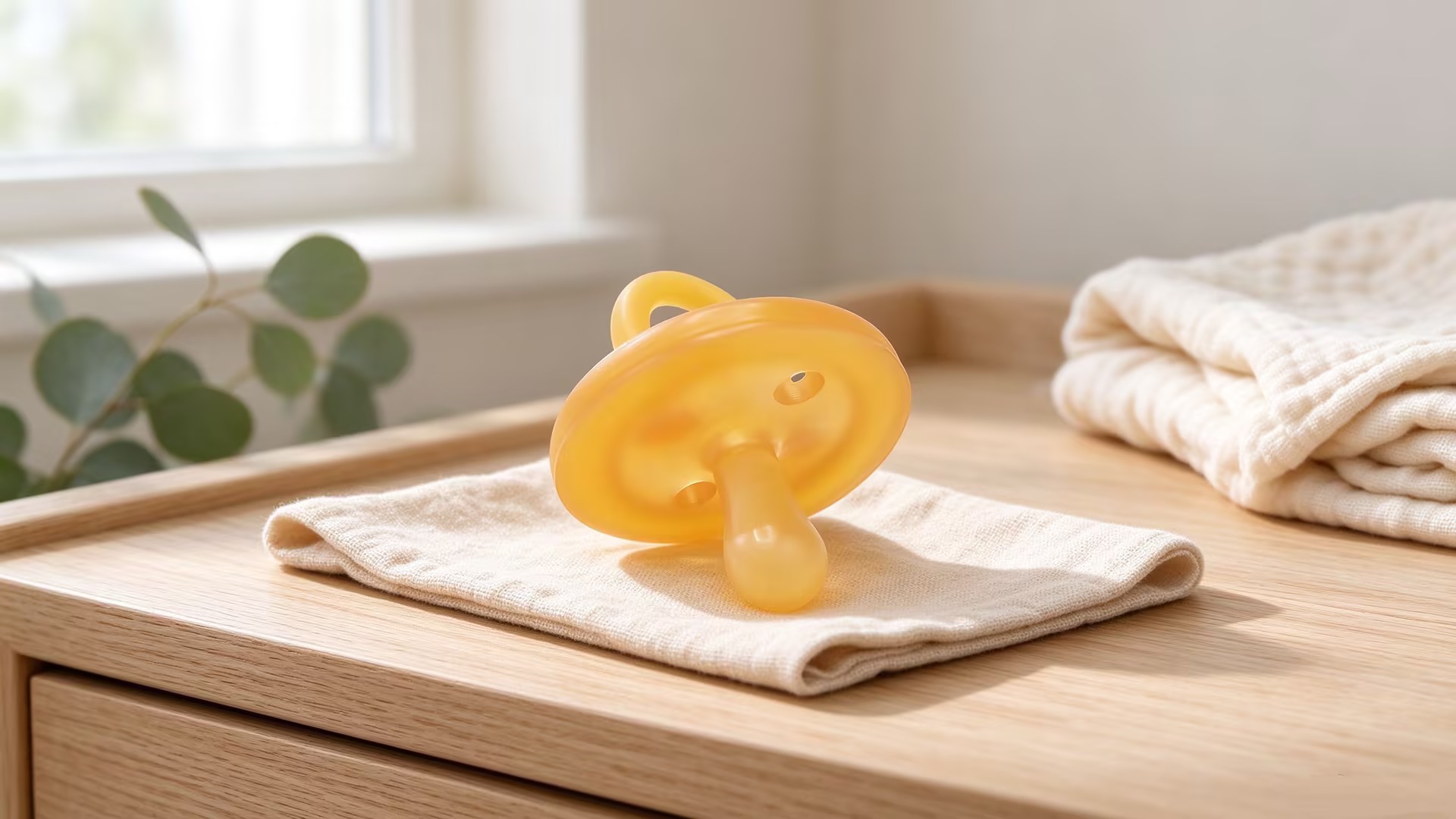
Nitrosamines in Rubber Teethers: Why EN 1400 Certification Matters for Buyers

Why Nitrosamines in Rubber Teethers Should Be on Your Sourcing Checklist
Every buyer who sources natural rubber teethers or soothers eventually runs into the same two words: nitrosamines. They appear in supplier claims (“nitrosamine-free rubber”), in European test reports, and increasingly in buyer questionnaires. Yet very few sourcing conversations actually explain what nitrosamines are, why they form in rubber in the first place, and — most importantly — what a credible test report should prove.
This article is written from a manufacturer’s side of the table. We make natural latex baby teethers, soothers and bath toys, and we are asked about nitrosamines almost weekly. Here is what we tell buyers, without the marketing layer: what the chemical risk is, what EN 1400 certification does and does not cover, the exact migration limits that matter, how the test is run, and the document checklist you can use to verify any supplier — including us.
What Are Nitrosamines and Why Do They Form in Rubber?
A nitrosamine is a chemical compound with an N–N=O structure (a nitroso group attached to an amine). Many N-nitrosamines are classified by the International Agency for Research on Cancer (IARC) as Group 2A probable human carcinogens — compounds for which there is strong evidence in animals and plausible, though not conclusive, evidence in humans. Examples you will see in test reports include N-nitrosodimethylamine (NDMA), N-nitrosodiethylamine (NDEA), N-nitrosodibutylamine (NDBA), N-nitrosomorpholine (NMOR), N-nitrosopiperidine (NPIP) and N-nitrosopyrrolidine (NPYR).
Nitrosamines do not come from the latex itself. They form during vulcanization — the industrial process that turns liquid natural latex into a stable, elastic solid. Vulcanization relies on accelerators: chemicals that make the sulfur cross-linking reaction fast and consistent. Many traditional accelerators are based on secondary amines. Under the heat of curing, and in the presence of nitrogen oxides (NOx) from the air or from compounding ingredients, those amines can react to form stable N-nitrosamines. Secondary sources include certain antioxidants and impurities in raw materials.
Three things make baby products different from an industrial rubber gasket:
- They sit in the mouth for hours. A soother or teether is in direct, prolonged contact with saliva at body temperature — the exact conditions that favor migration.
- The consumer is an infant. The body weight is small, and the exposure window spans the first years of life, when the risk calculus is strictest.
- The law says so. Because of the first two points, rubber teats and soothers are the most tightly regulated rubber articles in Europe. That is why the word “nitrosamine” keeps appearing in your supplier’s documents.
The important framing for a buyer: the presence of nitrosamines is a process and formulation issue, not a property of natural rubber itself. Good compounding, the right accelerator chemistry and proper post-treatment can drive migration below the legal limits — which is exactly what certification proves.
EN 1400: The European Safety Standard for Soothers
EN 1400:2013+A2:2018 — Child use and care articles – Soothers for babies and young children – Safety requirements and test methods — is the European standard for pacifiers and dummies. It is developed by CEN, the European Committee for Standardization, and covers materials, construction, performance, packaging and product information for products that resemble or function as a soother.
What the standard does not cover is worth knowing, because buyers routinely confuse the boundaries:
- Feeding bottle teats are not covered. They fall under the EN 14350 series.
- Specialist clinical soothers are excluded (for example products for premature babies or Pierre Robin syndrome).
- Teethers are not soothers. A teether is a toy and is regulated in the EU through the Toy Safety Directive 2009/48/EC and its chemical methods in EN 71-12 (nitrosamines and nitrosatable substances). The migration limits are the same as for soothers — see the next section — but the test standard you should ask for on a teether is EN 71-12, not EN 1400.
So why does this article talk about EN 1400 when you are buying a rubber teether? Two reasons. First, if a factory makes soothers that pass EN 1400 — with its nitrosamine, heavy-metal, BPA, MBT and mechanical requirements — the same compounding discipline and quality system carry over to the teether line, which uses the same family of nitrosamine-tested rubber compounds. Second, in practice the two standards share the same analytical backbone: EN 1400 points to EN 12868 for nitrosamine testing, and EN 71-12 is built on the same approach. A supplier who is confident enough to hand you an EN 1400 report on their rubber is, as a rule, the same supplier who will hand you an EN 71-12 report on the teether without hesitation. Our organic natural latex teethers and orthodontic natural rubber baby pacifiers are produced under that same quality system.
Within EN 1400, the chemical requirements cover:
- Nitrosamines and nitrosatable substances (by EN 12868 method) — the focus of this article;
- Migration of elements — limits for arsenic, barium and nickel were tightened in Amendment A2, and chromium VI and organic tin limits were added;
- Bisphenol A (BPA) — a requirement added in A2, aligned with the EFSA 2015 TDI and a French A-deviation (relevant if you are sourcing soothers with any plastic component);
- 2-Mercaptobenzothiazole (MBT) — a common rubber accelerator, limited to 8 mg/kg release from soothers;
- Mechanical safety — shield dimensions, ventilation holes, teat attachment and pull-force resistance, all of which address choking and suffocation risks.
The Limits That Matter: 10 µg/kg and 100 µg/kg
The legal migration limits for nitrosamines from rubber teats and soothers in the EU come from Commission Directive 93/11/EEC, a specific measure under the framework Regulation (EC) 1935/2004 on food contact materials. EN 1400 and EN 12868 are the methods by which compliance with those limits is demonstrated.
| Parameter | Limit | Equivalent |
|---|---|---|
| Total release of N-nitrosamines | ≤ 0.01 mg/kg | 10 µg/kg (10 ppb) |
| Total release of N-nitrosatable substances | ≤ 0.1 mg/kg | 100 µg/kg (100 ppb) |
Two details in this table are easy to miss and both matter:
- The unit is per kilogram of the rubber part. The limit is expressed against the weight of the elastomer or rubber teat/soother part, tested under defined saliva-simulant conditions. That is why the test method (how much sample, which simulant, which time and temperature) is just as important as the limit itself.
- “N-nitrosatable substances” is a safety net. These are compounds that are not yet nitrosamines but can become them — for example residual secondary amines — under the right conditions. The standard tests them by forcing nitrosation in the laboratory and measuring how much additional nitrosamine is formed. The 100 µg/kg allowance is wider because a precursor is one step away from the finished hazard, but a responsible manufacturer manages both numbers, not just the headline one.
For teethers, the same values apply through the Toy Safety Directive: EN 71-12 sets N-nitrosamine migration at 0.01 mg/kg and N-nitrosatable substances at 0.1 mg/kg for toy materials intended for children under 36 months or for mouthing. China’s own standards for soothers — GB 28482-2012 and GB 4806.2-2015 — adopt the same limits (0.01 mg/kg and 0.1 mg/kg), which is convenient when you are sourcing from Chinese manufacturers and selling into Europe: the numbers you need to check are the same at both ends of the supply chain.
One note for accuracy: in some older or second-hand documents you may see the German BfR recommendation phrased as “non-detectable with a detection limit of 10 µg/kg” for nitrosamines and “0.1 mg/kg” for nitrosatable substances. This is not a stricter limit — it is the same 10 / 100 µg/kg expressed in the language of laboratory detection limits. If a supplier shows you a report with any other number (for example 20 µg/kg for nitrosatable substances), ask where it comes from. The internationally accepted figures are 10 and 100 µg/kg.
How Nitrosamine Testing Actually Works
If you have never read a migration report, the jargon can be intimidating. Here is the process in plain terms.
- Sample preparation. The rubber part of the soother or teether (the teat, not the plastic shield) is separated and weighed. For soothers, EN 12868 uses a sample portion of 5 g in 20 ml of artificial saliva salt solution. If the part weighs less than the standard sample size, multiple identical parts are pooled.
- Migration. The sample is immersed in the artificial saliva and held at 40 °C for 24 hours — deliberately harsher than real use, to give a safety margin against a baby sucking at body temperature.
- Extraction. The migration solution is extracted with dichloromethane, concentrating the nitrosamines out of the aqueous phase.
- Analysis. The extract is measured by chromatography. GC-TEA (gas chromatography coupled to a thermal energy analyzer) is the reference technique in Europe and the US because it is highly sensitive and selective for N-nitroso compounds. GC-MS/MS and LC-MS/MS are also used. The laboratory quantifies the individual nitrosamines (NDMA, NDEA, NDBA, NMOR, NPIP, NPYR and others, depending on the standard’s compound list) and sums them. A separate, forced-nitrosation step measures the nitrosatable substances.
- Reporting. The result is compared with the limit, and the report states the outcome.
A credible third-party report looks like this:
- Laboratory identity: an ISO/IEC 17025-accredited test laboratory (accreditation number stated);
- Report number and date;
- Customer and sample description: product name, model, material (e.g. natural rubber latex), and ideally a photo and the batch number — this is how you connect the document to your goods;
- Reference standards: e.g. “EN 12868:2017” or “EN 71-12:2017”, and the applicable limit (Directive 93/11/EEC or 2009/48/EC);
- Test conditions: simulant, temperature, duration, sample weight;
- Results: each compound found, the sum of nitrosamines, the sum of nitrosatable substances, versus the limit;
- LOD/LOQ: the limit of detection and quantification of the method — a “non-detected” result is only meaningful when the detection limit is stated;
- Measurement uncertainty;
- Signatures of the laboratory personnel.
Two habits separate professional buyers from casual ones. First, always check that the report covers migration (release into saliva simulant), not content (total amount in the rubber). Content tells you nothing about what actually comes out in a baby’s mouth. Second, check that the sample description matches the product you are buying — a report for a different model, a different batch, or a different factory is not evidence for your goods. Batch numbers are how manufacturers make the document traceable, and any supplier who refuses to tie a report to a specific production batch should be questioned.
What a Factory Does to Keep Nitrosamines Low: Formulation and Process
Since nitrosamines form during vulcanization, they are controlled at the compounding and process stage, not “tested away” at the end. A manufacturer serious about nitrosamine management works on four levels:
- Accelerator chemistry. The single most effective lever is choosing accelerators and sulfur donors that do not generate secondary amines under curing conditions. Traditional thiuram and sulfenamide accelerators (for example TMTD-based systems) are the ones most associated with nitrosamine formation. Modern low- or zero-nitrosamine accelerator systems — typically benzyl- or dithiophosphate-based compounds such as TBzTD, ZBEC and ZDTP — are widely available and can achieve migration far below the 10 µg/kg limit. This is the decisive formulation choice, and it is exactly the kind of detail a supplier can describe even if the full recipe stays proprietary.
- Raw material purity. Nitrates and nitrites in the latex or in fillers are the nitrogen source that reacts with amines. Controlling the purity of the base latex, fillers, pigments and process oils removes the second half of the reaction.
- Antioxidant selection. Certain amine-based antioxidants are themselves nitrosatable. Formulators switch to non-amine or non-nitrosatable alternatives for mouth-contact compounds.
- Post-cure treatment. After molding, parts can be washed and leached in hot water to extract soluble residues, including any residual accelerators, their by-products and other extractables. Leaching is standard practice for food-contact and mouth-contact rubber and measurably reduces migration. Some factories also control workshop air to limit NOx exposure of the freshly cured parts.
None of this is exotic. It is standard, well-documented rubber technology — which is exactly the point: a “nitrosamine-free teether” claim is not magic, it is engineering, and it can be verified with a migration report.
What a manufacturer should not do is put the words “nitrosamine-free” on a product without a migration test behind them. Migration is not a binary state; the honest claim, backed by EN 12868 or EN 71-12 data, is “nitrosamine release below the 10 µg/kg limit of Directive 93/11/EEC / Toy Safety Directive.” Buyers should treat an unbacked “nitrosamine-free” label the same way they treat an unbacked “BPA-free” label: as a starting point for questions, not as evidence. The same reasoning applies to our rubber baby teether range: every claim is tied to a test report and a batch number.
The Buyer’s Verification Checklist
When you evaluate a supplier, work through this list in order:
- Ask for the standards you actually need. For soothers: EN 1400:2013+A2:2018 report, with the nitrosamine part tested to EN 12868:2017. For teethers: EN 71-12 report (or a 2009/48/EC toy test covering nitrosamines).
- Check the numbers. N-nitrosamines ≤ 0.01 mg/kg (10 µg/kg); N-nitrosatable substances ≤ 0.1 mg/kg (100 µg/kg). Anything else needs a citation.
- Check the laboratory. ISO/IEC 17025 accreditation, independent (not the factory’s own “in-house test” unless clearly labeled as such), report number and date present.
- Match the sample to your goods. Product name, model, material, photo, batch number — the report must be traceable to the batch you are importing.
- Check migration, not content. The test must be a release test into artificial saliva, not a total-content measurement.
- Ask about formulation. Which accelerator family is used (low-nitrosamine systems), what post-cure treatment (leaching/washing) is applied, and whether the compound is re-qualified when the recipe changes.
- Ask about batch frequency. A one-time report from five years ago is not the same as per-batch or quarterly verification on the current production.
- Look for the bigger picture. A supplier who also shows EN 71-3 (element migration), CPSIA/ASTM F963 for the US market, and REACH declarations is signalling a mature compliance system. Nitrosamine control is part of a hygiene culture, not an island.
The Bottom Line for Buyers
Nitrosamines are a real, regulated risk in natural rubber baby products — and a fully manageable one. The limits are clear (10 µg/kg nitrosamines, 100 µg/kg nitrosatable substances), the test methods are published (EN 12868 for soothers, EN 71-12 for teethers), and the manufacturing techniques are established. EN 1400 certification matters because it is the strongest single signal that a factory applies this discipline systematically to its rubber compounds — not because a teether is itself an EN 1400 product, but because the same compounding and quality system produces both.
Request the Test Documents Before You Commit
At our factory in Dongguan, we manufacture natural latex teethers, soothers and bath toys, and we routinely provide EN 12868 / EN 71-12 migration reports tied to production batches. Review the range:
- Organic natural latex teethers
- Orthodontic natural rubber baby pacifiers
- Full rubber baby teether category
- Complete product range
Or read about our manufacturing and quality approach, and start with our newborn toy safety guide. Ask any supplier — including us — for the nitrosamine migration report, the test standard, the lab accreditation and the batch number before you order. A ten-minute document check is the cheapest quality control a buyer can run.
Sources
- Commission Directive 93/11/EEC on the release of N-nitrosamines and N-nitrosatable substances from elastomer or rubber teats and soothers — EUR-Lex
- EN 1400:2013+A2:2018, Child use and care articles – Soothers – Safety requirements and test methods — CEN standard entry
- EN 12868:2017, Method for determining the release of N-nitrosamines and N-nitrosatable substances from elastomer or rubber teats and soothers — UNI standard entry
- French DGCCRF guidance on rubber food-contact materials (soothers: N-nitrosamines 10 µg/kg, N-nitrosatable substances 100 µg/kg) — economie.gouv.fr
- GC-TEA method paper on N-nitrosamine migration in food contact materials (GB 28482-2012 / GB 4806.2-2015 limits) — Analytical Testing Technology & Instruments (Chinese)
Why “BPA-Free” Isn’t Enough: What a 2026 Munich Pacifier Study Means for Parents