One-Piece vs Two-Piece Pacifiers: Why Structure Matters as Much as Material
Ask any parent what makes a pacifier safe and most will answer with a material: silicone, latex, BPA-free, phthalate-free. It is a reasonable answer — and it is incomplete. A pacifier is an assembly, and every junction in that assembly is a place where safety can leak out.
This article compares one piece pacifiers with two piece (and three piece) pacifiers across the dimensions that actually matter: hygiene, chemical exposure, mechanical failure and verifiability. The short version: a seamless, one-piece construction is not a marketing flourish. It removes the three most common failure modes of a conventional pacifier — the seam, the detachable part and the bonded chemical layer — in one design decision. Material still matters, but structure decides where that material ends up in your baby's mouth and how long it stays clean.
What a "two-piece" pacifier actually contains
Most pacifiers on the shelf are multi-component assemblies. A typical design has a nipple moulded from silicone or latex, a shield (the guard that stops the pacifier being swallowed) moulded from polypropylene (PP) or another rigid plastic, and a ring or handle that is either a third moulded part or a hinged loop. The nipple is usually friction-fitted or glued into the shield; the ring is clipped or welded on.
That architecture is so familiar that nobody stops to count the junctions. A two-piece pacifier has at least two material interfaces: nipple-to-shield and shield-to-ring. Add a decorative cap, a cover or a light-up module and the interface count rises further. Each interface is a structural feature, and structural features fail in predictable ways:
- Seams trap contamination. Every joint, lip and recess is a crevice. Saliva, formula, milk residue and dishwasher water collect there, and crevices are exactly where biofilm — the slime layer of bacteria — establishes itself. A pacifier that looks clean after rinsing can still harbour residue in a seam you cannot see and cannot reach with a brush.
- Parts loosen. Moulded parts rely on friction, snap fits or adhesive. Repeated sterilising — especially the boiling cycles that pacifier standards themselves prescribe — changes the polymer, relaxes the snap fit and weakens the bond. A ring that was firmly attached at purchase can, months later, twist free in a baby's mouth.
- Bonded layers add chemistry. Adhesives, weld lines and gaskets are themselves materials. They bring their own additive packages — solvents, adhesion promoters, plasticisers — into a product whose entire job is to sit in an infant's mouth.
The trade-off is not between "cheap bad design" and "expensive good design." The trade-off is architectural: every part count adds one more place where hygiene, chemistry or mechanical retention can fail. That is the argument this article walks through with data.
The 2026 Munich study: the shield was the problem, and the shield is a "part"
The clearest recent demonstration of the structural argument comes from a 2026 study in Munich that tested pacifiers and teethers sold in Germany. The study detected bisphenol A (BPA) in all seven products tested (7/7) — including products carrying "BPA-free" labels. The highest detected level reached 26,536 ng, which the authors calculated as approximately 11,600 times the EFSA tolerable daily intake for a child of that size. The finding that matters for this article, though, is not the headline number. It is the source.
We covered this study in detail in our BPA deep-dive for pacifiers and teethers; the numbers quoted here — 7/7 detection, 26,536 ng, 11,600× EFSA TDI — are from that analysis and are re-quoted here because the structural conclusion is the point.
What a one-piece pacifier removes
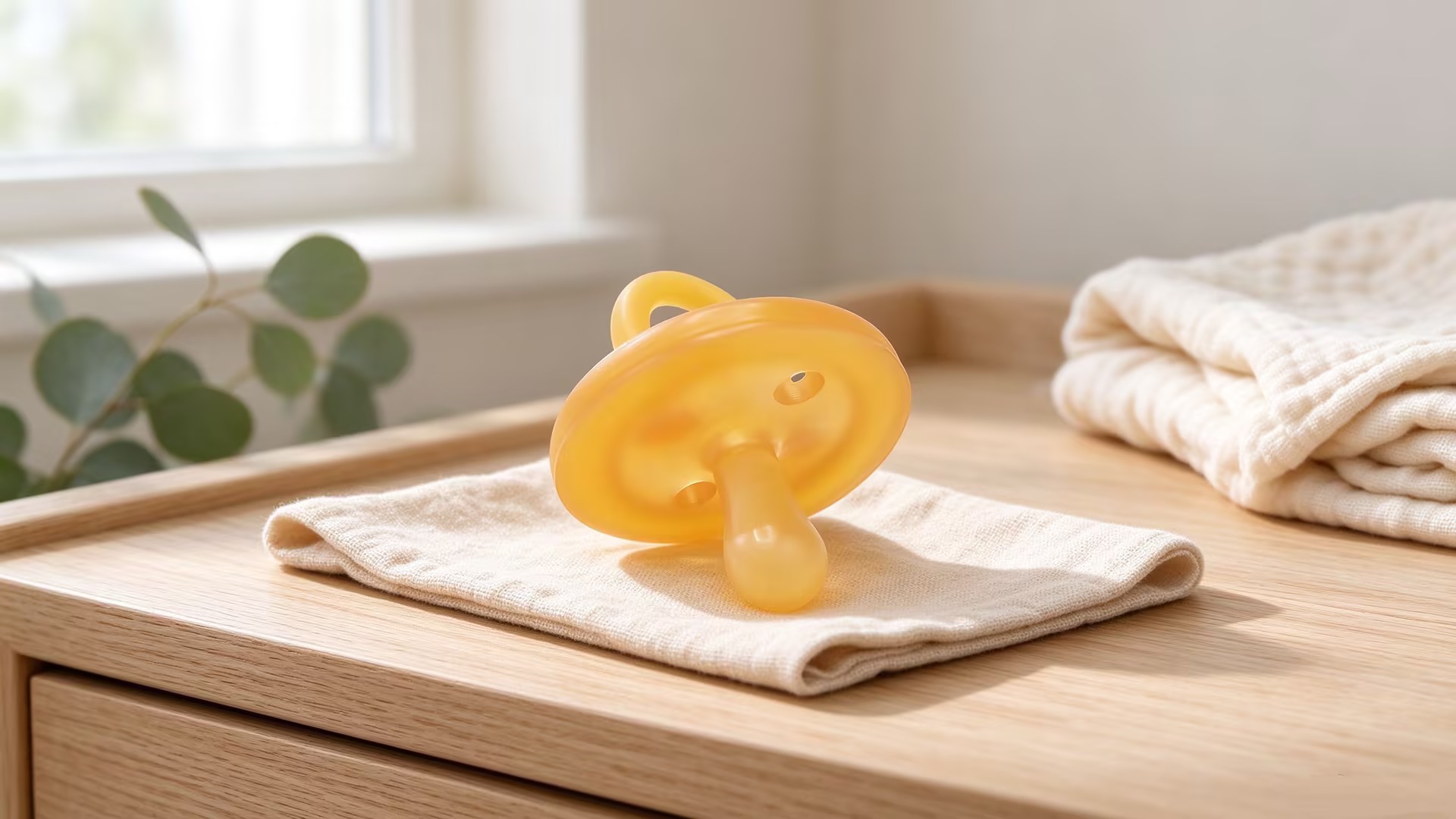
A one-piece pacifier — sometimes sold as a "seamless pacifier" or "monobloc design" — is moulded as a single continuous object. The nipple, shield and (where present) ring are one material, one pour, one surface. No assembly step, no glue, no snap fit, no gasket.
Removing the assembly removes the failure modes one by one:
- No seams to clean. A continuous moulded surface has no crevice between parts. Residue has nowhere to lodge. This is not a claim about "self-cleaning"; it is a geometric fact — a single surface has no internal interface to trap matter.
- No part to loosen. There is no ring to twist off, no cap to work loose, no shield to separate from the nipple. The pull-test question that haunts multi-part pacifiers — "will the nipple stay on the shield?" — does not even arise, because nipple and shield are the same piece of material.
- No adhesive or weld layer. One material means one additive system. No solvent from an adhesive, no plasticiser migrating from a weld line, no second polymer whose compliance you must verify separately.
- One material to verify. A seamless pacifier has a single bill of materials. The chemical test report covers the entire product, not three polymers with three report scopes.
None of this says a one-piece design is automatically safe — the single material still has to pass migration limits, mechanical tests and hygiene testing. What it says is that the one-piece design removes the structural class of risk so that the remaining testing is about the material itself, which is a much simpler question to answer. Our orthodontic pacifier is manufactured as a single-piece natural latex unit for exactly this reason: fewer parts, fewer interfaces, fewer questions.
How pacifier standards actually test structure
The "structure matters" argument is not a marketing opinion. Pacifier standards are, in large part, structure standards. The two regimes a buyer or parent will meet are EN 1400 in the EU and 16 CFR part 1511 in the US, and both spend most of their mechanical clauses on the geometry and retention of the shield, the ring and the nipple — the very junctions a one-piece design eliminates.
| Test area | EN 1400 (EU soothers) | 16 CFR 1511 (US pacifiers) |
|---|---|---|
| Shield swallow-prevention | Prescribed polyoxymethylene template (modulus 3,000–3,300 MPa, 80–90 Shore D). Rigid knobs/plugs/covers: effective projection 10–16 mm; flexible rings: penetration 10–35 mm, non-flexible ring collapses to ≤16 mm under 10 N. | Must not draw through the prescribed shield opening under 2.0 lb (8.9 N) applied over 5 s, held 10 s. Protrusion opposite the nipple ≤16 mm. |
| Ventilation holes | ≥2 holes, each containing a 4 mm diameter area and totalling ≥20 mm²; centres ≥15 mm apart on opposite sides of the minor axis; edges ≥5 mm from shield edge. | ≥2 symmetrically located holes; each ≥5 mm in minor dimension; edges ≥5 mm from guard perimeter. |
| Nipple / ring retention | Nipple-to-shield bond survives prescribed tensile load (90 N, held 10 s); teat pulled along its major axis under defined load and crosshead speed. | 10 lb (44.5 N) applied over 5 s, held 10 s, on nipple and handle/ring procedures. |
| Conditioning | Standard prescribes preparation sequence before structural tests. | Six rounds of 5-minute boiling and 5-minute cooling, then structural and shield tests repeated. |
| Small parts & attachments | Liberated components assessed with the small-parts cylinder. | 16 CFR 1511.6 prohibits ribbons, strings, cords or chains; 1511.7 requires the strangulation warning on each package. |
Read the clause list and notice what every test is probing: the shield geometry (will it pass through the swallow-prevention opening?), the vent holes (can air pass if the pacifier lodges in the airway?), and the retention of nipple and ring (will a part come off and become a small part?). A one-piece design does not make these tests unnecessary — it must still pass them — but it starts from a position where the shield cannot detach, the ring cannot separate, and the only material under test is the one continuous body. For a teether, the same logic runs through the toy standards: EN 71-1 mechanical requirements and ASTM F963 small-parts and integrity tests assess seams, detachable components and structural soundness, which is why our teether range is moulded in one piece as well.
A 10-point home check for pacifiers already in your house
Whether you choose one-piece or keep a multi-part pacifier, inspect regularly. This checklist is built from the clauses above and takes about two minutes.
- Pull the nipple — on a multi-part pacifier, grip the shield and pull the nipple firmly. Any movement or audible click means the fit has loosened; discard it.
- Twist the ring — a ring that rotates freely, or comes off with a firm twist, is a small-part risk. Discard.
- Squeeze the seams — run a thumbnail around every joint and look for a lip, gap or soft spot. Seams that open under pressure are both a hygiene trap and a failure point.
- Hold it to the light — check the vent holes are clear and at least the size called out in the standard (EN 1400: 4 mm diameter area; US: 5 mm minor dimension). Blocked vents are a real hazard, not cosmetic.
- Boil-test once — one 5-minute boil, cool, then repeat steps 1–3. If any part loosens after one cycle, it will not survive the six cycles a new product must pass; discard.
- Check the shield for cracks — stress whitening, cracks or crazing around holes or edges weakens the swallow-prevention geometry. Discard.
- Look for cloudiness or stickiness — natural latex that turns tacky or cloudy is degrading; silicone that becomes brittle or cloudy is aging. Replace either.
- Check the nipple tip — any tear, split or thinning where the nipple meets the shield is a breakage waiting to happen. Discard.
- Check for liberated parts — if a decorative cap, plug or cover has ever come off, treat the whole unit as suspect; a part that detaches once will detach again.
- Log the age — most brands recommend replacing pacifiers every 4–8 weeks for heavy use and retiring any pacifier at the first sign of damage.
If you are shopping new, the checklist simplifies further: a seamless, one-piece pacifier only needs checks 4, 7, 8 and 10 — the checks that are about the material itself — because the seam checks (1, 2, 3, 5, 6, 9) do not exist on a design with no seams and no detachable parts.
FAQ
Does "BPA-free" make a two-piece pacifier safe?
Is a seamless pacifier automatically compliant with EN 1400?
Is silicone or natural latex better for a one-piece pacifier?
Why do multi-part pacifiers still exist if one-piece is safer?
When should a pacifier be replaced?
Where to go next
If you are a parent: the highest-value single change is to switch the shield material — the part the 2026 Munich study flagged — and the simplest way to do that is to buy a pacifier where there is no separate shield at all. One material, one surface, one bill of materials, and a cleaning routine that is actually cleanable.
If you are a buyer or brand owner: when a supplier presents a pacifier, ask two questions beyond the chemical report. First, how many parts does the finished product contain? Second, does the EN 1400 or 16 CFR 1511 report cover the assembly after the prescribed boiling cycles, or only the fresh part? A supplier whose answer is "one piece" and "after conditioning" has already removed most of the structural risk before you get to material chemistry.
We manufacture seamless natural latex pacifiers and teethers in Dongguan for brands and distributors in more than 30 countries. The pacifier range is moulded as a single unit, each batch carries a Certificate of Conformity, and we can walk you through the EN 1400 and 16 CFR 1511 test data for the finished assembly — not just the raw material.
Request the test reports for any model and we will return the EN 1400 / 16 CFR 1511 mechanical data, the migration results and a batch-linked CoC template — no obligation.
Sources
- EN 1400:2013+A2:2018 — Child use and care articles, soothers for babies and young children, safety requirements and test methods (iTeh Standards)
- 16 CFR part 1511 — Requirements for pacifiers (eCFR)
- CPSC Business Guidance — pacifier requirements and general toy certification FAQ
- EUR-Lex — Commission Implementing Decision 2019/1698 (consolidated), harmonised list incl. EN 1400:2013+A2:2018
- Pacifier and teether inspection — shields, retention, vents and labels (TradeAider)
- EFSA — Bisphenol A assessment background for the 11,600× TDI calculation context
Baby Toy Certifications Decoded: EN 71, ASTM F963, CPSIA, FDA 21 CFR 177, LFGB and OEKO-TEX