Why “BPA-Free” Isn’t Enough: What a 2026 Munich Pacifier Study Means for Parents
Start With the One-Sentence Version
In January 2026, researchers at Ludwig Maximilian University in Munich tested seven commercially available pacifiers and found detectable BPA in every single one — including products whose packaging said “BPA-free.” The worst offender, a pacifier explicitly labeled “BPA-free,” released 26,536 nanograms of bisphenol A, which in a worst-case exposure scenario is roughly 11,600 times the European Food Safety Authority’s current daily reference value for a small child.
That one sentence is why this study went viral in parenting communities, and it deserves a close read before you panic — or before you dismiss it. The study did not find that all pacifiers are equally contaminated. It found that the label parents rely on most, “BPA-free,” tells you almost nothing about whether a pacifier actually releases BPA. That is a different problem, and a more useful one to solve.
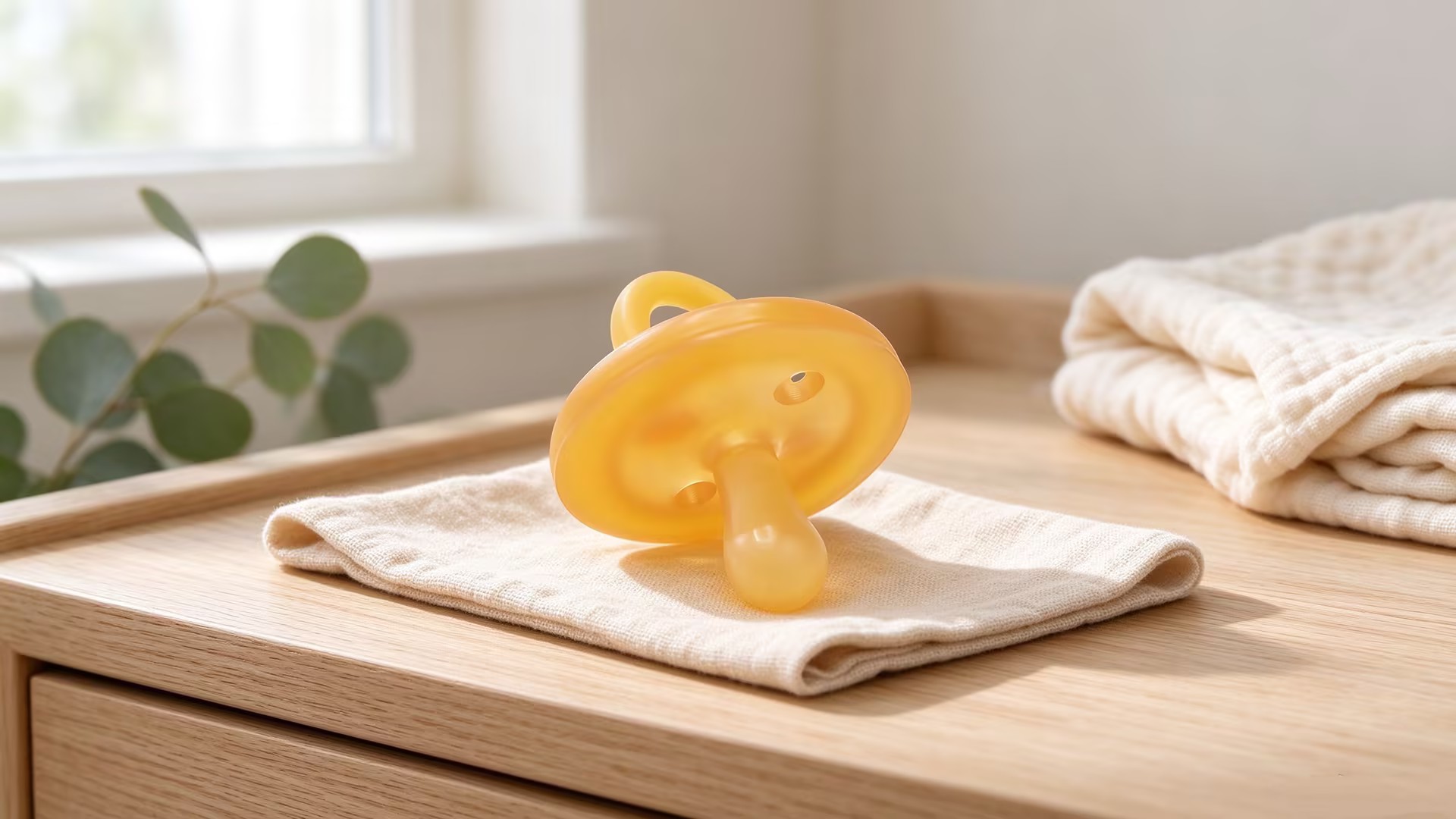
In this article we walk through what the study actually measured, where the BPA comes from, why the “BPA-free” claim is so weak, and what structural design — not labeling — does to eliminate the problem at the source. If you want to see what a one-piece pacifier with no plastic parts looks like before deciding anything, start with our natural rubber pacifier page.
What the Study Actually Tested and Found
The study, published in Environmental Science and Pollution Research, used high-performance liquid chromatography with fluorescence detection (HPLC-FLD), a method sensitive enough to measure trace amounts of BPA migrating out of a product. Seven pacifiers were bought from the open market — samples from Germany, China and India — and each one was disassembled into its components so the researchers could see exactly which parts released BPA. Migration was measured under realistic use conditions, not under extreme laboratory stress.
The headline result is simple: all seven pacifiers released detectable BPA, and four of the seven carried a “BPA-free” label. Total release ranged from about 33 to 26,536 nanograms per item. The highest result came from the pacifier labeled “BPA-free.” Even the lowest release, roughly 33 ng, exceeded the EFSA reference in a worst-case infant scenario, by up to about 50 times; the highest exceeded it by up to 11,600 times.
To understand why those numbers matter, you need the second part of the story: the reference value itself. In 2023, EFSA re-evaluated bisphenol A and lowered its tolerable daily intake from 4 micrograms per kilogram of body weight per day to 0.2 nanograms per kilogram per day — a reduction of roughly 20,000 times, based on new evidence about effects on the immune system. A daily limit that is 20,000 times stricter changes the meaning of every measurement. A result that looked trivial against the old number looks very different against the new one, which is exactly what the Munich researchers demonstrated.
Two more details are worth keeping in mind. First, the European Union bans BPA in baby feeding bottles, but pacifiers are not covered by that ban — they are regulated as toys or general products, where no specific BPA migration limit applies. Second, the study’s disassembly step showed that BPA can come from more than one component, which matters for the next question.
Where Does the BPA Come From?
The natural instinct is to blame the soft part, because that is what the baby sucks. The study’s component-by-component results tell a more interesting story: BPA migrated from the plastic parts of the pacifier — most notably the shield, which in most products is molded from polypropylene (PP) or another hard plastic — and in some samples from other plastic components as well. The soft teat, made of latex or silicone, was not the main source in most of the tested products.
This matches what regulators have found separately. The German Federal Institute for Risk Assessment (BfR) tested eighteen pacifier teats and found no BPA release in seventeen of them; latex and silicone teats are simply not where BPA normally lives. BPA is a building block of polycarbonate plastics and epoxy resins, and it also shows up as a contaminant in recycled or reprocessed plastics. A hard, transparent or colorful plastic shield is a far more plausible source than a soft latex teat.
None of this means the teat is automatically innocent in every product — the Munich data shows some samples released BPA from multiple components, and manufacturing processes vary. The practical lesson is structural: every separate plastic part is another potential source, and a pacifier with a plastic shield, a plastic ring and a soft teat has three independent places where BPA can enter. The same logic applies to teethers with plastic frames, handles or connectors. If you are choosing by material rather than by label, a product with fewer plastic components is a product with fewer sources, and a product with no plastic components at all has removed the entire category. That is why our natural latex teether line is built the way it is.
Why “BPA-Free” Labels Are So Misleading
If the label said “BPA-free” and the product still released BPA, something is broken with the label, not with the science. Here is what is actually going on.
First, the claim is usually about the formula, not the product. A manufacturer can honestly say the material it bought contains no added BPA, while the finished product picks up contamination elsewhere — from recycled plastic, from a mold release agent, from another component, or from the production line itself. “BPA-free” as a raw-material statement says nothing about what the finished item migrates into a baby’s mouth.
Second, the label tests one molecule. BPA is one member of a family of bisphenols, and manufacturers who react to consumer pressure often switch to BPS or BPF instead. Those substitutes are less studied, not proven safer, and research has shown that some “BPA-free” plastics still leach chemicals with estrogenic activity. Testing for a single substance while replacing it with an unstudied cousin is not a safety strategy; it is a marketing move.
Third, there is a regulatory gap. In the EU, BPA is banned in infant feeding bottles, but pacifiers sit outside that specific ban, so there is no mandatory BPA migration test for the category. A label in that space is voluntary, self-declared and, as this study demonstrates, not verified against the finished product. Parents are not wrong to look for the label; they are wrong to treat it as a complete answer. It is the minimum of diligence, not the end of it.
How One-Piece Design Removes the Problem at the Source
There is a structural answer to all of this, and it does not depend on a label. If a pacifier or teether is molded from a single material with no shield, no ring, no plastic handle and no adhesive layers, then the entire class of plastic-component sources disappears. There is nothing left for BPA to migrate from.
That is the logic behind one-piece natural rubber and medical silicone designs. The whole product — teat, shield and any attachment points — is one continuous piece of latex or silicone, vulcanized in a single mold. There are no separate plastic parts, no glued or welded joints, and no hard-plastic shield sitting against a baby’s face. A one-piece silicone shield is soft, flexible and free of polycarbonate and polypropylene entirely. The same design principle applies to teethers: a solid, molded, no-hole body with no frame and no handle means the only material in contact with the baby is the material you actually chose. Our one-piece natural latex teether range is made exactly this way, and it is the reason we can point to the structure rather than to a sticker.
We should be careful about what one-piece design does and does not claim. It removes the plastic-component route for BPA and related bisphenols, which is the route this study identified. It does not by itself prove that a latex or silicone compound is clean; the raw material still has to be sourced, washed and tested. But a single-material product gives a manufacturer a finite, testable system: one compound, one migration test, one answer. That is a much stronger guarantee than a label on a box containing five different materials.
A Practical Checklist for Choosing a Pacifier or Teether
Forget the sticker and look at the object. This checklist takes about two minutes and covers the three things that actually matter.
- Look at the structure. Is it one continuous piece of a single material, or does it have a hard plastic shield, ring, frame or handle? Every separate plastic component is a potential source. One-piece, all-soft construction removes the whole category. If the shield is hard plastic, ask what it is made of and whether it has been migration-tested.
- Ask for the test report, not the slogan. Any responsible manufacturer can produce a third-party migration test for the finished product. Ask specifically whether the test covers bisphenols beyond BPA (BPS, BPF and the rest), not just a single substance. A report on the finished item is worth more than any “free” claim on the packaging.
- Demand a complete material list. The honest answer is short: 100% natural rubber or food-grade silicone, plus food-grade pigments, nothing else. If the material list includes polypropylene, polycarbonate, ABS or vague terms like “plastic components,” you have found where the next study will find BPA.
One practical note: heat accelerates chemical migration from plastics. Boiling a plastic-shield pacifier, leaving it in a hot car or running it through high-heat dishwasher cycles can increase what migrates into your baby’s mouth. For any pacifier, follow the manufacturer’s cleaning guidance, and for natural latex, that means short, occasional boiling rather than daily high-heat treatment. If you want to see how we audit materials and structure from the factory floor, our manufacturing story walks through the process.
The Bottom Line
A study of seven pacifiers is not the final word on every pacifier on the market, and the Munich researchers never claimed it was. What it does is expose a weak spot that parents deserve to know about: the “BPA-free” label is not a migration test, plastic components are the likely source, and structural design — not labeling — is the reliable fix. None of this requires advanced chemistry. It requires looking at the product the way the study did: what is it made of, how many parts does it have, and where could a chemical hide?
The answer to “is BPA-free really safe?” is therefore not a substance name. It is a design. A one-piece, single-material pacifier or teether has no plastic shield, no plastic ring, no glued layers and no hidden components — which means it has no place for BPA to come from in the first place.
Explore the one-piece pacifier line
See the full range of one-piece natural rubber teethers, bath toys and pacifiers — all molded from a single material with no plastic parts. Browse the full product range.
Study and reference sources:
Migration of bisphenol A from commercially available pacifiers: HPLC-FLD analysis and exposure assessment in infants and toddlers — PubMed 41578066
EFSA 2023 re-evaluation of BPA: new TDI of 0.2 ng/kg bw/day — EFSA
BfR answers on bisphenol A in everyday products, including pacifier teat testing — BfR
Is Latex Safe for Babies? A Manufacturer’s Honest Look at Latex Allergy Risk