
Teething and Sensory Toys: Combining Comfort & Development
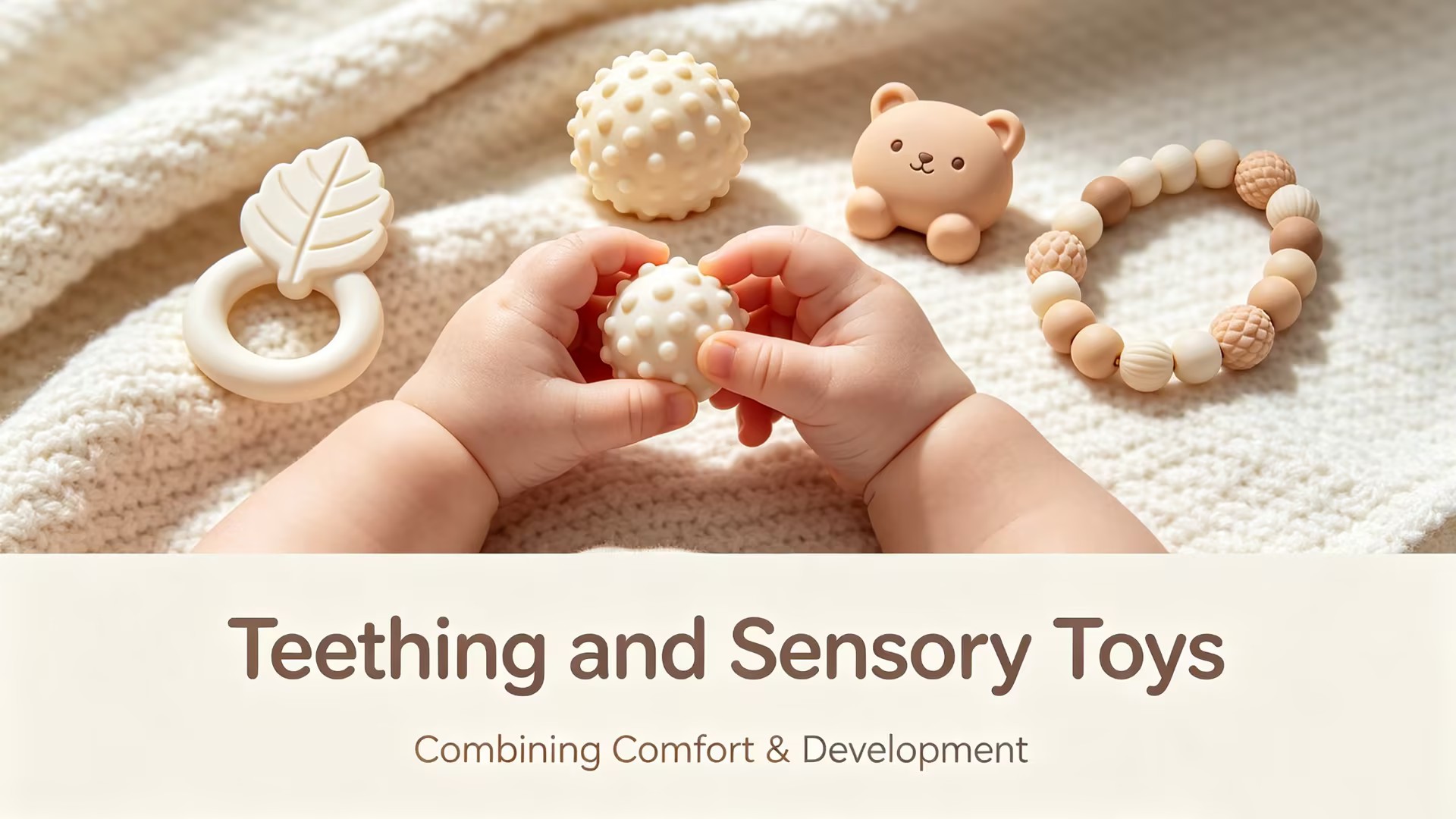
Ask most parents what a teether is for, and the answer is immediate: to soothe sore gums while teething. It is a fair answer — teething is uncomfortable, and a safe chewable object genuinely relieves it. But this single-function view of the teether is also the most common way the product gets undersold, both to parents and in product development. A teether that only soothes is a commodity; a teether that soothes and develops is a product with a story.
The shift is happening across the baby product market. Parents searching for teething and sensory toys are no longer looking for either a teether or a toy — they are looking for one product that does both. They search for sensory teething toys and baby sensory teether because they understand, often intuitively, that the teething months are also a critical window for sensory, motor, and cognitive development. The teether sits in the baby's hand and mouth for hours a day — that time is too valuable to waste on a single function.
This guide makes the case for upgrading the teether from a single-function product into a developmental baby product. It explains why the one-job teether is a missed opportunity, then builds the case for combining four elements — teething, texture, grasping, and sensory exploration — in a single design. For brands, this is not just a product improvement; it is a positioning strategy that moves the teether out of the commodity aisle and into the premium developmental category.
The Limits of the Single-Function Teether
Let us be clear about what a teether genuinely needs to do. During teething — which typically begins around four to seven months and continues through the toddler years — a baby's gums are swollen, tender, and itchy. Chewing on a firm but yielding surface applies counter-pressure that relieves the discomfort, and this relief is the teether's primary job. A teether that does not relieve teething pain has failed at its core function, no matter how clever its other features.
But here is the limitation: teething relief is a passive benefit. The baby chews, the gums feel better, and that is the entire transaction. The teether is an object the baby uses for a few minutes at a time, then sets down. It does not invite exploration, challenge, or learning. For a product that occupies so much of a baby's mouthing time — and so much of a parent's attention — this is a striking under-use of developmental opportunity.
The single-function teether also competes on the weakest possible axis: price. If all teethers provide the same relief, the parent chooses on price, color, or brand — none of which build loyalty. The result is a commodity market with thin margins and no differentiation. Every brand that sells teethers competes in this market, and most have no way out because their product is genuinely just a soother.
The way out is to recognize what the teething months actually are. The same period when a baby is teething — roughly four to eighteen months — is also when the baby is developing voluntary grasping, hand-eye coordination, tactile discrimination, cause-and-effect understanding, and the first fine motor skills. The teether is in the baby's hand and mouth during this entire window. If it is designed to support those developmental tasks in addition to relieving gums, it stops being a soother and becomes a tool — and the difference between the two is the difference between a commodity and a category.
Teething + Texture
The first upgrade is texture. A single-function teether usually has one surface — smooth, or at best, lightly textured. A developmental teether uses texture deliberately, because texture is the teether's second job: providing tactile input while the baby chews.
The relationship between teething and texture is mutually reinforcing. On the gum side, different textures provide different pressure: smooth zones offer gentle, even relief; ribbed zones provide firm, localized pressure along the ridge; bumpy zones alternate firm and gentle pressure. This variety means the baby can find the exact pressure that feels best for their current level of discomfort — a genuinely better teething experience than a single-texture soother.
On the developmental side, the same textures become tactile input for the hands and mouth. The baby runs fingers over the ribbed zone, pokes individual bumps, and compares the smooth zone with the textured one. This is tactile discrimination in action — the baby's brain building a map of surface differences. Every texture that helps the gums also teaches the hands, which is the core insight of the teether-plus-texture design. Our guide to tactile toys for babies covers the seven textures that matter in early development — soft, bumpy, ribbed, knitted, textured, smooth, and flexible — and a well-designed teether can carry several of them in a single piece.
Texture also makes the teether more engaging. A baby is more likely to hold, rotate, and mouth a toy with interesting surfaces than a plain one — and more time spent exploring means more time building skills, even as the teething relief happens in the background. The texture does not compete with the teething function; it enhances it, and it adds a second developmental job to the product.
Teething + Grasping
The second upgrade is grasping. A single-function teether is shaped for the mouth — often a simple stick, ring, or animal shape held briefly and chewed. A developmental teether is shaped for the hand as much as the mouth, because the teething months coincide with the development of voluntary grasping.
At four to six months, a baby's grasp transitions from the reflexive palmar grip of the newborn to a voluntary whole-hand grasp. The baby reaches for a teether with intention, wraps their hand around it, and holds it. At this stage, the shape of the teether determines whether grasping is easy or frustrating. A teether with a defined gripping zone — roughly 4 to 6 centimeters across — fits the developing palmar grasp. A teether that is too thick or too thin defeats it.
By six to eight months, the baby begins transferring objects between hands and adjusting their grip to the object's shape. A teether with multiple gripping points — a handle here, a ring there, a body in the middle — invites the baby to shift their hold, which is exactly the fine motor practice the stage requires. By nine to twelve months, as the pincer grasp emerges, a teether with small finger-sized features gives the baby something precise to hold and manipulate.
Weight matters here too. A teether that is too heavy frustrates a weak grip; one that is too light provides no feedback. The ideal developmental teether weighs roughly 40 to 70 grams at the six-month stage — light enough to manage, heavy enough to feel substantial. Our guide to sensory toys for 6 month old babies details these grasping milestones and the grip-zone and weight specifications that support them.
Teething + Sensory Exploration
The third upgrade is sensory exploration — the broadest and most valuable addition. Sensory exploration means the teether engages more than the mouth and gums. It engages the eyes, the ears, the hands, and the mind. A single-function teether provides one sensory input: the feeling of chewing. A developmental teether provides a whole sensory experience, and that experience is what turns mouthing time into learning time.
The most natural sensory addition to a teether is sound. A teether that squeaks or rattles when squeezed or shaken adds an auditory element to the chewing experience. The baby squeezes the teether, it makes a sound, and the baby learns the first lesson of cause and effect: my action produces a result. This transforms a passive chew into an active discovery, and it is one of the simplest ways to upgrade a teether's developmental value.
Visual sensory input matters too. A teether with high-contrast colors or patterns gives the eyes something to engage while the mouth works. A teether in soft natural tones engages differently — calmer, more soothing — which is valuable for a teething baby who is often fussy and overstimulated. The visual design of the teether is part of its sensory function, not a cosmetic afterthought.
And the deepest sensory exploration happens through the hands and mouth together. A teether with varied textures, a squeak element, and a gripping shape invites the baby to hold it, rotate it, squeeze it, mouth it, and examine it — a full sensory exploration loop that engages touch, sound, sight, and mouth simultaneously. This is the difference between a baby passively chewing a soother and actively exploring a developmental tool. It is also why the teether-plus-sensory design pairs naturally with the broader sensory toy category we have covered in our sensory toys for babies guide.
From Soother to Developmental Baby Product
Combine the four elements — teething, texture, grasping, and sensory exploration — and the teether stops being a single-function soother. It becomes a developmental baby product: a tool that soothes the gums while simultaneously training the hand, feeding the senses, and building the earliest cause-and-effect understanding. The difference is not in the raw material or the safety testing — it is in the design intent.
Teething is the entry ticket — safe counter-pressure that relieves sore gums, the non-negotiable core function.
Texture adds the second job — tactile input for the hands and varied pressure for the gums, turning chewing into discrimination practice.
Grasping adds the third job — a grip-optimized shape and weight that train the developing hand through the palmar grasp, transfer, and pincer stages.
Sensory exploration adds the fourth job — sound, visual interest, and multi-sensory engagement that turn passive chewing into active discovery and cause-and-effect learning.
The commercial impact of this shift is significant. A soother is priced as a soother; a developmental product is priced as a developmental product — a premium position parents accept because the value is visible. Parents do not choose between a cheap teether and an expensive one on the basis of chewing; they choose the teether that also helps their baby learn. The developmental teether reduces decision fatigue (one product serves the teething, sensory, and motor needs), supports a higher price point, and builds the brand story around genuine developmental thinking rather than a copy of a competitor's soother.
It also changes how the product is marketed. A single-function teether is marketed on relief: "soothes sore gums." A developmental teether is marketed on outcome: "relieves teething pain while building grasping, texture awareness, and cause-and-effect skills." The second message is harder to copy, easier to justify a premium for, and far more compelling to the research-driven parent audience. This is the positioning gap where brands win.
For the manufacturing side, the requirements are demanding but proven. The teether must combine smooth chewing zones with textured sensory zones in a geometry that is moldable, easy to clean, and safe. The squeak element, if included, must be integrated without creating a removable part. And every product must be tested to ASTM F963, EN71, and — because it is mouthed for hours — FDA 21 CFR 177.2600. These are the quality gates that separate a genuine developmental teether from a gimmick with a higher price tag.
| Dimension | Single-function teether | Developmental teether |
|---|---|---|
| Core function | Gum relief only | Gum relief + development |
| Texture | One surface | Multiple texture zones for discrimination |
| Grasping | Shaped for mouth, held briefly | Grip-optimized shape and weight |
| Sensory | Chewing only | Sound, visual, tactile multi-sensory input |
| Positioning | Commodity soother | Developmental baby product |
| Pricing power | Thin, price-led | Premium, value-led |
Building a Developmental Teether Line
For brands ready to make the shift, the product line strategy is straightforward. Start with the material — natural rubber is the strongest foundation because it can carry all four elements in one seamless, safe piece. It is soft enough for comfort, firm enough for feedback, flexible enough for safety, and moldable enough to carry texture zones, gripping features, and integrated squeak elements in a single-piece construction. It is naturally BPA-free, phthalate-free, and PVC-free, and certified-safe for mouth contact. Our natural rubber teethers are built on exactly this foundation.
Then design each product against the four-element framework. Every developmental teether should answer four questions: Does it relieve teething pain effectively? Does it carry two or three clearly distinct textures? Does it fit and train the current grasping stage? Does it offer at least one sensory feature beyond chewing — a squeak, a rattle, or high-contrast visual interest? A product that answers all four is a developmental teether; one that answers only the first is a soother.
Next, build the line across the age stages. A newborn-appropriate ring teether that focuses on texture and grasping. A six-month teether that adds squeak and cause-and-effect. A nine-to-twelve-month teether with finger-sized features that support the emerging pincer grasp. Each product carries the same developmental story at a different stage of the journey, which gives parents a natural upsell path and the brand a coherent narrative.
Finally, extend beyond the teether itself into the coordinated sensory range. The developmental teether is the anchor, but the same design philosophy extends to natural rubber educational toys, sensory balls, and rings — products that share the material, the safety story, and the developmental positioning. A family of products all designed as "developmental baby products" is far stronger than a single teether with an ambitious label. And for brands developing a custom design, our guide to custom natural rubber baby toys covers how the teething, texture, grasping, and sensory features are specified through the mold design and prototyping process.
The bottom line: A teether does not have to choose between comfort and development. By combining teething relief with texture, grasping, and sensory exploration, the teether becomes a developmental baby product — a tool that soothes the gums and trains the hand, feeds the senses, and teaches cause and effect, all in the same moment. For brands, this is the difference between selling a commodity soother and building a premium developmental category.
Frequently Asked Questions
What are teething and sensory toys?
Teething and sensory toys are products that combine the core function of a teether — safe gum relief — with sensory and developmental features such as varied textures, gripping shapes, sounds, and visual interest. They are designed so that the time a baby spends chewing also supports sensory exploration, fine motor development, and cause-and-effect learning, turning a single-function soother into a developmental baby product.
What should I look for in a baby sensory teether?
Look for a teether that serves four functions: (1) effective teething relief from a firm-but-yielding material; (2) two or three distinct textures for tactile discrimination; (3) a grip-optimized shape and weight that trains the developing hand; and (4) at least one sensory feature beyond chewing, such as a squeak or high-contrast visual. It must be one-piece, safe for mouthing, and certified to ASTM F963, EN71, and FDA 21 CFR 177.2600.
Are sensory teething toys safe for babies?
Yes, when manufactured to appropriate safety standards. Choose teethers made of natural rubber or food-grade silicone that are non-toxic, BPA-free, phthalate-free, and PVC-free, and certified for mouth contact under FDA 21 CFR 177.2600, with toy safety covered by ASTM F963 (US) and EN71 (EU). Ensure one-piece construction with no small parts, no loose fibers, and no coatings that can peel.
How can a teether support development, not just relieve gums?
A teether supports development when its design goes beyond the mouth. Varied textures train tactile discrimination and finger play; a grip-optimized shape and 40–70g weight support voluntary grasping and hand-to-hand transfer; a squeak or rattle element teaches cause and effect; and multi-sensory engagement keeps the baby exploring. Each feature adds a developmental job to the same chewing time.
How should brands position teethers to stand out?
Position the teether as a developmental baby product, not a soother. Build each product around four elements — teething, texture, grasping, and sensory exploration — and market the outcome, not just the relief: "relieves teething pain while building grasping, texture awareness, and cause-and-effect skills." This justifies a premium price, reduces decision fatigue, and builds a brand story competitors cannot easily copy. Back it with certified materials and a reliable manufacturing partner (ISO 9001, BSCI/SMETA).
Develop a Teether That Develops
Natural Baby World designs and manufactures developmental teethers — one-piece natural rubber products that combine teething relief with texture, grasping, and sensory exploration. Certified to ASTM F963, EN71, and FDA 21 CFR 177.2600, with ISO 9001 quality management. Tell us your target age range and we will develop a teether that parents see the value in.
Request a Product CatalogTextured Teethers for Babies: How Texture Supports Sensory Exploration
Tactile Toys for Babies: Why Texture Matters in Early Development