
Tactile Toys for Babies: Why Texture Matters in Early Development
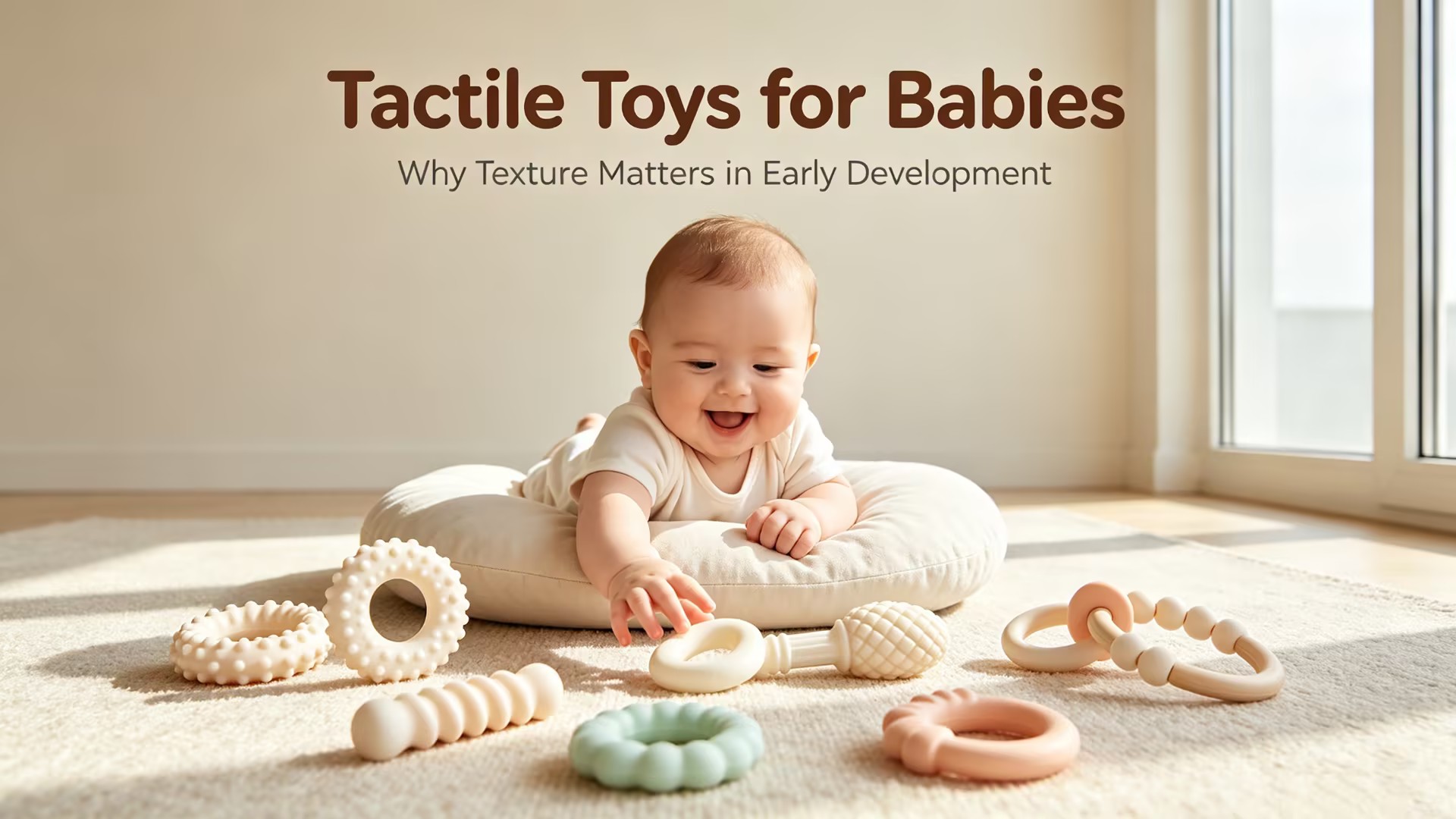
Before a baby can see clearly, hear a full range of sounds, or understand a single word, they can already feel. Touch is the first sense to develop in the womb — by around eight weeks of gestation, the fetus begins to respond to touch, and by the time a baby is born, the sense of touch is their most mature and most trusted sense. This is why texture matters so much in early development: for a newborn and infant, the hands and mouth are the primary tools for understanding the world, and every surface they explore is a lesson.
This reality has quietly made tactile toys one of the most important — and most searchable — categories in baby retail. Parents looking for tactile toys for babies are not just buying entertainment; they are looking for tools that help their baby make sense of the world through touch. They search for tactile baby toys and tactile toys for infants because they have read or heard that touch drives early brain development, and they want products that deliver on that promise.
This guide explains why texture matters, breaks down the seven surface qualities that matter most in early tactile exploration — soft, bumpy, ribbed, knitted, textured, smooth, and flexible — and shows how these qualities come together in the tactile toys that brands should be sourcing, with a focus on textured teethers and natural rubber rings. Whether you are a manufacturer, a brand, or a retailer, understanding the language of texture is the key to building a tactile toy line that parents trust.
Why Texture Matters in Early Development
Texture is not a cosmetic feature of a toy — it is the content of the toy. When a baby touches a surface, their fingertips — among the most nerve-dense parts of the human body — send a stream of signals to the brain. The brain processes these signals and builds a model of the physical world: what is smooth, what is rough, what is soft, what is firm, what is warm, what is cool. This tactile mapping is the foundation of spatial awareness, object recognition, and later, the fine motor control that underlies writing and tool use.
The developmental science is clear. Sensory input drives brain growth through a process of strengthening neural pathways — connections that are used frequently are reinforced, and those that are not are pruned away. A baby who experiences a rich variety of textures is building a more detailed tactile map, with more robust neural connections for processing touch. This is why exposure to varied texture is often described as "food for the developing brain" — the tactile system needs input to grow, just as muscles need exercise.
Texture also matters for a more practical reason: the mouth. Babies explore texture primarily with their hands and their mouth, and for the first year of life the mouth is often the more important of the two. A tactile toy must therefore be safe for mouthing — every texture, bump, and ridge will end up in the baby's mouth eventually. This is the critical intersection of tactile development and toy safety, and it is exactly why material choice matters as much as surface design.
The tactile category also connects directly to the broader sensory and fine motor categories we have covered elsewhere. Our guides to sensory toys for babies and fine motor toys for babies explore how touch interacts with the other senses and with motor skill development. Tactile toys sit at the center of both — they provide the sensory input that drives exploration, and the texture that drives the fine motor actions of grasping and finger movement.
The Seven Textures That Shape Early Exploration
Texture is not one thing — it is a family of surface qualities, each of which teaches the baby something different. In designing or sourcing tactile toys, it helps to think in terms of the seven textures that matter most in early development. Each one provides distinct sensory input, and the best tactile toys combine several of them in a single safe product.
| Texture | What it feels like | What it teaches |
|---|---|---|
| Soft | Gentle, yielding, skin-warm | Comfort, security, safe mouthing |
| Bumpy | Raised nubs and dots | Tactile discrimination, finger play |
| Ribbed | Parallel ridges and grooves | Directional texture, gum relief, grip |
| Knitted | Looped, fibrous, cloth-like | Varied grip, warmth, gentle interest |
| Textured | Combined mixed surfaces | Comparison, discrimination, complexity |
| Smooth | Even, flat, cool | Temperature, firm grip, contrast |
| Flexible | Yielding, springy, responsive | Cause and effect, hand strength, safety |
Soft
Softness is the first texture a baby knows. In the womb, the baby floats in warm fluid and presses against soft, yielding surfaces. After birth, softness is associated with safety, comfort, and care — soft blankets, soft clothing, soft skin. For a tactile toy, softness serves a dual role: it provides comforting sensory input, and it is the essential quality that makes a toy safe for a baby's sensitive skin and tender mouth.
Soft tactile toys are particularly important in the first months, when a baby's skin is thin and sensitive and their touch is exploratory rather than deliberate. A soft toy invites touch without demanding it — a baby can hold, mouth, and press a soft surface comfortably, building positive associations with tactile exploration. Softness also matters during teething, when a hard surface can cause pain and a soft one provides relief.
But "soft" does not mean formless. The best soft tactile toys have structure — they are soft enough for comfort but firm enough to provide feedback. This is where natural rubber excels: a natural rubber toy is soft and skin-warm, but its gentle firmness means a baby squeezing it feels resistance and learns about the relationship between pressure and response. A soft natural rubber baby teether provides both comfort and feedback in a single surface.
Bumpy
Bumpy textures — raised nubs, dots, and small protrusions — are among the most valuable tactile inputs for a developing baby. Bumps create contrast on a surface: the fingertip feels the raised bump, then the flat space between bumps, then the next bump. This alternation of raised and flat is exactly the kind of pattern the tactile system learns to discriminate, and it invites the fingers to explore each individual bump in turn.
Bumpy textures also support fine motor development. A baby running a finger over a series of nubs is practicing isolated finger movement — the precursor to the pincer grasp. Poking individual bumps trains finger dexterity. The raised surface provides more sensory feedback per touch than a flat surface, which means more neural stimulation and richer learning from the same amount of exploration.
For mouthing, bumps add a second benefit. A bumpy teether surface provides variable pressure on the gums — firmer where the bump rises, gentler in the spaces between — which is genuinely effective for teething relief. This is why textured teethers with bumpy zones are so popular: the same surface that teaches the hands discrimination also soothes the mouth. When you combine this with the finger-play benefit, a bumpy natural rubber toy becomes a three-in-one developmental tool.
Ribbed
Ribbed textures — parallel ridges and grooves — add directional information to the tactile experience. Unlike bumps, which repeat in every direction, ridges have a direction: a finger moving across the ridges feels a series of crests and valleys, while a finger moving along the ridges feels a smooth line. This directional contrast is a sophisticated tactile input that helps the baby's brain build spatial models of surfaces.
Ribbed surfaces are also excellent for gripping. The raised ridges create friction that helps a wet, clumsy baby hand hold onto a toy — a practical benefit that matters enormously during teething, when hands are wet with drool and toys are constantly being dropped. A ribbed handle or body is easier to hold than a smooth one, which means more successful grasping and less frustration.
For teething, ribs are one of the most effective textures. The parallel ridges provide firm, localized pressure on the gums along the line of the ridge, which is exactly the kind of counter-pressure that relieves teething discomfort. Many of the most effective teethers feature ribbed zones for this reason. A natural rubber teether with ribbed sections combines grip, gum relief, and directional tactile input in one seamless product.
Knitted
Knitted textures — the looped, fibrous surfaces of cloth toys — add a completely different quality to the tactile experience. Where rubber, silicone, and plastic are smooth or molded, knitted surfaces are made of hundreds of tiny loops, creating a complex, soft, variable texture that is unlike anything else a baby touches. Knitted toys are warm, lightweight, and reassuring, and they teach the tactile system about fiber, movement, and the subtle variability of natural materials.
Knitted toys also offer a different kind of grip experience. A knitted surface is slightly stretchy and absorbent, which gives a different feel than a firm molded surface. The combination of a knitted body with a firm internal structure — a common design for soft toys — gives the baby both a soft exterior and a structured interior, two tactile experiences in one product.
However, knitted textures require careful attention to safety. Loose fibers, long fur, and detachable parts are choking and inhalation hazards, and fabric surfaces can trap moisture and harbor bacteria. The safest knitted toys use tightly knit, short-pile materials that do not shed fibers, with no small parts. For brands, this means specifying knit quality and fiber safety as carefully as the texture itself — a knitted toy must be as safe as it is soft.
Textured
"Textured" in the broad sense means a surface that combines multiple texture zones — smooth here, bumpy there, ribbed around the edge, soft in the middle. Multi-texture toys are the most valuable tactile products because they invite comparison. A baby running a hand across a toy that changes from smooth to bumpy to ribbed is learning to discriminate between surfaces, which is the core skill of tactile development.
The key design principle for multi-texture toys is contrast with restraint. A toy with two or three clearly distinct texture zones teaches comparison; a toy with ten indistinguishable textures confuses. The best textured toys offer zones that are obviously different — smooth versus bumpy, ribbed versus soft — so the baby can feel the difference and the brain can build the discrimination.
Natural rubber is uniquely suited to multi-texture design because the material can be molded into almost any surface geometry in a single seamless piece. Smooth zones, bumpy zones, ribbed zones, and soft nubs can all coexist on one hygienic, dishwasher-safe toy — no glued-on parts, no seams where bacteria can hide, no loose fibers to shed. This one-piece multi-texture construction is a genuine design advantage that fabric and multi-component toys cannot easily match.
Smooth
Smoothness is easy to overlook because it feels like "nothing" — but smooth surfaces are a critical part of the tactile palette. A smooth surface provides the baseline against which every other texture is compared. It is also a distinctly different experience: smooth surfaces are often cooler to the touch, have less friction, and require a firmer grip to hold. Each of these qualities teaches the baby something.
Temperature is a subtle but real part of tactile input. A smooth, dense surface conducts heat away from the hand more quickly, so it feels cooler than a soft, airy surface. This temperature difference is part of how the baby learns about the material world — cool and warm, dense and light. A toy that combines smooth zones with soft zones gives the baby a temperature and density contrast alongside the texture contrast.
Smooth surfaces also challenge the grip. A smooth toy is harder to hold than a textured one, which means the baby must apply more deliberate grip strength. This is valuable for hand-strength development — a baby who can grip a smooth surface has built real hand control. The best tactile toys include smooth zones deliberately, not as an afterthought, so the baby experiences the contrast and the challenge.
Flexible
Flexibility is not a surface texture in the visual sense, but it is a texture in the tactile sense — it is how the surface responds to pressure. A flexible toy yields under the hand, springs back, and responds to squeezing. This responsiveness is one of the most engaging tactile inputs a baby can experience, and it teaches the relationship between action and result: when I press, it changes.
Flexible toys also support hand strength. Squeezing a flexible toy that resists and springs back exercises the intrinsic hand muscles, the same muscles that later support pencil grip and tool use. The resistance can be tuned to the baby's age — softer formulations for young infants with weak hands, firmer formulations for older babies who need more challenge. A toy that is too stiff to squeeze frustrates; a toy that collapses provides no workout.
Flexibility is also the safety feature that makes tactile exploration possible. A baby's exploration is clumsy and enthusiastic — toys are dropped, thrown, squeezed, and mouthed. A flexible toy bounces instead of breaking, yields instead of hurting, and is soft enough for tender gums. This is why flexible materials like natural rubber are the backbone of the tactile toy category: they make rich texture exploration safe enough to repeat, and repetition is how learning happens.
The texture principle in one line: Every texture teaches — soft teaches comfort, bumpy teaches discrimination, ribbed teaches direction and grip, knitted teaches fiber and warmth, textured teaches comparison, smooth teaches contrast and grip strength, and flexible teaches cause and effect. The best tactile toys combine several of these surfaces in one safe, mouthable product, so a single toy delivers a rich, varied tactile experience.
Textured Teethers & Natural Rubber Rings: The Perfect Fit
When the seven textures are applied to actual product design, two product forms stand out as the natural fit for the tactile category: textured teethers and natural rubber rings. These are not arbitrary choices — they are the products where texture, safety, and development come together most completely, and they are the backbone of many successful tactile toy lines.
Textured teethers are the clearest example of texture doing multiple jobs at once. A teether's primary function is to provide safe counter-pressure for teething gums, but a textured teether goes further: its bumpy, ribbed, and smooth zones simultaneously provide tactile discrimination for the hands, finger-play opportunities for fine motor development, and varied pressure for the gums. The baby holds it (texture and grip), mouths it (texture and relief), and explores it (texture and learning) — one product, four jobs. Our textured natural rubber teethers are designed around exactly this principle, with smooth chewing zones and textured sensory zones combined in a single seamless piece of certified-safe natural rubber.
Natural rubber rings are the other cornerstone. A ring is the simplest gripping shape — a newborn can hold it reflexively, an infant can grip it voluntarily, and a toddler can practice transferring it between hands. When that ring is molded with varied textures — smooth on one side, ribbed on another, bumpy in spots — it becomes a complete tactile tool that supports grasping, texture discrimination, finger play, and mouthing. Rings are also the easiest product to extend into a coordinated tactile set: a collection of rings in different textures and colors gives parents a ready-made tactile kit. Our natural rubber baby rings and pacifiers line uses the same certified-safe material, and a dedicated ring set can be developed to match your brand's texture story.
The reason both products work so well is the material. Natural rubber is soft enough for comfort, firm enough for feedback, flexible enough for safety, and moldable enough to carry every one of the seven textures in a single piece. It is naturally BPA-free, phthalate-free, and PVC-free, and when manufactured to FDA 21 CFR 177.2600, ASTM F963, and EN71 standards, it is one of the safest materials for mouth-contact baby products. This combination of texture, safety, and development is exactly why natural rubber has become the material of choice for the tactile toy category.
For brands building a tactile line, the product strategy is clear: build a core of textured teethers and natural rubber rings, then extend outward into multi-texture balls, tactile sensory toys, and coordinating sets. Each product should carry a clear texture story — which textures it includes, what they teach, and how they support development — so parents can see the value. And every product should be backed by transparent material certification, because in the tactile category, trust in the material is trust in the brand. If you are developing a custom tactile line, our guide to custom natural rubber baby toys covers how texture zones are specified in the mold design and prototyping process, and our natural rubber educational toys collection shows the wider range that a tactile-focused line can grow into.
Frequently Asked Questions
What are the best tactile toys for babies?
The best tactile toys combine several safe textures in one product: textured teethers with smooth, bumpy, and ribbed zones; natural rubber rings with varied surfaces; multi-texture balls; and soft fabric toys with short-pile knitted surfaces. They should be safe for mouthing, made of non-toxic material, and offer clear texture contrasts that invite the baby to compare and explore.
Why do babies need tactile toys?
Touch is the first sense to develop and the primary way babies learn about the world in the first year. Tactile toys provide the varied sensory input that drives tactile mapping and brain development, support fine motor skills like grasping and finger movement, and — when they are also teethers — provide relief for sore gums. Texture is not decoration; it is the content of the toy.
What textures are best for baby toys?
The most valuable textures are soft (comfort and safe mouthing), bumpy (tactile discrimination and finger play), ribbed (directional texture and gum relief), knitted (fiber and warmth), textured or multi-surface (comparison and discrimination), smooth (temperature contrast and grip strength), and flexible (cause and effect and hand strength). The best toys combine two or three clearly distinct textures in one product.
Are natural rubber tactile toys safe for babies?
Yes, when manufactured to appropriate safety standards. Natural rubber is non-toxic, BPA-free, phthalate-free, and PVC-free, and it is certified safe for mouth-contact products under FDA 21 CFR 177.2600, with toy safety covered by ASTM F963 (US) and EN71 (EU). Its flexibility and softness make it safe for mouthing and for clumsy exploration — a natural rubber toy yields instead of hurting, and bounces instead of breaking.
How should brands build a tactile toy line?
Build a core of textured teethers and natural rubber rings, then extend into multi-texture balls, tactile sensory toys, and coordinating texture sets. Give each product a clear texture story — which textures it includes and what they teach — and back every product with transparent material certification. Use a certified manufacturing partner (ISO 9001, BSCI/SMETA) and test to ASTM F963, EN71, and FDA 21 CFR 177.2600.
Build a Tactile Toy Line Around Texture
Natural Baby World designs and manufactures textured teethers, natural rubber rings, and multi-texture tactile toys — smooth, bumpy, ribbed, and flexible zones combined in single seamless pieces of certified-safe natural rubber. Certified to ASTM F963, EN71, and FDA 21 CFR 177.2600, with ISO 9001 quality management. Tell us which textures you want to feature and we will develop a product that parents can feel the difference in.
Request a Product CatalogTeething and Sensory Toys: Combining Comfort & Development
Fine Motor Toys for Babies: Product Guide for Brands & Retailers