
Sensory Toys for Newborns: Safe Product Ideas for Early Development
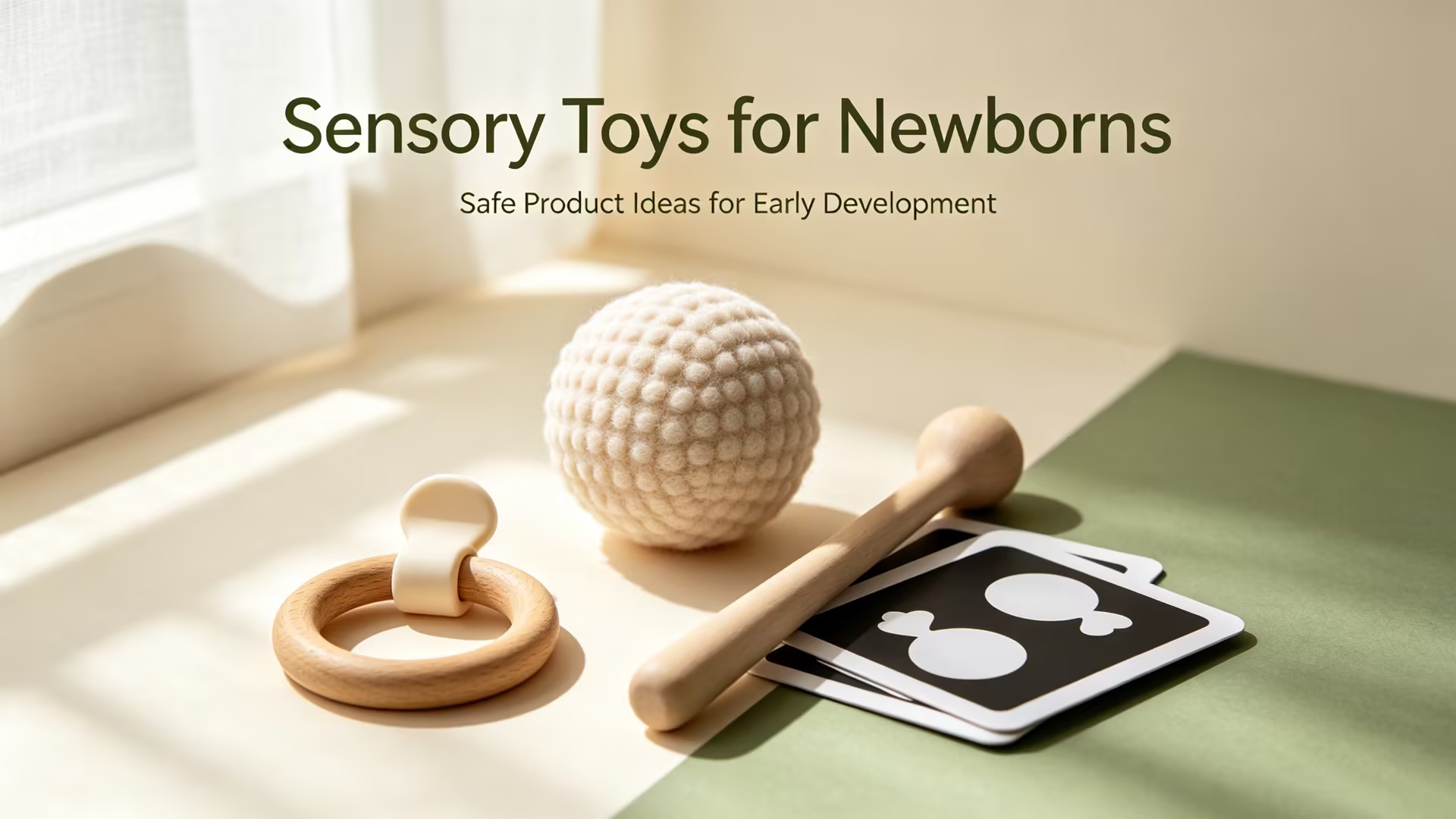
Walk into any baby store and the newborn section can feel overwhelming. Rattles, play mats, plush toys, activity gyms, teething rings — all marketed as "sensory" and all promising to boost your baby's development. But for a newborn in the first zero to three months, most of these products are simply too much. Newborns are not small versions of six-month-olds. Their visual system is still developing, their grasp is reflexive, and their nervous system is highly sensitive to overstimulation.
Choosing the right sensory toys for newborns means understanding what a baby in the first trimester of life can actually process — and what they cannot. This guide breaks down the seven design principles that make a newborn sensory toy safe and effective: high-contrast visual stimulation, soft textures, grasping, gentle sensory exploration, safe materials, lightweight design, and age-appropriate products. It then explains why natural rubber sensory toys are increasingly the material of choice for this delicate age stage.
For brands and retailers, getting the newborn category right is not just a product decision — it is a trust decision. Parents of newborns are the most research-driven, safety-conscious shoppers in the entire baby product market. A product that is genuinely designed for newborns — not merely labeled as "0+" — will earn reviews, repeat purchases, and word-of-mouth recommendations that no marketing budget can buy.
What Newborns Actually Need in the First Three Months
Before discussing specific products, it is worth grounding the conversation in developmental reality. A newborn at birth has approximately 20/400 vision — they can see shapes and movement, but fine detail and color distinction are extremely limited. By three months, vision improves to roughly 20/200, and babies begin to distinguish between primary colors and track moving objects more smoothly. The auditory system is more developed at birth — newborns can recognize their mother's voice and turn toward sounds — but loud, sudden noises can trigger the Moro reflex (startle response) and cause distress.
Motor development in the first three months is dominated by reflexes. The palmar grasp reflex means a newborn will close their fingers around anything placed in their palm, but they cannot intentionally reach for or hold objects. The tonic neck reflex (fencing posture) and the rooting reflex are also active. By three months, babies begin to have more voluntary control — they can bat at objects, bring their hands to their mouth, and briefly hold a lightweight toy placed in their hand.
The sensory implication is clear: newborn sensory toys should work with these developing systems, not against them. A toy that requires intentional reaching, fine motor control, or full-color vision is not a newborn toy — it is a toy for an older infant that has been mislabeled. The best sensory toys for infants in the zero to three month range are simple, slow, high-contrast, and designed to be experienced rather than manipulated.
High-Contrast Visual Stimulation
If there is one sensory channel that dominates newborn toy design, it is vision — and specifically high-contrast black and white. Newborns see the world in low resolution and cannot distinguish between similar hues, but they are highly sensitive to contrast. Bold black and white patterns, sharp edges, and high-contrast graphics are the most visually stimulating things a newborn can look at.
High-contrast visual stimulation works because it matches the developmental state of the newborn visual cortex. The neurons responsible for processing edges, contrast, and movement are among the first to mature, and repeated exposure to high-contrast patterns strengthens these neural pathways. This is why black and white cards, contrast books, and patterned play mats are consistently top sellers in the newborn category — they genuinely work, and parents can see their baby responding to them.
For brands, the design implication is straightforward: newborn products should prioritize bold, high-contrast graphics over pastel colors or cute illustrations. A black and white striped animal face will hold a newborn's gaze far longer than a soft pink bunny. The contrast should be sharp — no gradients, no muted tones, no busy patterns that blur together at newborn visual acuity. Simple geometric shapes (circles, stripes, checkerboards, bold silhouettes) are more effective than complex illustrations.
It is also worth noting that high-contrast does not have to mean black and white exclusively. By 6–8 weeks, some newborns begin to respond to high-contrast color combinations — red on white, yellow on black — but black and white remains the safest and most universally effective choice for the full zero to three month range. A product line that offers both black and white and high-contrast color options gives parents flexibility as their baby's vision develops.
Soft Textures
Newborns explore the world primarily through their mouth and hands, and the tactile quality of a toy is one of the most important factors in whether it will be accepted and enjoyed. For newborns, soft textures are not a luxury — they are a necessity. A newborn's skin is thinner and more sensitive than an older baby's, and their mouth is even more sensitive. Hard, rough, or scratchy surfaces can cause discomfort, skin irritation, or simply be rejected by the baby.
Soft textures in newborn toys serve multiple developmental purposes. They provide gentle tactile input that helps babies distinguish between different surface qualities — a foundational sensory discrimination skill. They are safe for mouthing, which is the primary way newborns explore objects. And they provide a comforting, predictable sensory input that can help soothe an overstimulated or fussy baby.
The ideal texture for a newborn toy is smooth yet tactile — not so smooth that it provides no sensory input, but not so textured that it feels rough or abrasive. Natural rubber and latex offer an ideal middle ground: the material is naturally soft and warm to the touch, with a subtle matte texture that provides gentle tactile input without being scratchy. A natural rubber teether with smooth, rounded surfaces and subtle texture zones is an excellent example of a newborn-appropriate tactile toy — it is soft enough for sensitive gums, provides enough texture for sensory exploration, and is safe for extended mouthing.
For fabric newborn toys, the texture should be plush but not overly fluffy — loose fibers can be a choking or inhalation hazard. Cotton, organic cotton, and short-pile velour are good choices. Avoid toys with long fur, loose threads, or textured surfaces that could shed fibers into a newborn's mouth or nose.
Grasping
Grasping in the newborn stage is fundamentally different from grasping in older infants. Newborns have the palmar grasp reflex — they will automatically close their fingers around anything placed in their palm — but they cannot intentionally reach for, pick up, or hold onto objects for more than a few seconds. A toy that is designed for newborn grasping must work with this reflexive pattern, not expect the newborn to perform motor skills they have not yet developed.
The key design principle for newborn grasping toys is easy placement and light weight. The toy should be thin enough or shaped so that it can be easily placed in a newborn's palm — a thin handle, a narrow ring, a flat shape. It should be light enough that the newborn's reflexive grasp can actually hold it without the toy immediately falling out. And it should have a texture that provides enough friction for the grasp to hold — smooth, slippery surfaces are harder for a newborn to grip.
Ring-shaped and handle-shaped toys are the classic newborn grasping toys for good reason. A thin, lightweight ring can be placed in a newborn's palm and the reflexive grasp will hold it. A toy with a built-in handle loop serves the same purpose. By 6–8 weeks, many newborns will begin to look at the toy they are holding, and by 10–12 weeks, some will begin to intentionally bring the toy to their mouth — these are important developmental milestones that the right grasping toy can support.
For brands, it is important to distinguish between "newborn grasping" and "infant grasping" in product design. A toy marketed as "0+" should be thin, lightweight, and easy to place in a palm — not a chunky block that requires a voluntary palmar grasp that most newborns cannot yet perform. Weight is particularly critical: a newborn grasping toy should weigh no more than 20–30 grams, so that even a weak reflexive grasp can hold it. A rubber pacifier with a lightweight handle is a good reference point for the weight and shape that works for newborn grasping — thin, light, and designed to be held rather than manipulated.
Gentle Sensory Exploration
One of the most common mistakes in newborn toy design is overstimulation. Newborns have a highly sensitive nervous system, and toys that combine loud sounds, bright flashing lights, busy patterns, and multiple textures can quickly overwhelm them. The result is not engagement — it is distress, crying, or gaze aversion (the baby looks away). Gentle sensory exploration is the principle that a newborn toy should provide one or two clear, calm sensory inputs, not a barrage.
Gentle sensory exploration means several things in practice. It means sounds that are soft and muted — a gentle rattle, a soft squeak, a quiet crinkle — not loud bells, electronic melodies, or beeping. It means visual patterns that are bold but simple — high-contrast black and white stripes or shapes — not busy multi-color patterns with fine detail that blurs at newborn acuity. It means textures that are smooth and subtle — not aggressive bumps, ridges, or multiple surface changes on a single toy. And it means movement that is slow and predictable — not fast shaking, vibrating, or sudden motion.
The developmental logic behind gentle sensory exploration is that newborns are still building their sensory processing capacity. Each sensory input requires neural processing, and when multiple inputs are presented simultaneously, the newborn's developing brain can become overloaded. A toy that provides one clear, gentle sensory input allows the newborn to fully process and engage with that input — which is how learning happens. A toy that provides five inputs at once may look impressive to an adult, but to a newborn it is simply noise.
For brands, this means resisting the temptation to pack every feature into a single product. A newborn rattle that also has flashing lights, music, vibrating texture, and teething surfaces is not a better newborn toy — it is an overstimulating one. The best newborn products are ruthlessly simple: one clear sensory function, executed well, with enough restraint to let the newborn engage without overwhelm. Our broader guide to sensory toys for babies covers how these principles scale across age stages, but for newborns the rule is simple: less is more.
Safe Materials
If there is one non-negotiable requirement for sensory toys for infants, it is material safety. Newborns put everything in their mouth — their hands, their clothes, blankets, and every toy they can get near. A toy that is not safe for mouthing is not safe for a newborn, period. This means the material must be non-toxic, free of harmful chemicals, and certified to meet the relevant safety standards for mouth-contact products.
The key safety standards for newborn toys are ASTM F963 (US toy safety standard), EN71 (European toy safety standard, with parts 1–3 covering physical/mechanical, flammability, and migration of certain elements), and — for products that contact the mouth — FDA 21 CFR 177.2600 (rubber articles intended for repeated use). These standards cover chemical content, physical safety (small parts, choking hazards, sharp edges), and — for mouth-contact products — the specific compounds that can be used in rubber and silicone materials.
Material choices that are generally considered safe for newborn toys include natural rubber and latex, food-grade silicone, organic cotton, and untreated natural wood. Materials that should be avoided or approached with extreme caution include PVC (which often contains phthalates), BPA-containing plastics, cheap unknown plastics, and any material with a strong chemical odor. It is also important to note that "BPA-free" does not automatically mean safe — some BPA-free plastics use alternative compounds (such as BPS) that may have similar endocrine-disrupting properties. The safest approach is to choose materials that are inherently non-toxic, such as natural rubber, rather than plastics that rely on chemical substitution.
For brands, material safety is not just a compliance checkbox — it is the foundation of trust with newborn parents. Parents of newborns research materials more carefully than any other segment, and they actively seek out products with clear, transparent material information. A product that lists its material composition, safety certifications, and testing reports on its packaging or product page will outsell a product that simply says "safe" or "non-toxic" without evidence. For manufacturers, this means maintaining ISO 9001 quality management certification and social audits such as BSCI or SMETA, and being able to provide test reports for every batch of material.
Lightweight Design
Weight is one of the most overlooked factors in newborn toy design, and one of the most important. A newborn's muscles are weak and their grasp is reflexive — a toy that is too heavy will simply fall out of their hand, or worse, hit them in the face when they lose their grip. Lightweight design is not just about making a toy easier to hold — it is about making it safe for a newborn who has limited motor control.
The ideal weight for a newborn grasping toy is between 15 and 30 grams. At this weight, even a weak reflexive grasp can hold the toy for several seconds, and if the baby loses their grip, the toy is light enough that it will not cause injury if it falls on their face. Toys that weigh more than 50 grams are generally too heavy for newborns — they may be appropriate for 4–6 month olds, but not for the zero to three month range.
Lightweight design also affects how a toy can be used. A lightweight toy can be hung from a play gym or stroller for visual tracking — newborns will follow a slowly moving lightweight object with their eyes, which is an important visual tracking exercise. A heavy toy cannot be hung safely, and it limits the ways the toy can be used. A lightweight toy is also easier for parents to manipulate in front of the newborn for interactive play — moving it slowly from side to side for visual tracking, or gently placing it in the newborn's palm for grasping practice.
For brands, lightweight design requires material and structural choices that reduce weight without compromising safety. Hollow construction, thin walls, and lightweight materials (such as natural rubber latex) can all help reduce weight. It is important to note that lightweight does not mean flimsy — a newborn toy should be durable enough to withstand repeated mouthing, squeezing, and dropping, even if it is light. Natural rubber is particularly well-suited to this balance: it is inherently lightweight, flexible, and durable, and it can be formed into thin, hollow shapes that are both light and robust. If you are developing a custom newborn product line, our guide to custom natural rubber baby toys covers how to balance weight, durability, and safety in the design and prototyping process.
Age-Appropriate Products
All of the principles above — high-contrast visuals, soft textures, grasping, gentle sensory exploration, safe materials, lightweight design — come together in the concept of age-appropriate products. An age-appropriate newborn toy is one that matches the developmental capabilities of a zero to three month old, rather than expecting the newborn to rise to the toy's level. This sounds obvious, but the baby product market is full of toys labeled "0+" that are clearly designed for older infants.
A practical framework for evaluating age-appropriateness is to ask three questions about any newborn product:
- Can a newborn perceive it? Does the toy use high-contrast visuals, gentle sounds, and soft textures that a newborn's developing sensory systems can actually process? Or does it rely on fine detail, full-color distinction, or loud sounds that a newborn cannot perceive?
- Can a newborn interact with it? Can the toy be placed in a newborn's palm for reflexive grasping, or hung for visual tracking? Or does it require intentional reaching, voluntary grasping, or fine motor control that a newborn does not yet have?
- Is it safe for a newborn? Is it lightweight, made of safe mouth-contact materials, free of small parts and choking hazards, and certified to the relevant safety standards? Or does it have features that are safe for older babies but risky for newborns?
A product that passes all three questions is genuinely age-appropriate for newborns. A product that fails any one of them should not be marketed as a "0+" or newborn product — it is a product for an older infant, and labeling it as newborn-appropriate is both inaccurate and potentially unsafe.
| Design principle | Newborn-appropriate | Not newborn-appropriate |
|---|---|---|
| Visual | High-contrast black & white, bold simple shapes | Pastel colors, fine detail, busy multi-color patterns |
| Texture | Smooth, soft, subtle matte texture | Rough surfaces, aggressive bumps, loose fibers |
| Grasping | Thin handle/ring, 15–30g, easy to place in palm | Chunky blocks, heavy toys, requires voluntary grasp |
| Sound | Gentle rattle, soft squeak, quiet crinkle | Loud bells, electronic music, beeping, flashing lights |
| Material | Natural rubber, food-grade silicone, organic cotton | PVC, unknown plastics, strong chemical odor |
| Weight | 15–30g, lightweight hollow construction | Over 50g, solid heavy construction |
Natural Rubber Sensory Toys
When all of these design principles are applied to material selection, one material emerges as particularly well-suited to newborn sensory toys: natural rubber. Natural rubber (also called natural latex) is derived from the sap of the rubber tree, and it has a unique combination of properties that make it ideal for the delicate newborn age stage.
First, natural rubber is inherently soft and warm to the touch — unlike hard plastic or cold silicone, it has a natural give and a skin-like warmth that newborns find comforting. This softness also makes it safe for mouthing: a newborn can gum and chew on a natural rubber toy without risk of injury to sensitive gums, and the material's flexibility means it will yield rather than resist a newborn's weak bite.
Second, natural rubber is naturally lightweight. A hollow natural rubber toy can weigh as little as 15–25 grams — well within the ideal range for newborn grasping — while remaining durable enough to withstand repeated squeezing, dropping, and mouthing. This combination of light weight and durability is difficult to achieve with other materials: plastic can be light but is often rigid and brittle, silicone can be soft but is often heavier, and fabric can be light but is not as durable for mouthing.
Third, natural rubber is a non-toxic, biodegradable material that is free from BPA, phthalates, PVC, and other harmful chemicals. When manufactured to FDA 21 CFR 177.2600, ASTM F963, and EN71 standards, natural rubber is one of the safest materials available for mouth-contact baby products. It is also naturally hypoallergenic for most babies, although a very small percentage of babies may have a latex allergy — for these babies, food-grade silicone is a suitable alternative.
Fourth, natural rubber takes color in soft, muted, natural tones — which aligns perfectly with the gentle visual design principles for newborn toys. Unlike bright, saturated plastic colors, natural rubber colors tend to be earthy and soft: warm mustard, sage green, terracotta, cream. These colors are visually calming for newborns and aesthetically appealing to design-conscious parents, and they photograph well for social media and e-commerce.
Our natural rubber educational toys collection applies these principles across a range of newborn-appropriate products — lightweight grasping toys, soft textured balls, high-contrast animal shapes, and gentle rattles — all made from natural rubber and certified to international safety standards. For brands looking to develop a custom newborn sensory toy line, natural rubber offers a material that is safe, lightweight, soft, and developmentally appropriate — and a manufacturing partner that understands the unique requirements of the newborn category can help turn a product idea into a safe, market-ready product.
The bottom line for newborn sensory toys: The first three months are not about flashy features or multiple functions — they are about simple, gentle, safe sensory inputs that match a newborn's developing capabilities. High-contrast visuals, soft textures, easy grasping, gentle sounds, safe materials, and lightweight design are the seven principles that separate a genuinely newborn-appropriate toy from a product that is merely labeled "0+." Natural rubber is one of the best materials for delivering on all seven principles, and brands that prioritize these design fundamentals will earn the trust of the most safety-conscious parent segment in the market.
Frequently Asked Questions
What are the best sensory toys for newborns (0–3 months)?
The best newborn sensory toys are simple, high-contrast, soft, and lightweight: black and white contrast cards, gentle rattles, soft textured balls, thin-handle grasping toys, and natural rubber teethers. They should provide one or two clear sensory inputs without overstimulation, be made of safe mouth-contact materials, and weigh no more than 15–30 grams for grasping.
When can babies start using sensory toys?
Newborns can benefit from sensory toys from birth, but the type of toy matters. From 0–3 months, use high-contrast visual toys, soft grasping toys, and gentle rattles. From 3–6 months, babies can use more interactive toys that require voluntary grasping and cause-and-effect. Always choose toys that match the baby's current developmental stage, not just the age label on the packaging.
Are high-contrast black and white toys good for newborns?
Yes. Newborns have limited visual acuity (approximately 20/400 at birth) and cannot distinguish fine detail or similar colors, but they are highly sensitive to contrast. Bold black and white patterns, stripes, and shapes are the most visually stimulating things a newborn can look at, and repeated exposure strengthens the developing visual cortex. High-contrast toys are one of the most evidence-based choices for the 0–3 month range.
Are natural rubber sensory toys safe for newborns?
Yes, when manufactured to appropriate safety standards. Natural rubber is non-toxic, BPA-free, phthalate-free, PVC-free, and biodegradable. It is soft, warm, and lightweight — properties that make it particularly well-suited to newborn mouthing and grasping. Look for products certified to FDA 21 CFR 177.2600 (mouth-contact rubber), ASTM F963 (US), and EN71 (EU). Note that a very small percentage of babies have a latex allergy; for these, food-grade silicone is a suitable alternative.
How do I choose age-appropriate sensory toys for my store or brand?
Use a three-part evaluation: (1) Can a newborn perceive it? — high-contrast visuals, gentle sounds, soft textures. (2) Can a newborn interact with it? — thin/lightweight for reflexive grasping, hangable for visual tracking. (3) Is it safe? — 15–30g, safe mouth-contact materials, no small parts, certified to ASTM F963/EN71/FDA 21 CFR 177.2600. Avoid products labeled "0+" that require voluntary grasping, fine motor control, or full-color vision — these are designed for older infants.
Source Safe Newborn Sensory Toys for Your Brand
Natural Baby World manufactures natural rubber newborn sensory toys — grasping toys, textured balls, gentle rattles, and teethers — certified to ASTM F963, EN71, and FDA 21 CFR 177.2600. Tell us your target age range and we will walk you through the product options, MOQs, and customization possibilities.
Request a Product CatalogSensory Toys for 6 Month Old Babies: What Should Brands Offer?
Sensory Toys for Babies: A Guide for Baby Brands & Retailers